

Purple flowers are a wonderful addition to any yard or garden. Whether you’re creating an exclusively purple landscape area, or you’re looking for that perfect row of tall perennials with purple flowers, as dramatic backdrop, these favorite flowering plants are sure to please.
Here’s our short list of top tall perennials with purple flowers and in the sections that follow, we’ll share where they grow the best, and how to properly care for them.
Favorite Tall Perennials With Purple Flowers
- Allium
- Aster, Tatarian Aster
- Bearded Iris
- Blazing Star
- Clustered Bellflower
- False Indigo
- Lavender
- Lupine
- Phlox
- Violet Sage
Allium, Allium Giganteum, Zones 4-10
Allium, sometimes called the Ornamental Onion, is a beautiful bulb or rhizome perennial that grows to be one to four feet tall on a single stem. Or the unique giant ornamental onion, that grows up to 5 feet tall, Allium Giganteum, as a fantastic visual interest in any landscape.
Blossoms
The beautiful puff-ball, spherical flowers that are 5-6 inches in diameter, and blooms in the spring or fall depending on the cultivar. Allium blossoms come in a variety of colors from purple to pink, yellow, white, or green.
Sun and Soil
This versatile stunner can tolerate any soil type so long as it is well drained. Allium grows best in full sunshine, in USDA zones four through ten.
Pests and Disease
Ornamental Allium can be mildly toxic to people and children, and moderately toxic to pets. Deer and other wild animals will avoid it, but slugs, snails, and the allium leaf miner may eat it. Downy mildew can occur, but isn’t common, however it is susceptible to bulb rot.
Traditional Uses
There is confusion and a lack of clarity between ornamental onion versus edible onion. The edible Allium is an incredible antioxidant, and it also has antibacterial and antiviral properties. Many people use it to treat kidney stones. It can also be used to repel bugs in the garden.
The edible allium is also a beautiful plant, though flowers may not be as tall, large and long-lasting.[1]https://hoosiergardener.com/year-of-edible-and-ornamental-alliums/ However, they’re still beautiful, so for foodscaping ideas for edible landscaping, you can simply substitute ornamental allium for edible allium.
RELATED: Chives vs green onions vs scallions

Aster, Aster Tataricus, Zone 3-9
Aster Tataricus is an herbaceous perennial that grows to be three to six feet tall, and produces many gorgeously showy purple daisy-like blooms in the fall.
Sun and Soil
Known to attract butterflies, Aster is great for pollinator gardens. This purple aster does best in full sunshine, medium watering, and well-draining soil in USDA zones three through nine. If you provide it with a lot of moisture or high-density nutrients, the stems and blooms may fall over (so stake it up to be safe).
Pests and Disease
It is deer resistant, but rabbits and other small furry creatures have been known to snack on them. Luckily, fungus, pests, and diseases don’t seem to pose much of a threat.
Traditional Uses
Asters are a natural laxative when combined with bloodroot. You can also produce a tincture with them that will relieve headaches. Teas can be used to relieve seasonal allergies, colds, and chronic asthma.
See also, herbal teas for cold and flu.

Purple Bearded Iris, Iris germanica, Zones 3-9
Iris germanica is a hardy perennial that looks and smells incredible, but is toxic to pets and people. This beauty stretches up to two to four feet tall depending on the variety, and blooms in spring to summer, depending on the species, and climate.
Sun and Soil
It grows best in USDA hardiness zones three through nine. Irises need full sunshine, average or well draining soil.
As the name suggests, the purple bearded Iris have six drooping lobes that somewhat resemble a beard. ‘American Classic’, ‘Celebration Song’, ‘Dusky Challenger’, and ‘Jesse’s Song’ are some of the best purple varieties.
Pests and Disease
Deer, bugs, and other pests generally leave irises alone, but the iris borer can pose a threat. These mean little caterpillars will chew holes through the center of the stem, leaving it susceptible to bacterial rot. All in all though, it is a tough plant that will do well with little care and slowly spread over the years.

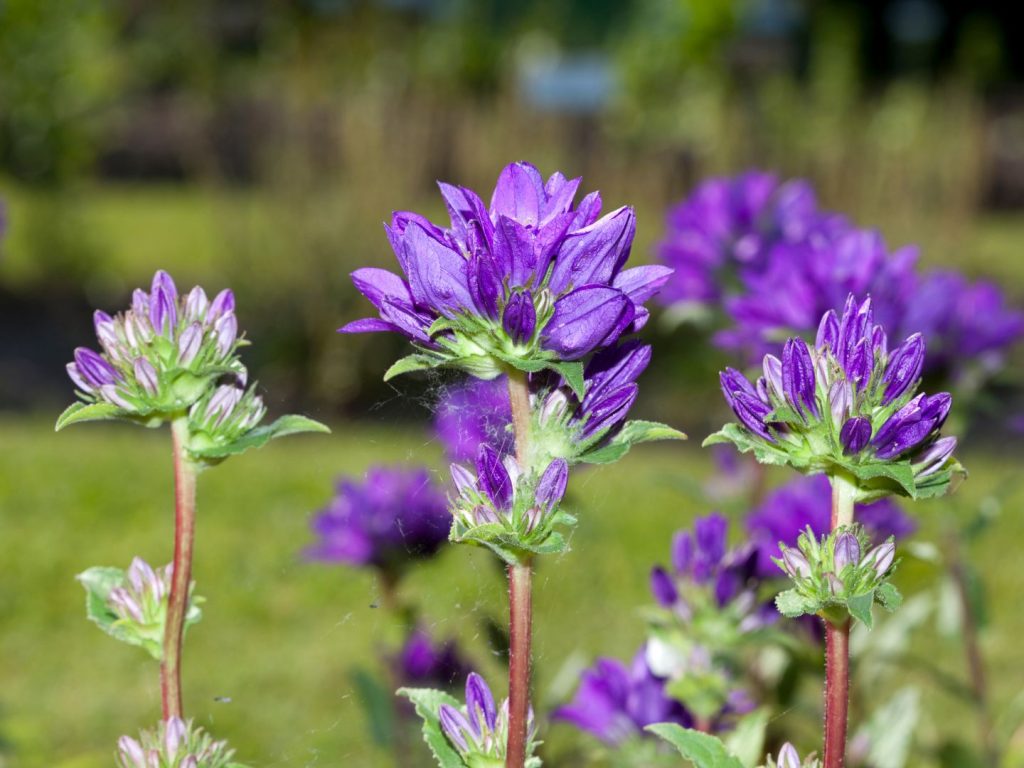
Clustered Bellflower, Campanula glomerata, Zones 2-8
Campanula glomerata, more commonly known as the cluster bellflower or wall bellflower, is one of the shorter purple perennials on this list, reaching two feet tall at maturity.
Blossoms
As the name describes, it produces five-petaled bell-shaped flowers in clusters on hairy stems. These sweet smelling bright violet blooms occur from late spring to the middle of summer.
Sun and Soil
It is a fast-growing perennial in USDA zones two through eight, but can be an annual in zones outside of this range. Give it full sunshine or partial shade, moist but well-drained soil, and calcareous environments.
Pests and Disease
While deer do not usually like this plant, they will eat it if they are desperate enough. Luckily, bellflowers have an extensive root system that spreads rapidly, so they can recover from damage relatively quickly and easily.
Traditional Uses
Not only does it smell sweet, but it also has a mild but sweet flavor used to top salads for an exotic flare. In eastern medicine, this bellflower is used to suppress coughs and treat sore throats.
Blazing Star, Liatris spicata, Zones 3-9
Blazing Stars, or Liatris spicata, is a stunning herbaceous perennial that grows to be two to four feet tall, and about a foot to a foot and a half wide.
Blossoms
This plant comes in a variety of bright and vibrant colors, including purple, reddish-purple, pink, and white. ‘Callilpsis’, ‘Kobold’, and ‘September Glory’ are some of the best purple varieties. It may take up to three years to finally flower, but they are well worth it. The blooms happen anytime from the summer to the early fall.
Sun and Soil
Liatris prefers USDA zones three through nine, full sunshine exposure, acidic to neutral soils, and medium moist ground. If you give this plant rich soil, it can grow exceptionally tall and become a bit floppy, but you can stake it up to prevent it from falling over and breaking.[2]https://mgeldorado.ucanr.edu/files/170168.pdf
Pests and Disease
Insects, deer, and other pests are not usually an issue, but leaf spot, stem rot, powdery mildew, rust, and verticillium wilt are more common fungal issues. This is usually due to the wetter, humid environment that Blazing Star grows in. Slugs and snails are common pests in wetter environments an may also be attracted to the plant.
Traditional Uses
Medicinally, Blazing Star it is used as a pain reliever, cough suppressant, and even as a stimulant. Liatris is not toxic to people or pets.

False Indigo, Baptisia Australis, Zones 3-9
False indigo, or Baptisia Australis, is a gorgeous perennial that matures in just one year, and reaches to be four to five feet tall and three to four feet wide.
Blossoms
A beautiful native wildflower with purplish pea-like flowers, False Indigo blooms in late spring or early summer.
Sun and Soil
Plant in USDA zones three through nine, where it will get full or partial sunshine. False indigo prefers moderately moist soil that is neutral or slightly acidic.
Pests and Diseases
The tall perennial purple flowers of Baptisia Australis are susceptible to powdery mildew if it doesn’t get proper air circulation. Deer and other pests generally leave it alone.
Traditional Uses
False indigo is mildly toxic to pets and people, so it is not used medicinally, though Aboriginal people and early colonizers did use it to dye clothing and other textiles.