
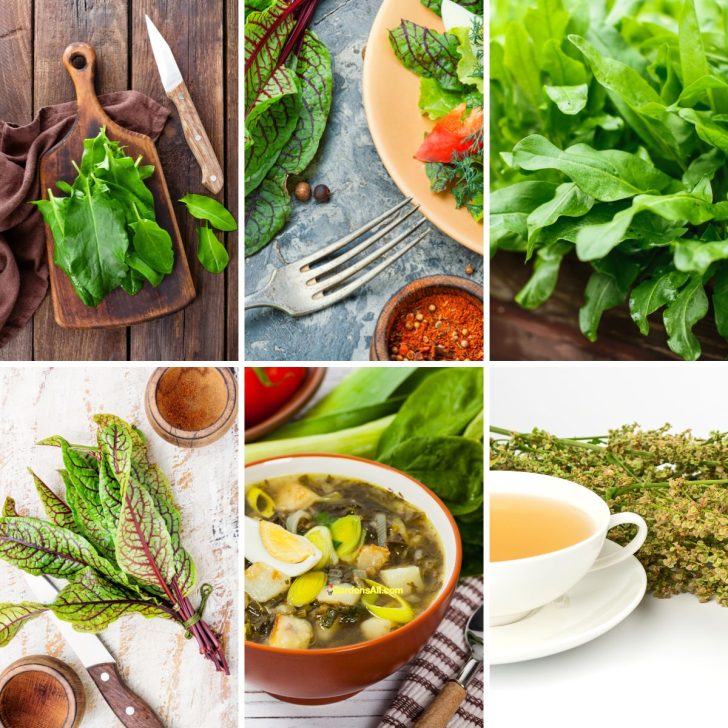
We love learning all about the plants in our garden and in the wild. Beyond the obvious edible uses of the vegetables we grow, there’s so much more to know. Take sorrel, Rumex acetosa, for instance. There are many proven and traditional sorrel benefits this oft overlooked plant has to offer.
Sorrel is a perennial herb that belongs to the Polygonaceae family. We have perennial French sorrel growing in our garden and the wild southern wood sorrel in the woods all around us. Both have edible and medicinal benefits.

Sorrel Benefits and Uses to get to Know
Known for its sour, lemony flavor and vibrant green leaves, this plant is more than just an herb to add flavor to dishes. Sorrel has been an integral part of traditional medicine and ethnobotanical practices across the globe for centuries.
Let’s explore the scientifically proven sorrel benefits as well as its ethnobotanical uses.
Proven Health Benefits of Sorrel
- Antibacterial / oral: Sorrel benefits oral health through the reduction of gingivitis.[1]https://www.sciencedirect.com/science/article/pii/S0254629918315436[2]https://www.ncbi.nlm.nih.gov/pmc/articles/PMC4372542/
- Anticancer / antimutagenic: While research is still ongoing, some studies have suggested that the anthocyanins and polyphenolic compounds found in sorrel might have anticancer properties. These compounds have been found to inhibit the growth of certain types of cancer cells in lab conditions.[3]https://www.ncbi.nlm.nih.gov/pmc/articles/PMC6264378/[4]https://pubmed.ncbi.nlm.nih.gov/21070811/
- Anti-inflammatory: Rhizome extracts were shown to demonstrate anti-inflammatory effects.[5]https://www.sciencedirect.com/science/article/pii/S0254629918315436
- Antioxidant: A Mongolian study showed that Rumex acetosa, which is used as a vegetable in that part of the world, was observed to display a very strong radical scavenging activity.[6]https://www.sciencedirect.com/science/article/pii/S0254629918315436
- Anti-ulcer: Result shows that hot water extracts and 70% of ethanol extract of the leaves that the administration of R. acetosa extracts notably reduced the incidence of gastric ulcers in the mice.[7]https://www.sciencedirect.com/science/article/pii/S0254629918315436[8]https://www.ncbi.nlm.nih.gov/pmc/articles/PMC3762272/
- Antiviral: Rumex acetosa inhibits the herpes simplex virus.[9]https://pubmed.ncbi.nlm.nih.gov/21070811/[10]https://www.ncbi.nlm.nih.gov/pmc/articles/PMC4193892/[11]https://www.sciencedirect.com/science/article/pii/S0254629918315436
- Cardiovascular: One study shows that R. acetosa may protect against the development of platelet-related cardiovascular diseases.[12]https://www.ncbi.nlm.nih.gov/pmc/articles/PMC7092512/
- Digestion: Traditionally, sorrel has been used to aid digestion, plus the high fiber content in sorrel can contribute to a healthy digestive system, including constipation prevention.[13]https://www.ncbi.nlm.nih.gov/pmc/articles/PMC9203642/[14]https://eflora.neocities.org/Rumex%20Sp
- Eye Health: Sorrel’s significant Vitamin A content is beneficial for eye health. Vitamin A aids in maintaining a healthy cornea, the eye’s surface, and is a component of rhodopsin, a protein that allows the eye to see in low light conditions.[15]https://www.ncbi.nlm.nih.gov/pmc/articles/PMC3693724/
- Immunity: The Vitamin C in sorrel not only acts as an antioxidant but also helps bolster the immune system. It can aid in the production of white blood cells, the body’s primary defense against foreign pathogens.[16]https://www.ncbi.nlm.nih.gov/pmc/articles/PMC4193892/
- Nutrition: French Garden Sorrel is rich in vitamins, minerals, and fiber. It’s a good source of vitamin C, providing antioxidant benefits, and Vitamin A, vital for eye health. It also has a notable amount of potassium, which can help regulate blood pressure, and iron, which is essential for red blood cell production.[17]https://www.ncbi.nlm.nih.gov/pmc/articles/PMC10143808/[18]https://www.phillyorchards.org/wp-content/uploads/2020/01/Sorrel-Info-Sheet.pdf
- Sinusitis: In combination with other herbs, such as in this herbal formula by Sinupret..[19]https://www.mountsinai.org/health-library/condition/sinusitis
Other Proven Sorrel Uses
Soil Health: Sorrel plants have shown an ability to help improve soil contaminated by acid rain by reducing the amount of copper in the soil.[20]https://pubmed.ncbi.nlm.nih.gov/21608265/
Ethnobotanical Uses and Benefits of Sorrel
Ethnobotany is the study of how different cultures use plants in their daily lives, including culinary uses, traditional medicine, and cultural practices. The French Garden Sorrel, with its widespread geographical presence, has a rich ethnobotanical history.
- Culinary Uses: Sorrel has a long history of culinary use in Europe, particularly in France. The tangy, slightly acidic flavor of sorrel has made