

If you’ve found them on your plants, you’ll be wanting to know how to get rid of potato beetles in the garden. The potato beetle is scientifically labeled Leptinotarsa decemlineata, and also called the Colorado potato beetle, but it doesn’t just attack potato plants.
We’ll cover how to get rid of potato beetles and the plants they attack shortly. But first we wanted to know what regions are most affected and also a little history, so sharing that next in case you’re also interested. (Or you can skip to it via the Table of Contents if you’re not interested in the regions and origins).
A Short History on the Potato Beetle
Where in the US is the Potato Beetle?
The potato beetle is widespread throughout the United States, and especially the Northeast and Midwest.
Why is It Called the Colorado Beetle?
The name “Colorado potato beetle” is somewhat misleading given the insect’s current distribution across the United States and other parts of the world. The beetle was first discovered in the Rocky Mountain region, specifically in Colorado, in the mid-19th century. At that time, it was primarily feeding on buffalo bur, a wild member of the Solanaceae (or nightshade) family botanically known as Solanum rostratum.
When settlers brought cultivated potatoes to this region, the beetle adapted and began feeding on these new plants, becoming a significant agricultural pest. It’s during this period that it gained the name “Colorado potato beetle.”
However, the beetle quickly spread beyond Colorado. It is highly adaptable and migratory, and it has been very successful in extending its range across North America and into other parts of the world. Despite this global spread, the name “Colorado potato beetle” has stuck.
If this isn’t the beetle causing damage on your plants, you may want to check our article on “bad beetles“.

Potato bug life cycle by Andrei Alyokhin via PotatoBeetle.org[1]http://www.potatobeetle.org/overview/#distr

Signs of Potato Beetle Damage
Colorado potato beetles (Leptinotarsa decemlineata) can cause extensive damage to potatoes and other plants in the nightshade family (Solanaceae), including tomatoes, eggplant, and peppers. Here’s how they typically affect these plants:
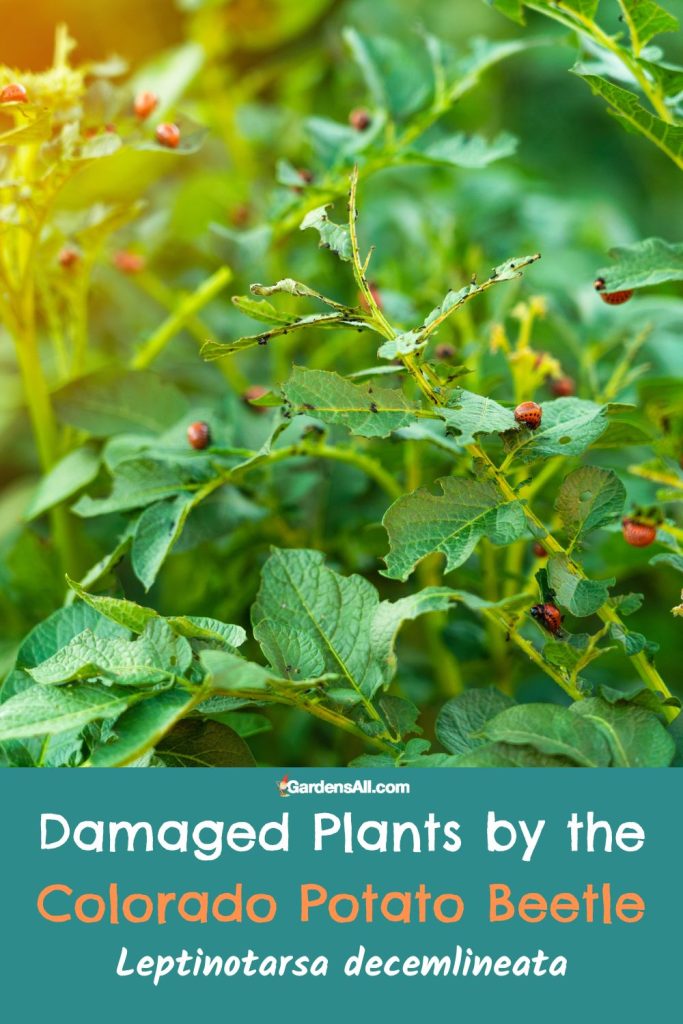
Damage from Potato Beetles
1. Leaf Damage & Defoliation: Both adult beetles and their larvae chew leaves and can strip plants down to the stems in short order if populations are high. They typically start at the top of the plant and work their way down.
2. Reduced Yield: The leaf defoliation impairs the plant’s ability to photosynthesize, which can reduce yield and even kill the plant if the damage is severe enough.
3. Plant Stress: Damage from potato beetles can stress plants, making them more susceptible to diseases and other pests.
4. Future Infestations: Female potato beetles can lay hundreds of eggs at a time, leading to future infestations that can further damage crops.
So what can you do? First, identify the culprits!
The Potato Beetle Life Cycle

How to Prevent and Get Rid of Potato Beetles Naturally
Monitoring your plants regularly can help you identify and address infestations early, before they cause severe damage. Implementing integrated pest management (IPM) strategies, including biological control, crop rotation, and use of resistant varieties, can also help keep potato beetle populations in check.
NOTE: Some of the prevention strategies are also employed as elimination strategies and vice versa, so please keep that in mind as you read through this list.
ELIMINATION: How to Get Rid of Potato Beetles
While prevention is vastly better than riddance, we’re listing the elimination strategies first because that’s what most people are desperately searching for now. However, once your garden’s health is under control, then you may find it helpful to review the prevention strategies and work on a plan to implement as many of those as possible.
1. Early Detection and Action
Swift action can significantly help in managing and mitigating potato beetles (or any garden pest). Regularly monitor your plants for any signs of these pests. Always consider an integrated pest management (IPM) strategy that includes a combination of the practices listed. This not only controls the pests but also minimizes the impact on the environment.
2. Handpicking
This method can be time-consuming, but it is effective especially for smaller gardens. Regularly inspect your plants for eggs, larvae, and adults. The eggs are typically orange or yellow and found on the undersides of the leaves, while the larvae are humpbacked and reddish with black heads. Remove and crush the eggs, larvae, and beetles when you find them.
3. Beneficial Nematodes
These microscopic worms live in the soil and can kill Colorado potato beetle larvae, and often these are available to purchase and release into your garden.
4. Use of Botanical Insecticides
In severe cases, you may want to consider using insecticides. There are options such as Spinosad and Neem that are considered organic methods. However, the beetles can develop resistance if the same product is used repeatedly. Always follow the manufacturer’s instructions when using insecticides.
For more elimination ideas, see also natural predators and row covers.
PREVENTION: How to Prevent Potato Beetle Infestation
1. Crop Rotation
Rotate crops every year to make it harder for the beetles to find the potatoes. These beetles will overwinter in the soil and emerge in the spring to find new host plants. If potatoes or other host plants aren’t in the same location, it reduces the beetle population.
2. Polyculture, AKA Companion Planting
In addition to rotating crops, another beneficial strategy is companion planting for plant diversity. This is the opposite of monoculture. We can consider that a singular crop planted in any area becomes a magnetic target for the pest that prey on it. Therefore, to interplant is an excellent practice that emulates the diversity within which nature grows.
3. Natural Predators
Encourage natural predators to live in your garden. Birds, ladybugs, lacewings, and predatory stink bugs are among the creatures that prey on potato beetles.
See also, birds that eat mosquitoes and bad garden bugs.
4. Row Covers
Using floating row covers can prevent the beetles from reaching your plants. These need to be installed after planting and removed during flowering so pollinators can reach the plants.
5. Trap Crops: Some gardeners use early-planting varieties of potatoes as ‘trap crops’. The beetles are attracted to the first plants that emerge, and once they’re established on the trap crop, you can remove and destroy these plants (along with the beetles).
6. Plant Beetle-Resistant Varieties
Resistant varieties can indeed play a key role in managing Colorado potato beetles, particularly in a home garden setting. However, it’s important to note that “resistance” can vary, and even resistant varieties may experience some level of damage in the presence of a high beetle population.
Here are a few varieties that have been reported to show some level of resistance to Colorado potato beetles:
- ‘Elba’: This variety has shown a good level of resistance to Colorado potato beetles. Elba potatoes are late-season and produce large, round tubers with white skin and flesh.
- ‘King Harry’: This variety has been genetically modified to have hairs on its leaves and stems that discourage the beetles from feeding.
- ‘NewLeaf Y’: This is a genetically-modified variety that has been en