
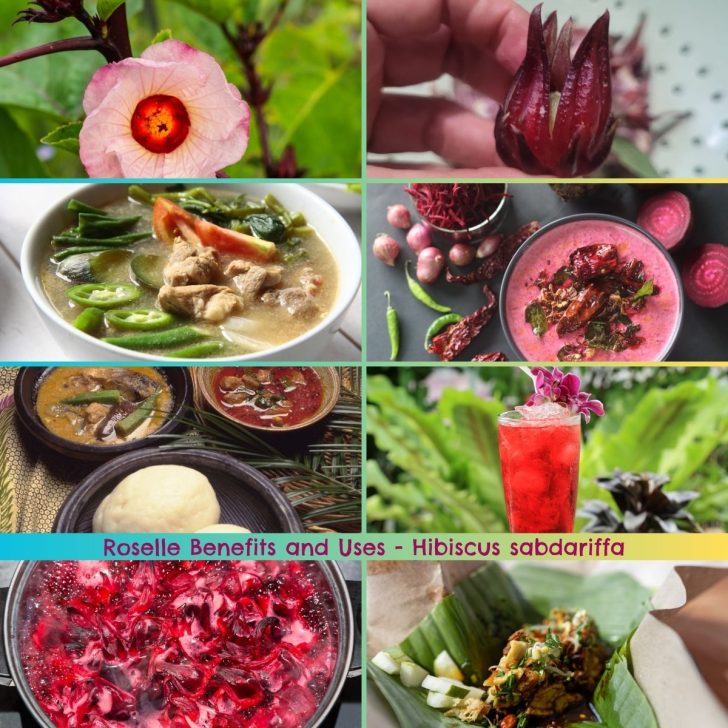
Scientifically known as Hibiscus sabdariffa, the Roselle plant is as versatile and potent for human health and wellness as it is beautiful. More than that, Roselle benefits are many, and all aerial parts of the plant are used in various cuisines, beverages, and medicinal remedies across different cultures.
This article delves into the diverse uses of Roselle and summarizes ts multifaceted benefits.
The seeds, leaves, fruits, and roots of the roselle plant edible and medicinal.
Quick Summary of Some Roselle Uses
- Edible flowers for salads and cooking
- Medicinally as:
- Roselle flower tea
- dried roselle flowers
- fresh roselle flowers
- roselle calyx, dried and fresh
- roselle rosehips
- Ornamental
Proven Medicinal Roselle Benefits
There are many scientifically proven benefits of Hibiscus sabdariffa, as you will discover in this article. It’s awesome that science is catching up to centuries old ethnobotanical knowledge, (and what “Grandma” knew)! 😉
Hibiscus sabdariffa decoctions and infusions of calyxes, and on occasion leaves, are used in at least 10 countries worldwide in the treatment of hypertension and hyperlipidemia.
~March 2013 Study on H. Sabdariffa PMC3593772[1]https://www.ncbi.nlm.nih.gov/pmc/articles/PMC3593772/
REFERENCE: Hibiscus sabdariffa in the treatment of hypertension and hyperlipidemia: a comprehensive review of animal and human studies. March 2013 Study.[2]https://www.ncbi.nlm.nih.gov/pmc/articles/PMC3593772/
Quick Scan List of Some Roselle Medicinal Benefits
This is the short list of the Roselle benefits identified through scientific research.
IMPORTANT: Remember, this is researched information, not prescriptive. It’s always advisable to do your own research and consult with your respective healthcare practitioners.
- Antibiotic
- Anti-inflammatory
- Antioxidants
- Blood pressure
- Cholesterol reduction
- Digestive Health
- Dietary fiber
- Diuretic
- Hypertension
- Hyperlipidemia
- Immunity
- Laxative
- Liver
- Obesity
- Skin / Anti-melogenic
A Guatemalan study on Hibiscus sabdariffa, revealed Roselle extract to contain ten phenolic acids, ten flavonoids, and two anthocyanins.
Apaza Ticona, L., Pérez-Uz, B., García Esteban, M.T. et al. Anti-melanogenic and Anti-inflammatory Activities of Hibiscus sabdariffa. Rev. Bras. Farmacogn. 32, 127–132 (2022). [3]https://doi.org/10.1007/s43450-022-00236-y
You may also enjoy our brief article on polyphenols and flavonoids.
Next, let’s break it down further.
Scientifically Validated Roselle Benefits and Uses
The Hibiscus sabdariffa plant has various uses, from medicine to cosmetics, because all of its parts are beneficial. Historically, Roselle has been utilized in various traditional medicinal practices, many of which have now been validated scientifically as well.
Antibiotic
Research revealed that the methanol extract of H. sabdariffa calyces contained effective antibacterial agent(s) that performed even better than penicillin against some microbial infections.[4]https://www.ncbi.nlm.nih.gov/pmc/articles/PMC4835995/[5]https://medlineplus.gov/druginfo/natural/211.html#
Antibacterial Roselle Benefits
Antibacterials are a subset of antimicrobials that specifically target bacteria. They do not have action against viruses, fungi, or other types of microorganisms.
The results of a one antibacterial study of Hibiscus sabdariffa, found that the methanol extract of H. sabdariffa calyces contained effective antibacterial agent(s). These compounds inhibited Gram-negative and Gram-positive bacteria, comparable to gentamicin, and greatly higher than penicillin which showed weak or no effect.[6]https://www.ncbi.nlm.nih.gov/pmc/articles/PMC4835995/
Studies of Hibiscus sabdariffa antibacterial benefits showed Roselle to be higher than penicillin and comparable to gentamicin.
Roselle’s antibacterial benefits were also proven to be beneficial in meat preservation, while adding antioxidant benefits.[7]https://www.ncbi.nlm.nih.gov/pmc/articles/PMC7464790/
Antimicrobial
Antimicrobials are agents that can act against a broad range of microorganisms, which may include bacteria, viruses, fungi, and other pathogens.
A study of the antimicrobial efficacy of H. sabdariffa found the presence of these beneficial compounds in Roselle extract: Saponins phlobatannins, terpenoids, anthraquinones, tannins, steroids and phenolics.Study[8]https://www.sciencedirect.com/science/article/pii/S1658365514000442
What’s the difference between Antibacterial and Antimicrobial?
Antibacterials are specialized antimicrobials that focus on bacteria. They fall under the larger category of antimicrobials, but they do not have the broad-spectrum activity that some other antimicrobials might have.
Anti-inflammatory
Polyphenolic compounds present in H. sabdariffa extract support the anti-inflammatory effect of Roselle.[9]https://link.springer.com/article/10.1007/s43450-022-00236-y Another study found that H. sabdariffa
seeds possess anti-inflammatory and analgesic activities in rat model research.[10]https://bdvets.org/JAVAR/V1I2/a13_pp50-57.pdf
Antioxidant Properties
Roselle is packed with antioxidants, which are known to combat oxidative stress in the body. This can potentially reduce the risk of numerous chronic diseases and inflammations.[11]https://www.ncbi.nlm.nih.gov/pmc/articles/PMC6347049/[12]https://medlineplus.gov/druginfo/natural/211.html#
Blood Pressure Regulation
Studies have found that drinking hibiscus tea, made from the Hibiscus sabdariffa plant, helped lower blood pressure in adults who were either at risk for hypertension or had mild hypertension.
Participants drank three cups of hibiscus tea a day for six weeks and saw a noticeable drop in their systolic blood pressure. The tea didn’t have the same impact on everyone but was most effective for those who started with higher blood pressure levels.
These findings suggest that adding hibiscus tea to your diet could be a simple way to help manage blood pressure.[13]https://www.ncbi.nlm.nih.gov/pmc/articles/PMC3593772/[14]https://www.ncbi.nlm.nih.gov/pmc/articles/PMC3593772/[15]https://www.ars.usda.gov/research/publications/publication/?seqNo115=240716
Daily consumption of hibiscus tea, in an amount readily incorporated into the diet, lowers blood pressure in pre and mildly hypertensive adults.
~Study published 2010: Hibiscus sabdariffa L. tea (tisane) lowers blood pressure…[16]https://www.ars.usda.gov/research/publications/publication/?seqNo115=240716
Cancer
Researchers have found that the leaves of the Roselle, have promising anti-cancer properties. These leaves are rich in special compounds called polyphenols, which were shown to be effective in stopping the growth of breast cancer cells in lab tests. Not only did the Roselle leaf extract halt cancer cell growth, but it also showed significant antioxidant activity.
When tested on zebrafish, the extract was effective in reducing tumor growth and the spread of cancer, similar to the effects of known cancer drugs like paclitaxel. These findings suggest that Roselle could potentially be a natural remedy for breast cancer treatment, offering hope for new ways to fight this common disease.
Researchers have found that the leaves of the Hibiscus sabdariffa, have promising anti-cancer properties.
~2020 Study of Roselle leaf extract against breast cancer cells[17]https://www.indianjournals.com/ijor.aspx?target=ijor:rjpt&volume=13&issue=2&article=020
Cholesterol
There’s evidence pointing to Roselle’s ability to aid in lowering levels of bad LDL cholesterol while boosting good HDL cholesterol.[18]https://www.ncbi.nlm.nih.gov/pmc/articles/PMC3593772/
Digestive Health
The plant leaves and flour made from the Roselle seeds provides essential dietary fiber, which can promote digestive health and regular bowel movement. [19]https://www.ncbi.nlm.nih.gov/pmc/articles/PMC4252421/
Hypertension
Roselle’s anthocyanin properties contribute to explain the hypotensive and anti-cholesterol effects.[20]https://www.ncbi.nlm.nih.gov/pmc/articles/PMC3593772/
Hyperlipidemia
Elevated level of lipids, like cholesterol and triglycerides, in the blood that can lead to atherosclerosis (hardening of the arteries) and other serious conditions like heart attack, stroke, and peripheral artery disease.[21]https://www.ncbi.nlm.nih.gov/pmc/articles/PMC3593772/
Immunity Boost
With its vitamin C content, and Roselle is often recommended as an immune system booster. Beyond that, studies on the dried calyx of Hibiscus sabdariffa showed that it has properties that can boost the immune system without being toxic. Specific parts of the extract increased the production of a helpful anti-inflammatory substance and decreased another that can cause tissue damage.