
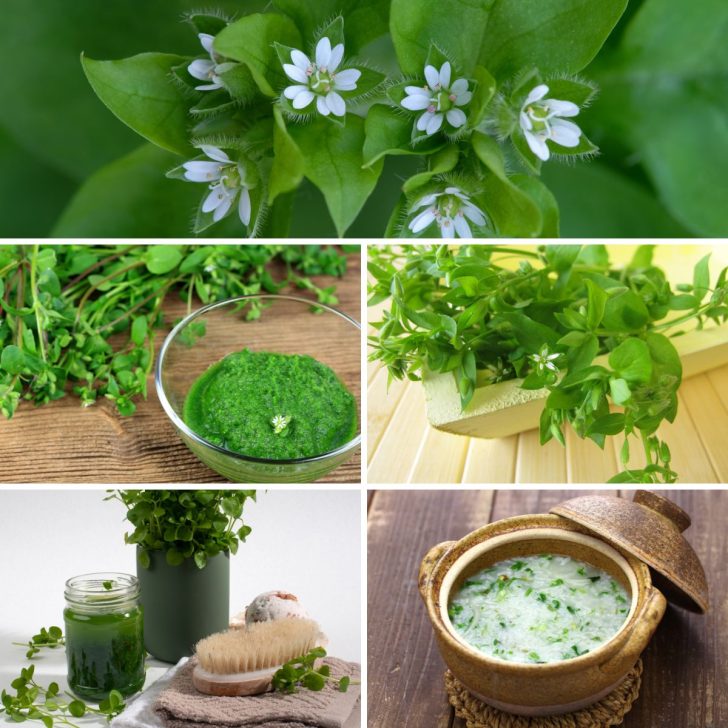
Stellaria media, commonly known as ‘chickweed’, is an herbaceous plant revered in various cultural traditions for its medicinal properties. This article explores the numerous chickweed benefits in both traditional (ethnobotanical) uses many of which have been validated through scientific research.
Traditional Chickweed Benefits
Ethnobotanical Uses
Throughout history, Stellaria media has been integral to herbal medicine, particularly in Europe and North America. Europeans have historically used it to alleviate inflammatory conditions and skin disorders, while Native Americans valued its healing properties for skin irritations and wounds.
Scientific Research on Stella media
Research has identified a rich composition of secondary metabolites[1]https://www.ncbi.nlm.nih.gov/pmc/articles/PMC7123774/ in chickweed. These include flavonoids, oligosaccharides, anthraquinones, fatty acids, steroid saponins, and phenolic compounds.[2]https://www.ncbi.nlm.nih.gov/pmc/articles/PMC7123774/
But what does that mean in terms of chickweed benefits? It turns out that these compounds contribute to a wide range of health benefits, such as anti-obesity, antifungal, antibacterial, antioxidant, anti-proliferative, anti-inflammatory, analgesic, antidiabetic, antianxiety and more.
So while we were not able to find specific studies for all of these health concerns listed below, some ailments are listed because of their proven responsiveness to compounds found in chickweed.
Chickweed Nutrients
Stellaria media, commonly known as chickweed, is packed with a variety of nutrients that contribute to its health benefits. Here is a detailed list of its nutritional content:
- Vitamins:
- Vitamin C: An antioxidant that helps protect cells from damage and is vital for the health of skin, bones, and connective tissue.
- Vitamin A: Important for vision, the immune system, and skin health. Chickweed provides vitamin A in the form of carotenoids.
- B Vitamins: Chickweed contains small amounts of B vitamins, including thiamine (B1), riboflavin (B2), and niacin (B3), which are essential for energy metabolism and nervous system function.
- Minerals:
- Potassium: Essential for maintaining proper heart function and regulating blood pressure.
- Calcium: Vital for bone health and muscle function.
- Magnesium: Important for muscle and nerve functions, blood glucose control, and bone health.
- Iron: Crucial for the formation of red blood cells and transport of oxygen throughout the body.
- Zinc: Supports the immune system, wound healing, and DNA synthesis.
- Phytonutrients:
- Flavonoids: Antioxidant compounds that may reduce inflammation and contribute to overall health.
- Saponins: Compounds thought to have anti-inflammatory and immune-boosting properties.
- Coumarins: Natural compounds that may have blood-thinning and vasodilating properties, although they are present in small amounts.
- Fatty Acids:
- While not rich in fats, chickweed may contain trace amounts of beneficial fatty acids.
- Dietary Fiber:
- Chickweed provides a small amount of dietary fiber, which supports digestive health.
Chickweed’s nutritional profile makes it a beneficial addition to a healthy diet, providing a range of essential vitamins and minerals along with unique phytonutrients. However, the specific nutrient content can vary based on growing conditions, harvest time, and preparation methods.[3]https://www.academia.edu/96423266/Stellaria_media_Linn_A_comprehensive_review_highlights_the_nutritional_phytochemistry_and_pharmacological_activities[4]https://www.sciencedirect.com/science/article/abs/pii/S0300908416303960
Therapeutic Chickweed Benefits and Uses
Scientific studies linked in the footnotes here are either direct studies on the chickweed benefits, or based on the benefits of the chickweed chemical makeup. These include compounds with proven beneficial properties for a wide array of ailments such as inflammation.[5]https://www.sciencedirect.com/science/article/abs/pii/003194229400935M
- Anti-inflammatory & Analgesic[6]https://citeseerx.ist.psu.edu/document?repid=rep1&type=pdf&doi=05a33474394eee9e243a9fb9e04ef76c1d7a5f4b
- Anti-obesity[7]https://journals.lww.com/ijnp/_layouts/15/oaks.journals/downloadpdf.aspx?an=01625776-201202020-00008
- Antidiabetic[8] … Continue reading
- Antibacterial[9] … Continue reading
- Antifungal[10] … Continue reading[11]https://pubmed.ncbi.nlm.nih.gov/26196691/
- Antioxidant[12]https://www.sciencedirect.com/science/article/abs/pii/S1387700323006706
- Anti-cancer / antiproliferative[13]https://www.academia.edu/96423266/Stellaria_media_Linn_A_comprehensive_review_highlights_the_nutritional_phytochemistry_and_pharmacological_activities[14]https://pubmed.ncbi.nlm.nih.gov/23761431/
- Anti-anxiety / Anxiolytic[15]https://phcogcommn.org/wp-content/uploads/2021/08/PharmacognCommn_2_3_58.pdf
- Antimicrobial[16]https://www.sciencedirect.com/science/article/abs/pii/S0300908410003792
- Asthma[17]https://www.sciencedirect.com/science/article/abs/pii/S0300908416303960
- Bowel disease[18]https://pubmed.ncbi.nlm.nih.gov/28811706/
- Broken Bones[19]https://www.ncbi.nlm.nih.gov/pmc/articles/PMC7284062/
- Gastrointestinal Disorders[20]https://journals.lww.com/ijnp/Fulltext/2012/02020/Anti_obesity_effect_of_Stellaria_media_methanolic.8.aspx
- Hepatoprotective[21]https://pubmed.ncbi.nlm.nih.gov/22810196/
- Jaundice[22]https://www.sciencedirect.com/science/article/abs/pii/003194229400935M
- Measles