
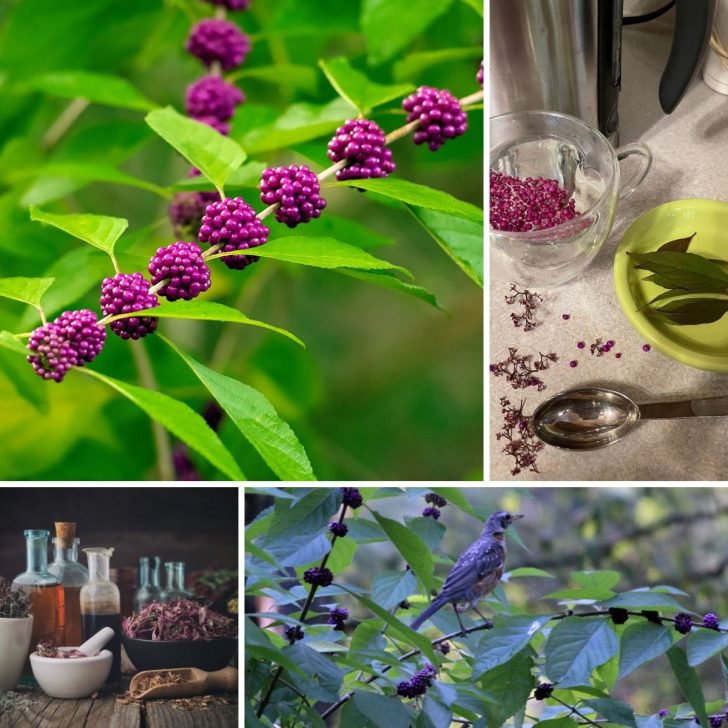
We’re on a mission to learn as much as we can about the plants that we grow, and their benefits beyond the obvious. So while we’ve been growing the striking beautyberry plant for awhile now, we’re finally getting into discovering some of the many beautyberry benefits and uses.
The beautyberry plant, Callicarpa americana, is a remarkable species known for its striking purple berries and lush foliage. This plant, native to the southeastern United States, is not only a visual delight but also a source of various health benefits. In this article, we will explore the extensive benefits and uses of the beautyberry, focusing on its berries, leaves, and roots, and delve into the scientific studies that validate these benefits.
Beautyberry Benefits and Uses: A Comprehensive Overview
Ethnobotanical and Ethnomedicinal Uses
The beautyberry plant has a rich history in ethnobotanical and ethnomedicinal practices, particularly among Native American tribes. These indigenous communities traditionally used the plant for its medicinal properties.
The roots and leaves were commonly employed in treating maladies such as malaria, colic, and rheumatism. Moreover, the leaves were used as a natural insect repellent, a practice that has been substantiated by modern research.
Chart on Ethnobotanical Uses of Callicarpa americana
| Species | Part Used | Country | Use | Reference |
|---|---|---|---|---|
| C. americana L. | Bark | United States | Fever | [17] |
| Leaves | United States | Dropsy | [64] | |
| Roots | United States | Skin cancer | [28] | |
| Roots | United States | Dysentery | [81] | |
| Roots and berries | United States | Colic | [58] | |
| Roots and branches | United States | Fever, malaria, rheumatism | [58] |
STUDY REFERENCE: Jones WP, Kinghorn AD. BIOLOGICALLY ACTIVE NATURAL PRODUCTS OF THE GENUS CALLICARPA. Curr Bioact Compd. 2008 Jun 1;4(1):15-32. doi: 10.2174/157340708784533393. PMID: 19830264; PMCID: PMC2760847.[1]https://www.ncbi.nlm.nih.gov/pmc/articles/PMC2760847/#R17
Traditional Cultural Uses of Beautyberry Plant
- Fever
- Headache
- Hepatitis
- Indigestion
- Rheumatism
The benefits and uses of beauty berry leaf tea, derived from the leaves of the Callicarpa americana, are distinct from those of the roots and berries of the plant. Each part of the beautyberry plant has its unique properties and potential health benefits.
The leaves are notable for their insect-repellent and potential antimicrobial properties, the berries for their high antioxidant content and nutritional value, and the roots for their traditional medicinal uses.
Some Proven Callicarpa americana Benefits by Plant Parts
Here are a few of the Callicarpa americana benefits we were able to validate via published scientific research.
PLANT: The Callicarpa Americana Plant
The entire plant: leaves, twigs, fruit and roots have been found to have multiple compounds effective against human cancer cells.[2]https://pubs.acs.org/doi/full/10.1021/np060534z[3]https://www.ncbi.nlm.nih.gov/pmc/articles/PMC2760847/[4]https://pubmed.ncbi.nlm.nih.gov/17279798/
| Species | Part Used | Biological Activity | Reference |
|---|---|---|---|
| C. americana L. | Fresh leaf essential oil | Antialgal | [5]https://pubmed.ncbi.nlm.nih.gov/10898657/ |
| C. americana L. | Fresh leaf essential oil | Mosquito bite deterrent | [6]https://pubmed.ncbi.nlm.nih.gov/16028979/ |
| C. americana L. | Fruits, leaves, and twigs | Cytotoxic activity | [7]https://pubmed.ncbi.nlm.nih.gov/17279798/ |
STUDY REFERENCE: Jones WP, Kinghorn AD. BIOLOGICALLY ACTIVE NATURAL PRODUCTS OF THE GENUS CALLICARPA. Curr Bioact Compd. 2008 Jun 1;4(1):15-32. doi: 10.2174/157340708784533393. PMID: 19830264; PMCID: PMC2760847.[8]https://www.ncbi.nlm.nih.gov/pmc/articles/PMC2760847/#R17
Now let’s break it down further.
LEAVES: Beautyberry Leaf Tea (Leaves)
- Antialgal Properties: The leaf essential oil was found to be a mild deterrent to the growth of algae.[9]https://pubmed.ncbi.nlm.nih.gov/10898657/
- Antibacterial Properties: Demonstrated promising antibacterial potential against Cutibacterium acnes, as well as the ability to boost MRSA resistant antibiotics.[10]https://www.ncbi.nlm.nih.gov/pmc/articles/PMC6803531/[11]https://news.emory.edu/stories/2020/07/esc_beautyberry_leaf_extract/campus.html
- Anti-Inflammatory Effects: Extracts from the leaves may have anti-inflammatory properties, useful for alleviating minor aches and pains.[12]https://www.ncbi.nlm.nih.gov/pmc/articles/PMC6803531/
- Antioxidant Properties: The leaves contain antioxidants, which help neutralize harmful free radicals and reduce oxidative stress.[13]https://etd.ohiolink.edu/acprod/odb_etd/etd/r/1501/10?clear=10&p10_accession_num=osu1658348337902922[14]https://pubmed.ncbi.nlm.nih.gov/24667350/
- Natural Repellent: Historically used as an insect repellent, indicating the presence of protective compounds, studies also show “significant mosquito repellent qualities”. In fact, the researchers discovered new compounds in the Callicarpa americana leaves, never before been identified from natural sources, and named as: 13,14,15,16-tetranorclerodane[15]https://www.ncbi.nlm.nih.gov/pmc/articles/PMC5154363/ and callicarpenal [16]https://pubs.acs.org/doi/full/10.1021/jf0509308
- Antimicrobial: Preliminary research suggests antimicrobial properties against certain bacteria and fungi, and in particular, the ability to boost resistant to e