
Amaranth for Landscape Beauty and Foodscapes
Growing amaranth for its stately and vivid presence alone would be enough, but the benefits of amaranth are so much more than beauty alone.
Amaranth Origins
An ancient grain for modern times, amaranth is known to have been cultivated as a staple crop by the South American tribes such as the Aztecs and Incas far back as 8,000 years ago. Revered by the ancient Aztecs, amaranth was all but lost through the dominance of the Cortes and Spanish Conquistador invasion and takeover.
However, as with many plant treasures from South America, it’s making a comeback that’s spreading around the globe. Thanks to the insight and efforts of philanthropist and holistic food advocate and chef, George Mateljan, it was introduced into the United States in 1970s.[1]https://www.ancientgrains.com/amaranth-history-and-origin/
Beyond the Americas, Amaranth is known to been in use in Himalayan and used for Asian countries for centuries.
Amaranth Uses
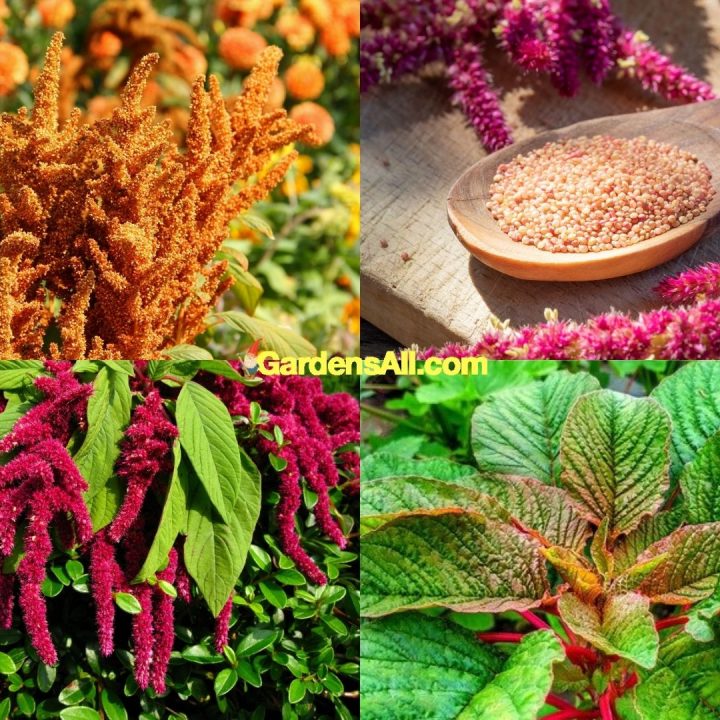
A number of amaranth varieties are known for their ornamental flowering beauty. However, amaranth is also a good plant for foodscaping ideas for edible landscapes, providing annual food value, from amaranth grain to leaves and blossoms, stems and roots.
If you’ve ever had the amaranth grain or cereal, you’ll know that it consists of tiny seeds, much like quinoa. But it’s also a leafy green vegetable, (or the “greens” could be maroon, green, gold, or purple, depending on the color variety).
Food Uses of Amaranth
GREENS – Amaranth Leaf Uses
Use as you would spinach or Swiss chard, raw (young leaves) or cooked (mature leaves).
- RAW in salads and sandwiches
- GREENS cooked in stir fry, sautees, soups and stews (like these sauteed okra leaf greens)
- HERB or potherb, sprinkled in as an herb for a touch of greens color and flavor, in soups as well as a variety of dishes
GRAIN – Amaranth Seed Uses
Not an official grain, but a “pseudocereal”, Amaranth seeds are a good gluten free source of dietary minerals and fiber and are good for a wide variety of uses. All amaranth seeds are beneficial, but the black amaranth seeds are richest in essential oils.
- COOKED like quinoa, buckwheat and other grains
- GROUND into a gluten free flour and used like other flours
- MICROGREENS – grown as a microgreens crop to harvest similar to sprouts
- OIL – Amaranth oil is used cosmetically and nutritionally and prized for its high concentrations of omega-3 fatty acids and squalene.[2]https://pubmed.ncbi.nlm.nih.gov/11782209/
- POPPED for a light and crispy protein snack good alone or added to nut mixes and salad toppings
- RAW in seed and nut mixes, muesli, granola, oatmeal, smoothies similar to chia, flax and sesame seeds
- SPROUTED for salads, sandwiches and toppings
Amaranth seeds mixed with honey and various plant saps, were eaten by the indigenous people of Mexico and South America in large amounts in the form of amaranth drinks and cakes. So important to the pre Columbian cultures was amaranth that it’s use became woven into their religious beliefs and ceremonies.
SOURCE: Long Island Seed Project
Dye Uses for Amaranth
The Hopi Indians used red amaranth, Amaranthus cruentus, for red dye as well as for food and medicine.
Ornamental Uses of Amaranth
Are all amaranth plants attractive?
Yes, most amaranth plants are attractive in some form, from vibrant and colorful leaves to beautiful blossoms that rise to the sky or weep in colorful cascades of color.
Here are some of the ornamental uses of amaranth plants.
LANDSCAPES: Amaranth Plants – Attractive in Landscapes
Amaranth plants are beautiful in landscapes and an attractive plant for front yard gardens that even a tough Homeowners Association (HOA) might approve, especially if well integrated in a landscape bed.
FLORAL ARRANGEMENTS: Amaranth Flowers for Floral Arrangements
Fresh amaranth flowers make lovely cut flowers in water vases. They’re also good as dried flowers for wreaths and arrangements, and retain their original color well.
RELATED: Foodscaping ideas using attractive edible landscaping.
What is the Color of Amaranth?
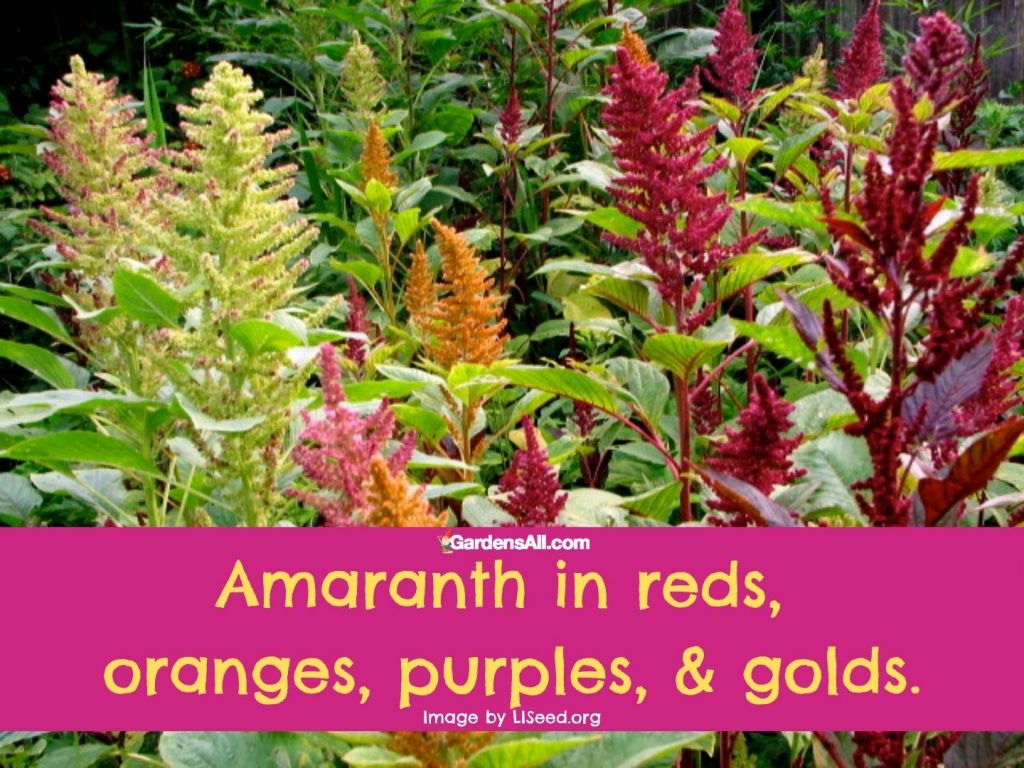
Beyond the very different color variations, such as gold, orange and purple, the most common and dominant amaranth color is in the red range. In fact the word ‘amaranth’ is used as a color name unto itself, with varying hues and shades, often within the one plant.
In trying to describe it here, the exact color of amaranth is hard to pinpoint to exactly, so we’re including an amaranth color chart at the end of the page (for you artists and color fans). As with most colors, there is a huge range from mauve to red, from magenta to deep purple. It’s like saying “blue”, which puts us on the same page of blue, but doesn’t explain where on the spectrum we might be.
Some Lovely Varieties of Colorful Amaranth Plants
- Coral Amaranth – beautiful as a potted plant
- Giant Golden Amaranth – especially good for seed (cereal-grain) avg. yield is 1 lb. of seeds per plant.
- Green Calaloo Amaranth – great for edible leaves; popular in Caribbean cuisine.
- Green Amaranth – aka, “Emerald Tassels”, especially lovely grouped in pots with Coral and golden amaranth
- Love Lies Bleeding amaranth -more cascading blossoms of vibrant maroon, another perfect amaranth for potting and grouping with the coral and emerald amaranths. Also good for edible seeds and leaves.
- Red Garnet Amaranth is another favorite for yard, gardens and pots, and brings to life its color name beautifully.
Growing Amaranth – Benefits
Most amaranth plants are edible from roots and stems, leaves, flower heads and seeds that nest within the blossoms. Consider you’re interest in growing amaranth and what you’d like to use it for, then research the plants with those particular uses and benefits.
Best Edible Amaranth Varieties
Are All Amaranth Plants Edible?
Yes! While all species of amaranth are considered edible, there are some varieties have better food value than others.
Edible AMARANTH SEEDS as Grain and Other Uses
Listed by Amaranth Botanical and Common Names of Best Amaranth for Seeds
- Amaranthus caudatus –
- Common Names
- Foxtail amaranth
- Love-Lies Bleeding
- Tassel Flower
- Velvet Flower
- Common Names
- Amaranthus cruentus –
- Common Names:
- Blood Amaranth
- Orange Amaranth / Juana’s Orange Amaranth
- Red Amaranth
- Purple Amaranth
- Prince’s Feather
- Mexican Grain Amaranth
- Hopi Red Dye Amaranth
- Common Names:
- Amaranthus hypochondriacus –
- Common Names:
- Cocks Comb
- Lady Bleeding
- Love Lies Bleeding
- Pile Wort
- Prince-of-Wales Feather
- Prince’s Feather
- Red Cocks Comb
- Common Names:
- Amaranthus retroflexus – edible seeds can be eaten raw or cooked, but thoroughly research poison warnings on this particular variety of Amaranth first especially if growing it around grazing animals.
- Common Names:
- Careless Weed
- Common Amaranth
- Common Tumbleweed
- Pigweed / Pigweed Amaranth
- Red Root Amaranth
- Wild Beet Amaranth
- Common Names:
Edible AMARANTH LEAVES – Cooked, Raw of Dried for Tea and Herbs
Listed by Amaranth Botanical and Common Names of Best Edible Amaranth
- Amaranthus blitum –
- Common Names:
- Livid Amaranth
- Pigweed
- Purple Amaranth
- Common Names:
- Amaranthus cruentus –
- Common Names:
- Purple Amaranth
- Red amaranth
- Common Names:
- Amaranthus dubius –
- Common Names:
- Red Spinach
- Chinese spinach
- Spleen Amaranth
- Common Names:
- Amaranthus tricolor (previously known as Amaranthus gangeticus) – growing 1.6′ – 5′ feet tall
- Common Names:
- Amarante Douteuse
- Calaloo / Callaloo
- Chinese Spinach
- Floramor
- Flower-Gentle
- Fountain Plant
- St. Joseph’s Coat
- Tampala
- Three-colored Amaranth [#affiliatelink]
- Common Names:
- Amaranthus viridis –
- Common Names:
- Calalu / Callaloo
- Slender Amaranth
- Green Amaranth
- African Spinach
- Green Amaranth
- Rough Pigweed
- Wild Amaranth
- Common Names:
Edible Amaranth Stems
Amaranth stems can be cooked used like asparagus, are are cooked with the amaranth leaves for curries and stir fry in some Asian countries.
Edible Amaranth Roots
While the amaranth roots may not be a top menu item in popularity for flavor, it can be eaten prepared like other roots. We will give the roots a try when it’s time to pull up these annual plants by first frost.

Amaranth Benefits
When we talk about benefits of food, it’s good to be aware that all edibles growing in the yard and garden are beneficial and nutritious. That means that all foods in their natural state have nutritional benefits that accrue as health benefits.
How that translates nutritionally is that the nutritional profile of the different vitamins and minerals have been found to be beneficial for various ailments and preventions. Thus any plant containing good amounts of these nutrients are also good for those things, which is why so many plants are antioxidants or good for the heart or blood pressure.
List of Some of Amaranth Health Benefits
- Anti-inflammatory
- Antioxidant
- Blood sugar regulation
- Blood pressure
- Cholesterol
- Bone health
- Digestive system
Amaranth Nutritional Benefits – High in Nutrients
- High in Protein
- Fiber
- Calcium
- Iron
- Manganese
- Magnesium
- Phosphorus
- Macronutrient Rich
- Micronutrient Rich
You can find the specifics of amaranth nutrients on the USDA website under FoodData Central, and also at the links below.
Amaranth Nutrients on USDA Website
- Amaranth grain, cooked