
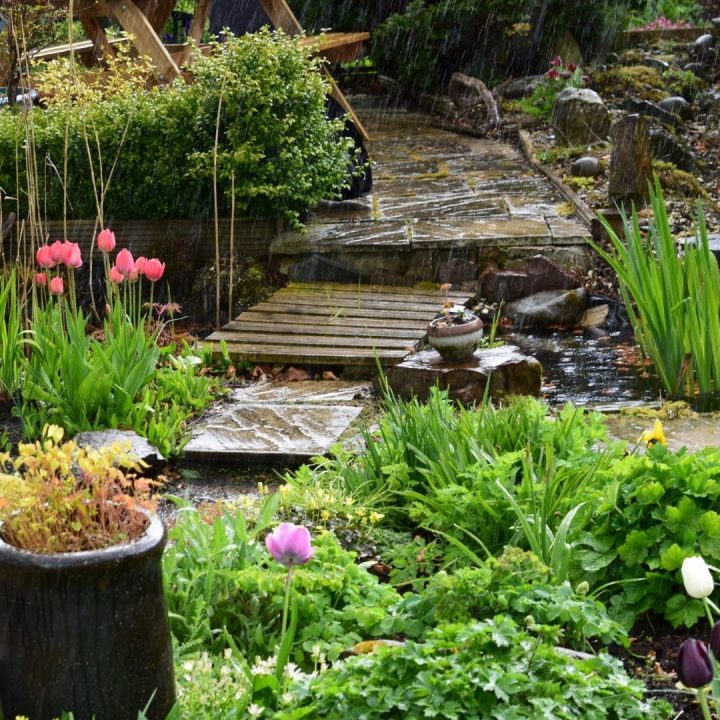
Rain Gardens are Beautiful, Practical and Environmentally Friendly!
Rain gardens are a brilliant idea designed to grow plants with the flow of rainwater. Instead of fighting Mother Nature, work with her! Water diverted through a rain garden filters and cleans water, with less waste. It just makes sense.
The fancy name for rain gardens is bioretention facilities[1]https://en.wikipedia.org/wiki/Bioretention
Rain gardens are a win-win for our plants and the environment.
Rainwater directed into rain barrels and prepared areas with plants can be used to create beautiful rain gardens that water your plants as well as for developing natural habitat for wildlife.
You will be inspired by this captivating article and concept on rain gardens excerpted from an article by Jeanne Huber for This Old House Magazine.com.

Benefits of Rain Gardens for Your Yard and Neighborhood
- Rain garden designs can put water to work for you by directing it where you want it to go
- Reduce water saturating septic lines in rural areas
- Minimize polluted runoff water in urban areas washing across chemically treated lawns
- Minimize impact of pollution washing over impervious surfaces like parking lots
- Reduce flooding and erosion (saves soil)
- Make an attractive feature in your yard
- Cut down on water pollution in storm sewers
- Helps mitigates the impact of dry spells
Have a look at this step-by-step article on rain gardening written by Jeanne Huber for This Old House Magazine. She starts with this lead-in.
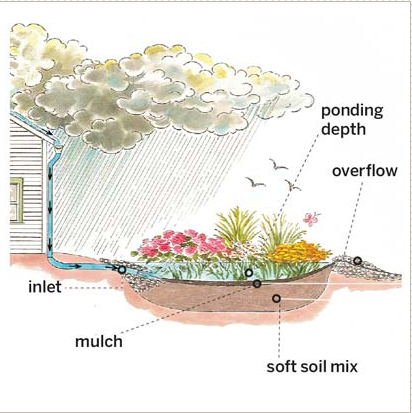
“During a downpour at a typical house in many municipalities, water gushes out of downspouts, across lawns treated with pesticides and fertilizers, into an oily street, and, finally, down a storm drain that dumps that pollution along with the water into a stream, river, or bay.
By building a rain garden, you can divert your gutter water into an attractive planting bed that works like a sponge and natural filter to clean the water and let it percolate slowly into the surrounding soil.
Installing a rain garden isn’t difficult if you’re willing to dig or you bring in machines to help. Ask your local Cooperative Extension Office for specifics about soil mix, garden size, and plants for your area. Then you’re ready to build.”
~Jeanne Huber, for This Old House Magazine[2]https://www.thisoldhouse.com/toh/how-to/intro/0,,20517496,00.html

For those who wish to learn more about this marvelous way to conserve and create beauty, here are some top-notch reference materials.
Building a Rain Garden
Now that we’ve presented the basics, here’s a video by rain garden enthusiasts out in Washington State who decided to harvest the runoff from their property. As you’ll see, there are lots of ways to do this.
And of course this — and ideas like this — can be done anywhere.
Plants, Shrubs and Trees for Rain Gardens
Excerpted from list by Laurie Danko for Penn State Extension
Wet Zone 1
This area will be the deepest and hold the most water for the most amount of time. The plants listed below can tolerate standing water for a period of time, and most are also good at retaining soil.
Shrubs for Rain Gardens – Wet Zone 1
You’re better off procuring the bulk of plants needed from your local nursery. Call them before you go to see if they have most of the items you want to save time. If not, they may be able and willing to order them for you. We’ve searched for these and found that some of them can be ordered through Amazon, so we’ve provided a few links for that.
- Black chokeberry (Aronia melanocarpa)* – edible berries high in vitamin C
- Buttonbush (Cephalanthus occidentalis)* – not edible, but attractive to hummingbirds
- Elderberry (Sambucus canadensis)* – highly popular for edible, medicinal berries
- Ninebark (Physocarpus opulifolius)* attractive foliage and flowers good for pollinators; medicinal with caution; but, can attract pests: aphids, spiraea leaf beetle, and moth caterpillars[3]https://nativeplants.evergreen.ca/search/view-plant.php?ID=00496
- Possumhaw (Viburnum nudum)* – Edible but bitter berries, medicinal with care[4]https://www.pfaf.org/user/Plant.aspx?LatinName=Viburnum+nudum
- St. Johnswort (Hypericum densiflorum)* – edible leaves and flowers, well known medicinal[5]https://www.ediblewildfood.com/st-johns-wort.aspx" target="_blank" rel="noopener noreferrer">https://www.ediblewildfood.com/st-johns-wort.aspx
- Silky dogwood (Cornus amomum)* – Edible berries, medicinal bark, can also be used for brushing teeth[6]https://www.pfaf.org/user/Plant.aspx?LatinName=Cornus+amomum
- Smooth alder (aka Tag alder) (Alnus serrulata)* – Bark has medicinal benefit[7]https://practicalplants.org/wiki/Alnus_serrulata
- Spicebush (Lindera benzoin)* – Fragrant, edible and medicinal, Spicebush is a good one to plant![8]https://www.pfaf.org/user/Plant.aspx?LatinName=Lindera+benzoin
- Swamp azalea (Rhododendron viscosum) – Aromatic and lovely, good for pollinators like birds and bumblebees but poisonous to humans.
- Swamp rose (Rosa palustris) – petals and rosehips, edible and medicinal[9]https://ouroneacrefarm.com/10-shrubs-wildlife-friendly-edible-landscape/
- Wild raisin, aka Teaberry (Viburnum cassinoides)* – edible and medicinal, fruit,
Winterberry (Ilex verticillata)*
Find ideas for edible hedges here.
List created by Lauri Danko, March 2005, Revised June 2006 for Extension.psu.edu