
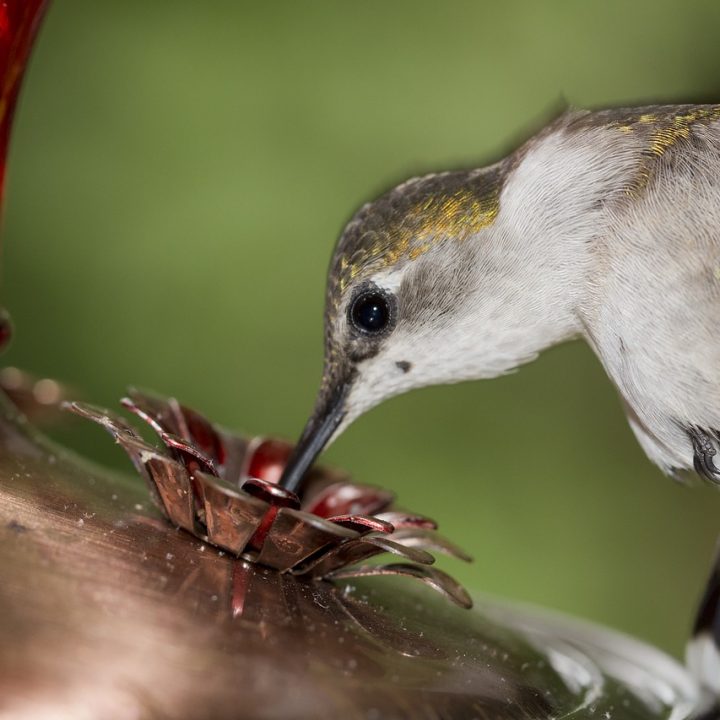
People love to put out hummingbird food to attract these enchanting feathered garden friends. A hummingbird food recipe is super simple, and will go a long way toward attracting hummingbirds to your yard.
In a hurry… to discover the Best Hummingbird Feeder? Get the scoop now.
Or… read on for humminbird benefits, facts and fascinations, plus some hummingbird video clips.
Why We Love Hummingbirds So
Standing in the garden, a hummingbird hovered right in front of me and it felt like a blessing.
And then I wondered… why is it that we’re so enchanted with hummingbirds?
They give us no thought and yet we’re enchanted by them.
Many of us devote time and money into attracting, feeding, housing, watching, filming, photographing and sharing about hummingbirds. Of course we also love and appreciate so many of nature’s creatures, (though not the Japanese beetles, squash vine borers or ticks… YUK)!
But for this conversation… hummingbirds hold a special place. So I wondered…
Why do you love hummingbirds?
Send us a note if you’d like to share. And now… onto more about these creatures, beginning with the practical reasons for attracting hummingbirds to your yard and garden.
Hummingbird Benefits
- Beautiful to see
- Eat lots of bugs
- Pollinate your plants
And don’t worry. Hummers will still eat plenty of insects even if you feed them. So go ahead and give them some hummingbird food to attract—and keep them—as residents. You can be sure they’ll help out with mosquitoes and other insects while there.
Audio Article – Hummingbird Food:
Dazzling Hummingbird Facts
In appearance, many hummingbirds sparkle like jewels of ruby, emerald, and sapphire. Here are some cool facts on these winged garden jewels.
Hummingbird Facts
- Smallest warm-blooded creatures on earth, averaging between .05-.16 oz, (the weight of a standard envelope is .169 oz)
- Named for the sound from its wings rotating an average 60 x per second
- Incredibly Fast – Hummingbird’s top airspeed approaches 50 MPH (in a dive) [1]https://en.wikipedia.org/wiki/Hummingbird
- Extremely agile flyers able to fly in any direction in an instant or hover in place
- So tiny, they’re prey to large spiders, lizards, frogs, bass fish, and an assortment of predatory birds. [2]https://www.audubon.org/news/which-animals-prey-hummingbirds
- Eats insects – hummers can ingest several hundred fruit flies, mosquitoes and other insects per day
- Drink nectar – around half their body weight in nectar/sugar water each day
Though dainty in appearance, hummers are voracious insect eaters.
Hummingbird Food
Hummingbird Nectar
Hummingbirds consume about half of their body weight in nectar (sugar) daily and can eat as frequently as every 10 minutes. So, for an eight hour period, that’s up to 48 feedings. Also, one little hummer may ingest several hundred fruit flies in just one day! We’re all for that! [3]https://askabiologist.asu.edu/hummingbird-foraging
Nectar water for hummingbirds is like rocket fuel, giving them more energy for pollinating your plants and scooping up more insects. Plus, they may become seasonal visitors.
Within a minute, hummingbirds feed on multiple flowers. Their total daily intake ranges from three to seven calories. That number of calories sounds trivial, yet, if converted to human scale by body weight, that’s about 155,000 calories per day.
Hummers Are Territorial
For hummingbirds, it’s literally eat or die. Given this compelling need, they are quite territorial as they lay claim to flowers and feeders, vigorously defending their food territory. As such hummers rarely socialize. [4]https://www.audubon.org/news/where-do-hummingbirds-get-all-energy[5]https://animals.sandiegozoo.org/animals/hummingbird
Hummingbirds require the human equivalent (by weight to calorie ratio) of 155,000 calories per day!!
What Insects do Hummingbirds Eat?
- Small spiders
- Beetles
- Gnats
- Mosquitoes
- True bugs
- Aphids
- Flies
- Many more…
Hummers devour small spiders, (reportedly their favorite), as well as beetles, gnats, mosquitoes, true bugs, aphids, flies, and many other insects. They’re also known to tipple a little tree sap now and then.
Sugary nectar is necessary to support their hyperactive aerial acrobatics, but hummers need insects for protein and minerals and for feeding their young.[6]https://en.wikipedia.org/wiki/Hummingbird
I’ve seen hummingbirds pick captive insects from a spider’s web and also bust through a swarm of gnats like a shark through a bait ball.
~Coleman Alderson, GardensAll.com
2 Female Hummingbirds – Feeder Truce – 15 seconds
It was so much fun watching these two ruby red throated females first approach, scratch at and then bounce off each other. Then both backed off, and engaged in a seeming truce of being okay with feeding at the same time from opposite sides of the feeder.
Watch at 1/2 Speed
The entire video clip is a fast 15 seconds with the quick tussle at the beginning, followed by a feeding truce, so you may want to watch it on half speed.
Hummingbird Heart Rate and Metabolism
Hummingbirds have the highest rate of calorie burn of any other warm-blooded creature. They can’t even get a normal period of sleep. Instead, every night, they enter a form of suspended animation called “torpor” as their heart rate decreases dramatically and their body temps plummet to about 1/15 their waking state. [7]https://en.wikipedia.org/wiki/Hummingbird
Hummers do rest, periodically perching on whatever’s handy to conserve energy. It’s estimated hummingbirds spend a surprising 75–80% of their time sitting and digesting, and just 10–15% of their time feeding. [8]https://www.audubon.org/news/where-do-hummingbirds-get-all-energy
Hummingbirds have the highest rate of calorie burn of any other warm-blooded creature.