
Learning about pollinator flowers for bees is an intriguing discovery into their codependent relationship and how we can help.
Blooms and Bees – A Love Story
Blooms and bees have cooperated with each other for as long as they’ve been here. They need each other. The flower needs the bee, as well as other pollinators, as much as the bee needs the flower.
It’s a beautiful relationship that I enjoy watching year after year. We need this relationship to stay healthy so that our species can also thrive. The health of our plants and environment rely on pollinator flowers for bees, and bees for pollinator flowers.
The bees and flowers need each other and their symbiotic relationship serves all life on earth.
A Flower – Dressed for Success
Flowers can do some wild things to attract the bees. Everything from the color of a flower to its shape, and scent is designed to attract pollinators like bees and butterflies.
The bees heed the calling and rush over to collect the bounty. They go back to their colony and tell all of their sisters about this food source. In turn, they spread the pollen so the flowers can produce fruit, vegetables, and seeds. It’s a beautiful co-dependent relationship and approved by Mother Nature.
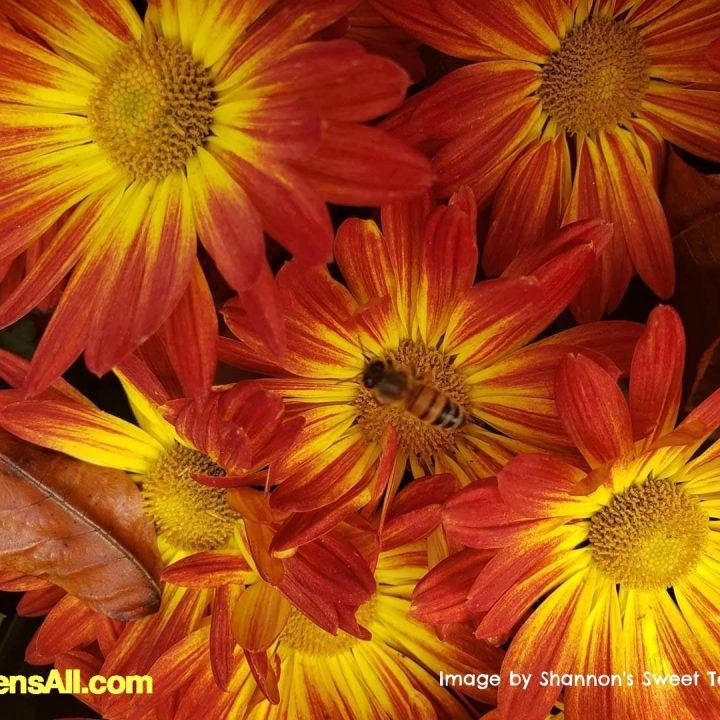
A beautiful codependent dance is necessary for the blooms and bees to survive.
Image by Shannon Schofield, beekeeper, homesteader, poet, writer, author

Pollen Power and Nectar
Some flowers produce pollen only, like camellia. Others produce nectar only, like buckwheat. There are flowers that produce both pollen and nectar, like dandelions, good early spring blossoms that are great pollinator flowers for bees and butterflies too.
There are few native plants for pollinators with nectar or pollen in the winter, which is why bees store honey. They can only store honey when there’s an excess of nectar.
A worker bee will find a source of nectar and use its straw-like tongue of a proboscis to suck nectar out of the bloom. It stores this nectar in its honey gut and brings it back to the beehive. It passes the nectar to another worker bee who further processes it in their honey gut. Then, the honey is placed in a comb cell and capped for later use.
Dandelions are an early spring pollinator flowers for bees and produces both pollen and nectar.

Spring Nectar Flow
In the early spring (here in the south – it may be later spring in colder climates) something amazing happens between the blooms and the bees. Nature provides an abundance of plants for pollinators that are full of both pollen and nectar.
In spring, native plants provide bees with an abundance of nectar and pollen, called a nectar flow.

Bee Bread for Baby Bees
When pollen and nectar are plentiful, the honeybee workers can make an abundance of bee bread. Bee bread is a mixture of pollen and nectar that honey bees feed their brood.
When there are plenty of plants for pollinators and the bees have an excess of bee bread the queen is signaled to lay eggs at her highest rate (up to 2000+ eggs per day)! This builds the colony’s population so it will have more workers to gather more food.
Abundant bee food signals to the queen bee to lay more eggs.

What NOT to Plant for Pollinators
It is important for the bees to have good sources of pollen and nectar. Ornamental trees, such as the Bradford pear may produce pollen, however it has little to no nutritional value to the bee.
The Bradford pear does not waste its energy on nutritional pollen because it does not make fruit. A similar thing happens with GMO and hybrid plants which also do not require pollination from the bees.
The pollen of ornamental trees, such as the Bradford pear has little to no nutritional value for bees.

Protecting Our Pollinators
There are many things we can do — and not do — to help the blooms and the bees.
Don’t Spray
- Don’t kill the dandelions
- Try not spray your yard or blooms with pesticides or herbicides.
- Remember: If it kills insects, it kills bees.
- Even organic neem oil and diatomaceous earth will kill bees.
- Herbicides kill the plants that bees depend on the most, such as the dandelion.
When You Must Use Sprays
We’re not saying never to use any of these products. We understand the need to protect your crops from pests. However, it’s best for you, your plants, nature and the ecology of your yard, garden and beyond to employ them sparingly. Use only when necessary, and be sure to read and understand the directions before use.
Many pesticide and herbicide products suggest using at night when the bees are not foraging. Many also instruct the user to keep pets and children away from the product for a certain amount of time. So read up on the product instructions and consequences before deciding whether to apply it.
Do Plant:
- Plant Flowers, Shrubs and Trees
- Pollinator flowers for bees in a variety of colors.
- A bee garden or pollinator garden with a variety of plants.
- Definitely plant fruit-bearing trees and shrubs which have some of the best pollinator flowers for bees.
- Plant dandelions… (or let them grow if you already have them in your yard).
- Plant perennial plants for the greatest return on your investment.
- Herbs and plants in the mint family
- Native wildflowers, such as black eyed susans
Pollinator Flowers for Bees
The Mighty Dandelion
While many people view dandelions as their nemesis and wage war each spring with herbicides to get rid of them, dandelions are wonderful food for pollinators.
This lion of a plant is the first abundant source of both pollen and nectar in many areas. Dandelion are also nutritious food for us and for the soil.
Did you know that dandelion plants replenish soil with much needed nitrogen and help with aeration? Yes, nature knows what it is doing and will fertilize your lawn as a reward for leaving the dandelion.
RELATED: Dandelion health benefits
The “lowly dandelion” is a lion of an herb, packed with powerful nutrients and for health and healing.
