

We’ve come to regularly enjoy medicinal herbal tea blends that we grow or harvest from the yard and woods around us. We love learning about new ones and adding them into our herbal collection. This season the new one for us is discovering and enjoying honeysuckle tea benefits.
It all started in late March during our daily dog walks and seeing all the many fresh new wild plants. The first to show up are usually the wild violets (Viola sororia), plantain (Plantago lanceolata), multiflora rose (Rosa multiflora).
Then practically overnight we started seeing this vine everywhere with two different leaves on the same vine, (called heterophylly, or heterophyllous).

Honeysuckle Tea Benefits
We covered some of the many honeysuckle benefits in our article by that title. Typically, nutritional breakdowns of herbal teas aren’t often available. However, it’s reasonable to conclude that sipping on herbal teas will provide micro infusions of the beneficial compounds found in the plant matter.
So if you’re wondering what honeysuckle tea is good for, Traditional Chinese medicine makes these claims from centuries of use for honeysuckle tea, some of which are the result of being combined with honey or other herbs.
Honeysuckle tea is typically drunk in the summer for clearing heat, detoxicating and strengthening the body’s response against disease by improving the activity of the immune system.
REFERENCE: Study on Lonicera japonica Thunb. JinYinHua[1]https://www.ncbi.nlm.nih.gov/pmc/articles/PMC7120270/

Honeysuckle Tea Use in Traditional Chinese Medicine (TCM)
Used for centuries in Chinese medicine, honeysuckle tea, known as Jinyinhua in China, is a popular health tonic used in many forms and beneficial for many maladies and over health support, and is used for:
- Cooling
- Detoxicating
- Immunity
Honeysuckle flowers 4 stages of development
- juvenile bud stage:
- green bug
- white bud
- mature white stage
- silver flowering stage
- golden flowering stage
REFERENCE: Lonicera japonica Thunb 金银花 (Jinyinhua, Honey Suckle)[2]https://www.ncbi.nlm.nih.gov/pmc/articles/PMC7120270/
4 Ways to Enjoy Honeysuckle Tea, Dried or Fresh
- just honeysuckle flower tea
- leaves and flowers of honeysuckle plant
- honeysuckle flowers combined other flowers, herbs and fruit blends
- honeysuckle blossoms combined with black or green tea

Are There Any Honeysuckle Tea Side Effects?
Studies show no toxic effects of Lonicera japonica. Given that honeysuckle flowers have been used for millennia in Asian medicine, it is considered a safe herb, in the quantities typically consumed in tea, tinctures, and as seasoning or garnish.
Honeysuckle flowers, leaves and vines are considered as medicine and food, Jinyinhua is definitely a safe herbal medicine, and often used for the treatment of infectious diseases and health maintenance.
However, if you’re prone to sensitivity to plants, naturally approach any herbal use with prudence.
“Lonicera japonica has been used for thousands of years in China. Now, more than 140 chemical compounds have been isolated.”
REFERENCE: J Ethnopharmacol. 2011 Oct 31 study on Lonicera japonica Thunb.: Ethnopharmacology, phytochemistry and pharmacology. Figure 2[3]https://www.ncbi.nlm.nih.gov/pmc/articles/PMC7127058/
How to Make Honeysuckle Tea
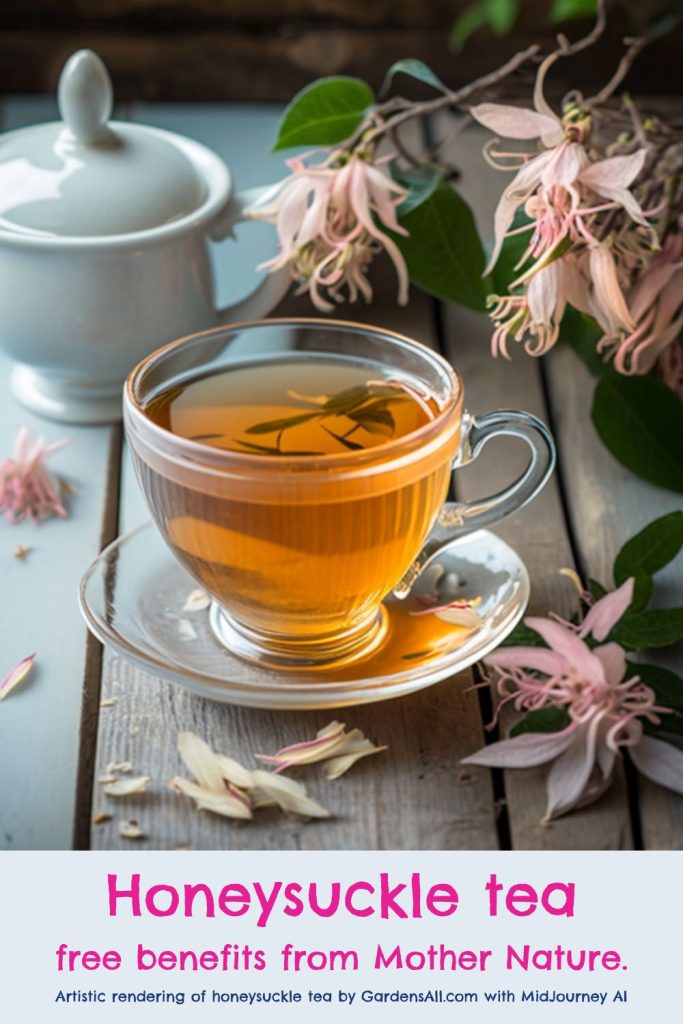
Honeysuckle tea is a delicious and fragrant beverage that can be enjoyed hot or cold.
If you’re already familiar with making herbal teas and infusions, you won’t need this honeysuckle tea recipe. Just proceed as you normally do, and adjust quantities to be more or less depending on your preferences for a milder or stronger brew.
Create your own variations. Most herbal teas go well in combination with your other favorites, so don’t be afraid to experiment and add a little of this and a little of that!
Meanwhile, for starters, here is a simple recipe to make honeysuckle tea:
Honeysuckle Tea Recipe
Ingredients for 2-4 servings
- 1/4 cup dried honeysuckle flowers (or 1/2 cup fresh honeysuckle flowers)
- 4 cups of water
- honey or other sweeteners (optional); we like to use a leaf or two of dried stevia
Instructions:
- Rinse the honeysuckle flowers and remove any stems or leaves.
- Place the flowers in a tea infuser or a tea bag.
- Bring 4 cups of water to a boil in a pot.
- Add the honeysuckle tea infuser or bag to the pot of boiling water.
- Reduce the heat to low and let the tea simmer for about 10-15 minutes.
- Remove the tea infuser or bag from the pot.
- If desired, add honey or other sweeteners to taste.
- Pour the tea into a teapot or individual cups.
- Enjoy your delicious and fragrant honeysuckle tea!
Note: It is important to make sure that the honeysuckle flowers you use for the tea are not poisonous. Some varieties of honeysuckle can be toxic, so be sure to use a safe and edible species. If you are unsure, consult with an expert or avoid using honeysuckle flowers altogether.

Can You Make Honeysuckle Tea With Leaves, Flowers and Stems?
While honeysuckle tea is traditionally made with only the flowers, it is possible to use the leaves and stems as well. However, it is important to note that the leaves and stems have a bitter taste and may alter the flavor of the tea.
To make honeysuckle tea with fresh leaves, flowers, and stems, follow these steps:
- Gather fresh honeysuckle leaves, flowers, and stems.
- Rinse them well under cold running water to remove any dirt or debris.
- Remove any parts that are damaged or discolored.
- Roughly chop the leaves and stems and place them in a teapot or large bowl.
- Add the honeysuckle flowers to the pot or bowl.
- Bring 4 cups of water to a boil in a pot.
- Pour the boiling water over the honeysuckle mixture and let it steep for about 10-15 minutes.
- Strain the mixture through a fine-mesh sieve into a teapot or individual cups.
- If desired, add honey or other sweeteners to taste.
- Enjoy your honeysuckle tea!
Keep in mind that the leaves and stems can make the tea taste more bitter, so you may need to adjust the amount of sweetener you use. You can also experiment with different ratios of flowers, leaves, and stems to find a flavor that you enjoy.
What Are Honeysuckle Flower Tea Nutrients and Benefits?
Known for its many health benefits, honeysuckle tea contains a variety of nutrients that can support overall health and wellness. Here are some of the nutrients and benefits attributed to honeysuckle flower tea due to the nutritional profile of the honeysuckle flowers.
Honeysuckle Nutrients
- Vitamins: Honeysuckle flowers are a rich source of vitamins, including vitamin C, vitamin A, and vitamin B6.
- Antioxidants: Honeysuckle flowers are high in antioxidants, including chlorogenic acid, luteolin, and quercetin.
- Minerals: Honeysuckle flowers are a good source of minerals, including calcium, magnesium, and potassium.
Honeysuckle Benefits
For extensive information proven benefits and supportive research, see our article on honeysuckle benefits.
- Immune support
- Anti-inflammatory properties
- Digestive support
- Skin health
- Respiratory health
Overall, honeysuckle flower tea is a delightful beverage that can provide a range of nutrients and health benefits.

I’m LeAura Alderson, a garden, herb and plant enthusiast with a passion for discovering the many edible and medicinal benefits of the plants all around us, including the weeds, while transforming the land through regenerative permaculture practice. I am also a writer, editor and media publisher (now mostly retired due to replacement by AI), but which now allows more time to build our regenerative permaculture homestead farm.
References