
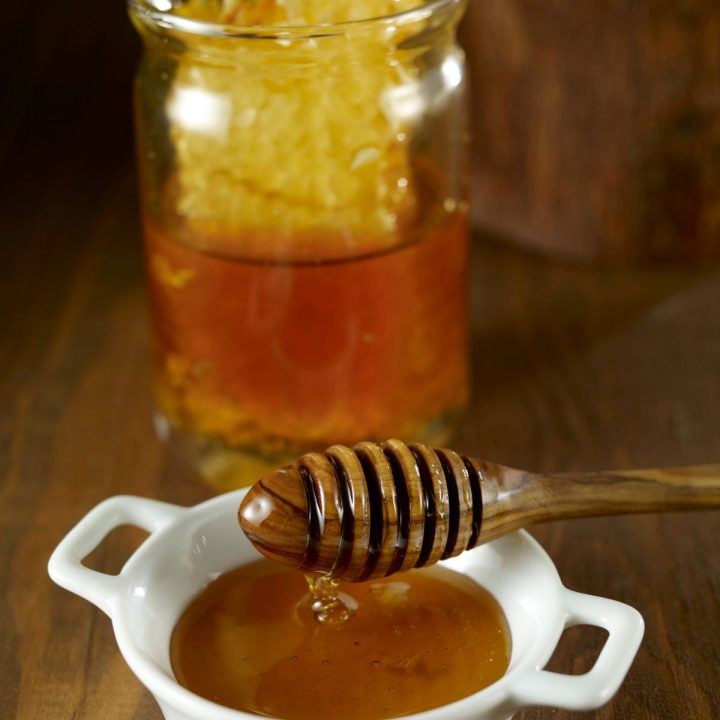
Honey – an Ancient Remedy
The benefits of honey have been in use throughout the world for eons, long before science was a thing. Beyond an incredible nectar to delight any palate, honey has been used to treat a wide array of issues both internally and externally.
The benefits of honey are tremendous in capacity and scope, from healing wounds, remediating allergies to reducing the risk of serious diseases.
Honey is one of the oldest traditional medicines.
SOURCE: April 2011 study on medicinal properties and antibacterial activity. PMC3609166.
Science Proves What Our Ancestors Knew
The benefits of honey are numerous and extensively researched. That paired with wonderful flavor makes honey a popular choice for those looking for a more natural approach to their health.
First, let’s get into some of the many benefits of honey, which are a lot more than just sweetness!
Honey Nutrients
Honey contains only trace amounts of vitamins and minerals at less than 1% of recommended daily values (RDA) per one tablespoon serving.
However, honey’s primary health contribution — and the reason honey is beneficial to so many ailments — is that it is a powerful antioxidant.
Now remember, honey will vary in nutrient density and values, even from the same hives, depending on the time of harvest, weather conditions, available flora and the health of the beehives.
For more on nutritional benefits of honey, see the section on honey antioxidants.
The Benefits of Honey
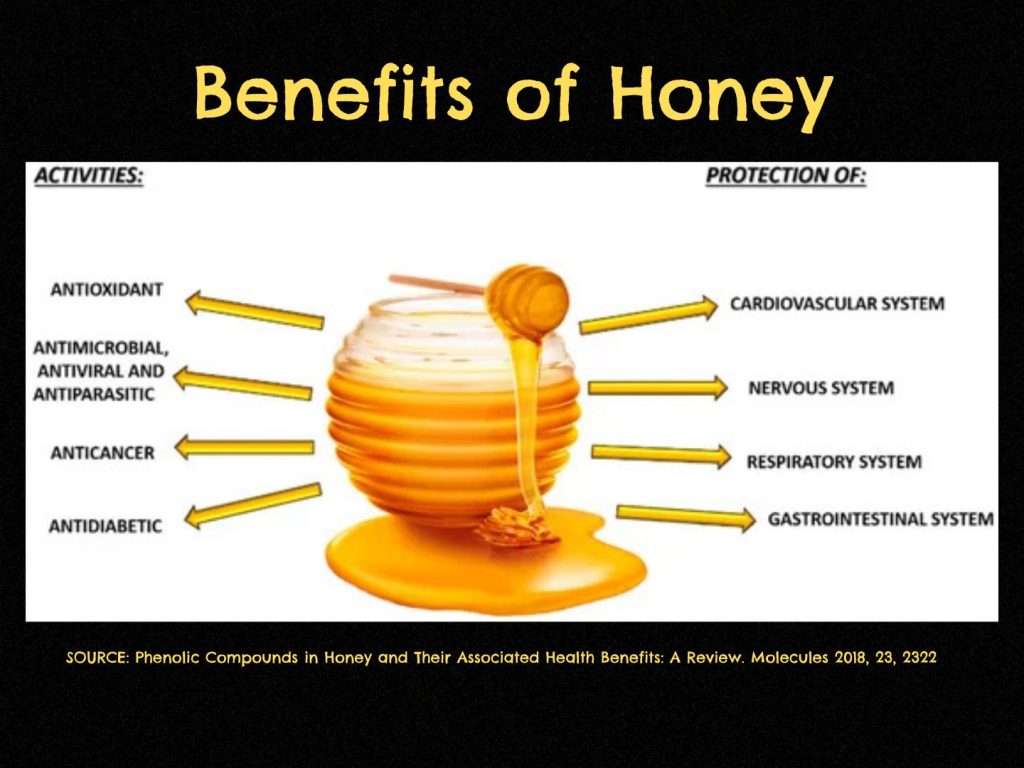
Studies have found what ancients knew: more than a golden nectar of the gods (and bees!), honey is beneficial for a wide array of ailments and preventatives. We’re listing many of these here and including links to actual scientific research as well.
- Allergic diseases:[1]https://www.ncbi.nlm.nih.gov/pmc/articles/PMC7870997/
- anaphylaxis
- asthma
- atopic dermatitis
- seasonal allergies –
- popular usage believes local honey to reduce or eliminate seasonal allergies
- Some studies reveal that consuming raw local honey over time definitely improves seasonal allergies.
DOSAGE USED: This study applied 1g of honey per kg of body weight per day in separate doses for 4 weeks. 1 Tbsp. = 20 g, so approx. .05 Tbsp. (1 gram) of honey per kg. of body weight; (1 lb. = 0.453592kg). So for 130lbs I calculate 2.95 Tbsp. (so basically 3 Tbsp. per day) [2]https://www.ncbi.nlm.nih.gov/pmc/articles/PMC6074882/
- Antibacterial – beneficial for wound healing and infection prevention
- is also an in vitro bactericidal
- Anticancer – honey has been shown to reduce tumor growth and cell proliferation [3]https://www.ncbi.nlm.nih.gov/pmc/articles/PMC3865795/ [4]https://www.hindawi.com/journals/ecam/2013/829070/
- Antidiabetic[5]https://www.ncbi.nlm.nih.gov/pmc/articles/PMC3399220/[6]https://www.ncbi.nlm.nih.gov/pmc/articles/PMC5817209/[7]file:///Users/leaura%20alderson%20laptop/Desktop/nutrients-10-01009.pdf
- Antifungal[8]https://academic.oup.com/mmy/article/44/3/289/970394?login=false
- Antimicrobial – With the rise in antibiotic resistance, alternative antimicrobial solutions are needed.[11]https://www.mdpi.com/2079-6382/9/11/766/htm
- Antioxidant – Honey exhibits strong antioxidant activity[12]https://www.ncbi.nlm.nih.gov/pmc/articles/PMC5822819/
- Antiviral[13]https://www.ncbi.nlm.nih.gov/pmc/articles/PMC7750705/[14]https://pubmed.ncbi.nlm.nih.gov/24880005/
- Atherosclerosis* – reduces risk of hardened arteries [15]https://www.mdpi.com/2072-6643/11/1/167/htm[16]https://www.ncbi.nlm.nih.gov/pmc/articles/PMC6356546/
- Burns – honey is so well established as one of the best natural treatments for burns and wounds that there are numerous options from honey imbued bandages to ointment and salves. One of the more popular brands is Medihoney.[17]https://www.ncbi.nlm.nih.gov/pmc/articles/PMC3188068/
- Cough suppressant – in studies, honey appears to be as effective as a common cough suppressant ingredient.[18]https://www.mayoclinic.org/symptoms/cough/expert-answers/honey/faq-20058031
- Emollient – moisturizes and softens
- Humectant – preserves moisture
- Immunomodulatory – stimulates immune response
- Obesity[19]file:///Users/leaura%20alderson%20laptop/Desktop/nutrients-10-01009.pdf
- Wounds – promotes healing, protection and antibacterial properties
* Difference between arteriosclerosis and atherosclerosis [20]https://southflcardio.com/atherosclerosis-vs-arteriosclerosis-know-the-difference/#:~:text=In%20short%2C%20Arteriosclerosis%20is%20a,fat%20levels%20in%20the%20body.
REFERENCE: Review of clinical research on honey and health[21]https://www.ncbi.nlm.nih.gov/pmc/articles/PMC5424551/
ALLERGIES
Allergic Diseases
Scientific studies have shown that honey is able to relieve symptoms and severity of inflamed cells and regulate the recruitment of inflammatory cells in cellular and animal models of allergic diseases.
Benefits Of Local Honey for Seasonal Allergies
There aren’t yet enough scientific studies to verify the efficacy of local honey for seasonal allergies. However, many people swear by it and the benefits of local honey for seasonal allergies have been well known anecdotally, for some time.
Raw and unfiltered honey contains pollen from whatever plants are blooming at the time the bees collect the resources. When you consume local honey, you are also consuming the pollen from these plants. Over time, ingesting your local pollen will help reduce the symptoms associated with seasonal allergies.
This is known as the principle of homeopathy, where — like flu shots — pathogens are introduced in minute amounts which support the body in adapting by creating acceptance or resistance, depending on the pathogen.
For the best results, use local honey from hives that are within a 50-mile radius of your home. This will ensure you are getting the pollen from plants that grow in and around your area.
Modern medicine may be still on the fence about whether or not honey truly works for allergies. But the millions of honey-eaters out there that have witnessed first hand what honey can do sing its praises loud and clear.
Contributions from a Beekeeper – “Honey, My Morning Medicine”
I’m taking my morning medicine right now. Becoming a beekeeper is one of the best things I’ve done.
I used to take allergy meds year- round, especially in the fall. I haven’t taken pharmaceutical medicine since keeping bees.
I would get laryngitis and couldn’t talk for several days. I started talking my fall honey last month. Use seasonal honey for seasonal allergies. Many keepers label honey by season for this purpose.
A lot of folks don’t like the thick, dark fall honey. It’s my favorite! A very flavorful medicine that’s all the buzz 🐝
~Shannon Schofield, beekeeper, homesteader – see her article here on pollinator flowers for bees and lessons from the Garden
Many keepers label honey by season to take for allergies
ANTIBACTERIAL – Honey is Widely Known as a Powerful Antibacterial Agent
You may have seen it in the movies: a wounded character spreads honey over an open wound. Honey has been used for injuries long before bandaids and Neosporin were even an idea.
Honey has antibacterial and antimicrobial properties due to the enzymatic production of hydrogen peroxide. This also promotes wound-healing, through maintaining moisture that keeps skin soothed and pliability, as well as a protective barrier similar to that provided by a bandage.
Honey also has immunomodulatory properties relevant to wound repair, and the medical grade honeys are used as a potent in vitro bactericidal against antibiotic-resistant bacteria, some of which cause life-threatening infections to humans.
As with nutritional content, the antimicrobial activity of natural honeys can vary considerably, due to locations and sources of nectar.
Manuka Honey
Manuka honey, Leptospermum scoparium, originating in New Zealand, has been reported to have an inhibitory effect on around 60 species of bacteria.
widely known to be one of the most beneficial honeys, is also called non-peroxide honey, and yet it also displays significant antibacterial effects even without the hydrogen peroxide. Healing is supported while microbial growth is inhibited due to low pH levels and high sugar density.
You can even buy manuka bandages!
REFERENCE: April 2011 study on medicinal properties and antibacterial activity. PMC3609166.[22]https://www.ncbi.nlm.nih.gov/pmc/articles/PMC3609166/
Studies comparing Malaysian tualang honey (Koompassia excelsa), conclude it to be almost equal in antimicrobial efficacy as manuka honey.[23]https://www.ncbi.nlm.nih.gov/pmc/articles/PMC2753561/
All raw honey has antiviral properties, and studies show Manuka honey to have the highest antiviral benefit.[24]https://pubmed.ncbi.nlm.nih.gov/24880005/
REFERENCE: August 2014 Study PMID: 24880005 on Anti-influenza Viral Effects of Honey In Vitro: Potent High Activity of Manuka Honey
ANTIOXIDANTS – Honey is High in Antioxidants
- Amino Acids – honey contains 26 amino acids which constitutes 50–85% of the total amino acids[25]https://www.hindawi.com/journals/omcl/2018/8367846/
- Antioxidants –
- flavonoids – 13 are commonly found in honey
- phenolic acids – 14 are commonly found in honey
Antioxidants are like the construction and clean-up crew of the body. They build, repair and clean up free radicals toward helping the body stay healthy and free of disease.[26]https://www.healthline.com/nutrition/foods-high-in-antioxidants
REFERENCE: Molecules publication review (see the downloadable PDF) of Phenolic Compounds in Honey and Their Associated Health Benefits: A Review
Studies found that monofloral honey generally has a greater antibacterial effect than multifloral
SOURCE: Study on Honey Collected from Different Floras[27]https://pubmed.ncbi.nlm.nih.gov/22432560/
honey.
COUGH SUPPRESSANT – Honey Is A Natural Cough Suppressant
Honey is a natural and tasty cough suppressant that can help ease coughs and sore throats. Just look at all the commercially-produced cold medicines and cough syrups on the market and you will see a great number of them list honey as an ingredient.
To treat coughs, honey can be taken alone or mixed with other beneficial ingredients, such as lemon. Mixing honey and lemon together in warm water or warm tea can help reduce the symptoms associated with the common cold. You can also combine cinnamon and honey together. The benefits of local honey and cinnamon are similar to what you can experience mixing honey with lemon.
We use honey when making fire cider, which is a potent antiviral and immunity boosting concoction. You may also be interested in herbs for cold and flu.
Children and Honey
A study that was conducted with children suffering from upper respiratory tract infections found that, when given 2 teaspoons of honey before bed, the children had a reduction of coughing and improved sleep.[28]https://www.ncbi.nlm.nih.gov/pmc/articles/PMC4264806/
Keep in mind, however, that honey should never be given to children under the age of one. This is because of a rare but potentially serious form of food poisoning known as infant botulism. This can occur from spores of the bacteria Clostridium botulinum, found in some honey may contain.
Caution: Do Not Give Honey to Children Under the Age of One
EMOLLIENT and HUMECTANT – Honey Is A Powerful Humectant And Emollient
Honey is a natural humectant and emollient, which means it draws and seals in moisture, while reducing dryness in your skin. Even after the honey has been washed off, it still leaves behind these skin-loving properties. It also contains antioxidants and vitamins that can help prevent and reduce wrinkles on your skin.
WOUNDS – Honey Helps Heal Minor Wounds
When applied topically, honey acts as an antiseptic that can help heal scrapes, cuts, and minor burns. This is due to the 3 components found in honey that are natural wound healers: sugar, propolis, and hydrogen peroxide.
The sugar acts as an absorbent, sucking up moisture to create an environment where bacteria can’t grow and survive, while the propolis provides antibacterial properties and the hydrogen peroxide disinfects the wound. Honey also creates a natural bandage around the wound as it dries.
Choosing the Best Honey for Health
Now that you know a little bit more about honey and the benefits of local honey, let’s look at how to choose the right honey for your health. The truth is, not all honey is created equally, and the honey found in stores is typically not the best option when you want the medicinal benefits that local and raw honey provides.
Honey is more than just something to sweeten your favorite beverage or dessert. It is a hard-working substance that contains an abundance of vitamins, minerals, and enzymes that can help improve your overall health and wellness. And the benefits of local honey are even greater!
Store Bought Honey vs. Local Honey
One of the downfalls of store-bought honey is that, despite what the label states, you are not sure exactly where the honey comes from or whether it is actually even 100% pure honey.
Fake Honey
Unfortunately, honey is the third most faked food in the world. WHAT?!? Sad to say, but research appears to bear the truth of that statement.
The title of the first and second most faked foods goes to milk and olive oil. This means that there is a good chance that the “honey” sitting on your grocery store shelves has been altered.
Producers will use various substances, including corn syrup, sucrose, and beet sugar, to dilute real honey, or they use sugars that have been chemically modified to replicate honey.
This fake honey doesn’t contain all the wonderful benefits or complex flavoring of pure honey does. It also doesn’t have the pollen in it that is needed in order to fight off allergy-related symptoms.
Honey is the third most faked food in the world.[29]https://www.insider.com/fake-honey-problems-how-it-works-2020-9
SOURCES:
Filtered Honey vs. Unfiltered Honey
When using honey for medicinal purposes, knowing whether or not it is filtered is an important factor that you shouldn’t overlook.
During the filtration process, pollen and other small particles are removed from the honey. This results in honey that is less nutritious and not as medically beneficial. Furthermore, filtered honey is usually heated as well, which destroys and kills many of the beneficial attributes that raw honey naturally has.
If you want the health benefits of local honey, you will need to use honey that hasn’t been filtered. Look for honey labeled as “raw”, and try to avoid honey found in your supermarket. Instead, visit your local farmers market to find a beekeeper in your area who you can purchase straight-from-the-hive honey from.
Filtered Honey vs. Strained Honey
If you talk to your local beekeeper about whether or not their honey is filtered, they will more than likely tell you that they strain their honey, not filter it. Even though that may sound similar, filtering honey is not the same as straining honey, and knowing the difference will go a long way to ensuring you get the best honey for your health.
Beekeepers use a honey sieve to strain the honey before bottling it. The sieve has mesh holes big enough to allow for pollen and all the other good things that are naturally found in honey to easily pass through. These holes are small enough, however, to stop pieces of wax and other honeycomb debris.
Why Does the Taste and Color of Honey Differ?
While you may think all honey is the same, there are actually numerous differences. Real honey varies in color and taste, and can vary greatly with each passing year.
Even if you purchase honey from the same local beekeeper, the taste and color of the honey is likely to change from one season to the next. This is because the flavor and appearance of honey all depends on what plant the bees are working on.
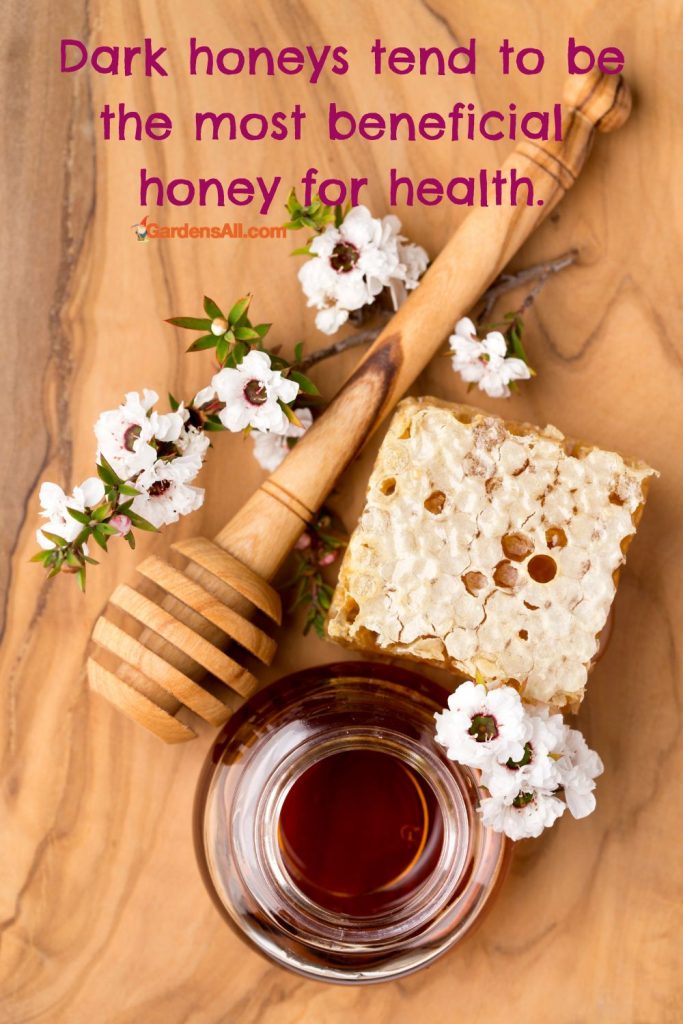
A good general rule of thumb is that the lighter the color of the honey, the milder its flavor. Darker honey typically has a more robust flavor, and is also said to have more health benefits than its lighter counterpart.
No matter what color or season the honey is from, the healthiest honey is most often found from local beekeepers. As with any area of life there are gradations of quality adherence, but all the beekeepers we know and buy from, love and tend their bees hives with great care, and harvest the honey using best practices.
Dark Honeys Tend to Be the Most in Beneficial Honey for Health
The colors of honey vary by area, seasons and quality of plants and bees, so some of these will be darker or lighter.
Some of the Healthiest Dark Honeys
- Blackberry honey
- Blueberry honey
- Buckwheat honey
- Chestnut honey – some are darker than others; choose the darkest for most benefits
- Jarrah honey (Australian)
- Manuka honey (New Zealand)
- Thyme honey
- Tualang honey
Some of the Healthiest Medium to Light Honeys
- Alfalfa honey
- Chestnut honey
- Dandelion honey
- Thyme honey – thyme honey blended with wildflower tends to be a lighter colored honey
Dark honeys tend to be the most in beneficial honey for health.
The Benefits of Honey for Human Health
The majority of honey research to date, has necessarily occurred most with lab animals rather than humans, so we can expect there to be variables in ultimate human applications.
However, animal studies have proven to yield comparable results for the human animal, and especially when supported and verified through systematic reviews and meta analysis.[30]https://www.eufic.org/en/understanding-science/article/hierarchy-of-science-evidence-infographic
Similarly, honey has been proven in enough human trials and usage, both traditionally and clinically, such that there’s no question that the benefits of honey are many and varied.
We think that the bees are little miracles creating an incredible elixir to delight the palate and heal the body, and we’re most grateful for both❣️🙏🏼🐝
You may also enjoy this article on pollinator flowers for bees and best plants for attracting bees. Our friend Shannon wrote it and here’s what she had to say about honey for her seasonal allergies:
My fall allergies were debilitating for years. Once I started keeping bees and consuming the honey I no longer require medicine to get through it. Another one was goldenrod.
~Shannon Schofield of Shannon’s Sweet Tooth Farm
See our article on Herbs for Seasonal Allergies for more.

I’m LeAura Alderson, a garden, herb and plant enthusiast with a passion for discovering the many edible and medicinal benefits of the plants all around us, including the weeds, while transforming the land through regenerative permaculture practice. I am also a writer, editor and media publisher (now mostly retired due to replacement by AI), but which now allows more time to build our regenerative permaculture homestead farm.
References