

The more I work with, study, and research the incredible plant kingdom, the more amazed I am of the abundance of gifts from nature. From the humblest weeds all around us to powerful herbs, such as basil seed benefits and uses, there’s so much to discover and enjoy, and we love sharing that with you!
In India, basil seeds (Sabja seeds), are recommended for health and medicinal benefits in traditional Ayurvedic medicine. Also known as Tukmaria in other parts of the world, numerous basil seed benefits are derived from the sweet basil plant, Ocimum basilicum, a cousin to the culinary basil that many of us are familiar with. I
Despite their tiny size, these seeds pack a powerhouse of nutritional benefits and have been extensively used in traditional medicine and culinary practices across various cultures. So let’s get into some of the remarkable basil seed benefits and uses for health and more.
BASIL SEED BENEFITS AND USES
More Nutritious Than Chia Seeds!
Basil seeds are said to have nearly 2x more fiber, calcium, potassium and iron of chia seeds. Like chia seeds, upon soaking in water or other liquid, the outer pericarp (seed husk) produces a beneficial gelatinous coating around each seed that can serve as a thickener and emulsifier.
Culinary Uses of Basil Seeds
Most of us are familiar with the use of basil leaves, but basil seeds are also edible, and have a unique feature that makes them a great addition to numerous recipes. When soaked in water, they swell and form a gel-like substance around them, similar to chia seeds. This not only enhances their texture but also makes them easier to consume and use in food and drink.
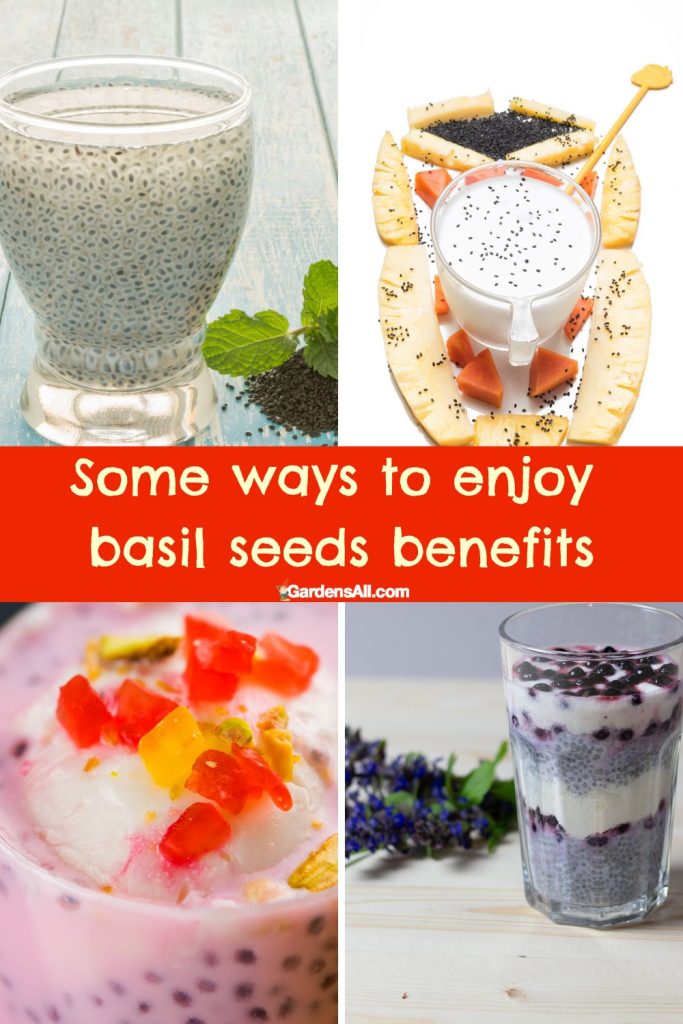
- Beverages: One of the most popular uses of basil seeds is in drinks. In many parts of Asia, they are added to beverages like falooda, a sweet dessert drink, and rooh afza, a popular herbal concoction. Basil seeds can also be added to smoothies, lemonade, or herbal teas for an added nutrients, fiber and flavor.
- Desserts: Basil seeds have a subtle flavor that complements a wide array of desserts. They are commonly used in puddings, ice creams, and sweet soups.
- Salads and Yogurts: For a nutritious boost and lightly crunchy feature, basil seeds can be sprinkled over salads or mixed into yogurt.
- Baking: Basil seed use in baking include bread, muffins, and other baked goods for a healthful twist.
Approximate Nutritional Benefits of Basil Seeds
IMPORTANT NOTE: These amounts are approximate rounded averages only. We researched several different sources and some of the amounts tend to vary widely, so this is just to provide a general overview of the approximate nutritional profile of one tablespoon (13 grams) of basil seeds.
1 Tablespoon of Basil Seeds Contains Approximately:
- Calories: 60
- Carbs: 7 grams
- Dietary Fiber: 5 grams – Basil seeds are high in dietary fiber, accounting for nearly 19% of the recommended daily intake (RDI) based on a 2,000 calorie diet.
- Protein: 2 grams – While not a major source of protein, a tablespoon of basil seeds provides about 4% of the RDI.
- Fat: 2.5 grams – Approximately half of the fat in basil seeds comes from healthy omega-3 fatty acids at around
- Omega-3 fatty acids: 1,240 mg – There’s no established RDI for Omega-3s, and various health organization recommend anywhere from 250-1,600 mg per day for general health, with less for women than men. So suffice it to say that you’re getting a healthy dose of Omega-3’s with basil seeds.
- Calcium: 90-200 mg – This represents about 7-15% of the RDI for Calcium, which is essential for bone health.
- Iron: 0.8 mg – This accounts for about 4.5% of the RDI for Iron, a mineral crucial for blood production.
- Magnesium: 37 mg – Offering around 9% of the RDI, magnesium is key for many processes in the body, including regulating muscle and nerve function, blood sugar levels, and blood pressure.
- Trace amounts of other nutrients, including:
- Potassium
- Vitamin K
These values will vary by sources and specific variety of basil seeds and growing conditions, so again, these are just general guidelines of nutritional benefits of basil seeds.

Basil Seed Benefits for Health and Wellness
Scientifically Studied Basil Seed Benefits
Beyond their culinary uses, basil seeds are associated with an impressive list of health benefits, predominantly attributed to their rich nutritional profile, flavonoids, and polyphenol content.
- Digestive Health: Thanks to their high fiber content, basil seeds can aid in digestion. They promote regular bowel movements and help in preventing constipation. Additionally, their mucilaginous property may assist in soothing the stomach lining and alleviating digestive discomfort.[1]https://www.mdpi.com/2304-8158/10/7/1467
- Weight Management: The fiber in basil seeds can also aid in weight management. They tend to slow digestion, thereby promoting a feeling of fullness and helping to curb overeating.[2]https://www.frontiersin.org/articles/10.3389/fphar.2021.722258/full
- Heart Health: Basil seeds are a good source of alpha-linolenic acid (ALA), a type of omega-3 fatty acid. Regular consumption of ALA may reduce the risk of heart disease by lowering inflammation and improving the health of your blood vessels.[3]https://www.ncbi.nlm.nih.gov/pmc/articles/PMC8303141/
- Blood Sugar & Diabetes: Studies suggest that basil seeds may help control blood sugar levels. They can slow down the conversion of carbohydrates into glucose, making them beneficial for people with type 2 diabetes.[4]https://www.actascientific.com/ASNH/pdf/ASNH-05-0917.pdf[5]https://www.ncbi.nlm.nih.gov/pmc/articles/PMC8303141/
- Bone Health: They are rich in essential minerals like calcium, magnesium, and phosphorous, all of which contribute to maintaining bone health.[6]https://www.ncbi.nlm.nih.gov/pmc/articles/PMC8303141/
- Skin and Hair Health: The omega-3 fatty acids in basil seeds can also promote healthy skin and hair. These fatty acids help to nourish the skin and hair from within, giving them a healthy and natural glow.[7]https://www.netmeds.com/health-library/post/sabja-seeds-uses-benefits-for-health-weight-loss-skin-and-falooda-recipe
Next, we list a few of the ethnobotanical uses of basil seeds. But first…
Modern Versus Traditional Medicine
- Western Modern Medicine – early 19th Century (~200 years old)[8]https://www.ncbi.nlm.nih.gov/pmc/articles/PMC9609744/#:~:text=Western%20medicine%20was%20transformed%20into,innovations%20in%20the%20clinical%20medicine.
- Traditional Chinese Medicine – 3rd Century BCE (~2,200 years old)[9]https://www.britannica.com/science/traditional-Chinese-medicine
- Indian Ayurvedic Medicine – (5,000+ years old)[10]https://artoflivingretreatcenter.org/blog/ayurveda-overview-ancient-healing-systems/#:~:text=Ayurveda%20has%20its%20origins%20in,years%20to%20India’s%20Vedic%20period.
What is Ethnobotany?
Ethnobotany refers to the study of how different cultures use plants and their derivatives.
Yet it’s worth noting that traditional approaches such as the Indian Ayurvedic Medicine and Traditional Chinese Medicine (TCM) have both been around and in practice for thousands of years, and still going strong today. That’s a lot longer than the current ruling mainstream of modern medicine and science.
Each has its pros and cons, so we like to consider and include both.
Ethnobotanical Uses of Basil Seeds:
Here are some traditional uses of basil seeds:
- Cooling Agent: In traditional Indian and Middle Eastern cultures, basil seeds have been consumed in the summer for their cooling properties.
- Stress Relief: Basil seeds are used in Ayurveda, the traditional Indian medicinal system, for their stress-relieving properties.
- Respiratory Health: In traditional medicine, basil seeds have been used to treat respiratory conditions like coughs and colds.
- Skin and Hair Health: Used topically, basil seeds have been traditionally believed to promote healthy skin and hair.
- Detoxification: In some cultures, basil seeds are consumed as a natural detoxifier.
Prudence
While basil seeds are generally safe for consumption, they should be taken in moderation. If you are pregnant, breastfeeding, or have a pre-existing health condition, it is always advisable to consult a healthcare professional before incorporating them into your diet.
In Summary
Basil seeds, with their unique properties and myriad benefits, make a nutritious addition to the diet. Whether incorporated into your favorite recipes or used as a health supplement, these little seeds offer big rewards.
You can find help on when and how to harvest basil seeds here, and you can enjoy more of the wonderful basil benefits by growing basil microgreens.
If you want to try basil seeds now and it’s not yet time to harvest your own, you can buy basil seeds on Amazon.

I’m LeAura Alderson, a garden, herb and plant enthusiast with a passion for discovering the many edible and medicinal benefits of the plants all around us, including the weeds, while transforming the land through regenerative permaculture practice. I am also a writer, editor and media publisher (now mostly retired due to replacement by AI), but which now allows more time to build our regenerative permaculture homestead farm.
References