

Cinnamon is a popular and potent spice that is found in most kitchens around the world. While its primary use is for cooking and baking, it can also be used for a variety of household and gardening problems, such as ant control. This article will guide you on methods and ways to use cinnamon for ants.
One study found that cinnamon does have potential ant repellent capacity.
Nutmeg was ineffective in repelling ants, but cinnamon and turmeric all showed promise as ant repellents.
Old Dominion University 2022 study on Ants and Spices[1]https://digitalcommons.odu.edu/cgi/viewcontent.cgi?article=1000&context=reyes-2022
Using Ground Cinnamon for Ants
AKA Cinnamomum zeylanicum L. and Cinnamon cassia L.
When ants are faced with the smell of cinnamon, they tend to retreat. This is due to the strong smell that interferes with the ant’s ability to communicate and navigate. To use cinnamon for ant control:
- Identify the Ant Trail: Ants often follow the same path when collecting food. Look for the trail, and you will find the ants.
- Spread the Cinnamon: Once the trail is identified, sprinkle ground cinnamon directly on the ants’ path. They will lose their way, break their trail, and go somewhere else.
- Create a Barrier: You can also create a cinnamon barrier by sprinkling a line of cinnamon around the area you wish to protect, such as around plants or food sources.
While this method won’t kill the ants, it’s an effective way to redirect them and protect specific areas from being invaded.
Cinnamon has proven ant repellent benefits.[2]https://digitalcommons.odu.edu/cgi/viewcontent.cgi?article=1000&context=reyes-2022
Test Results of Cinnamon as an Ant Repellent
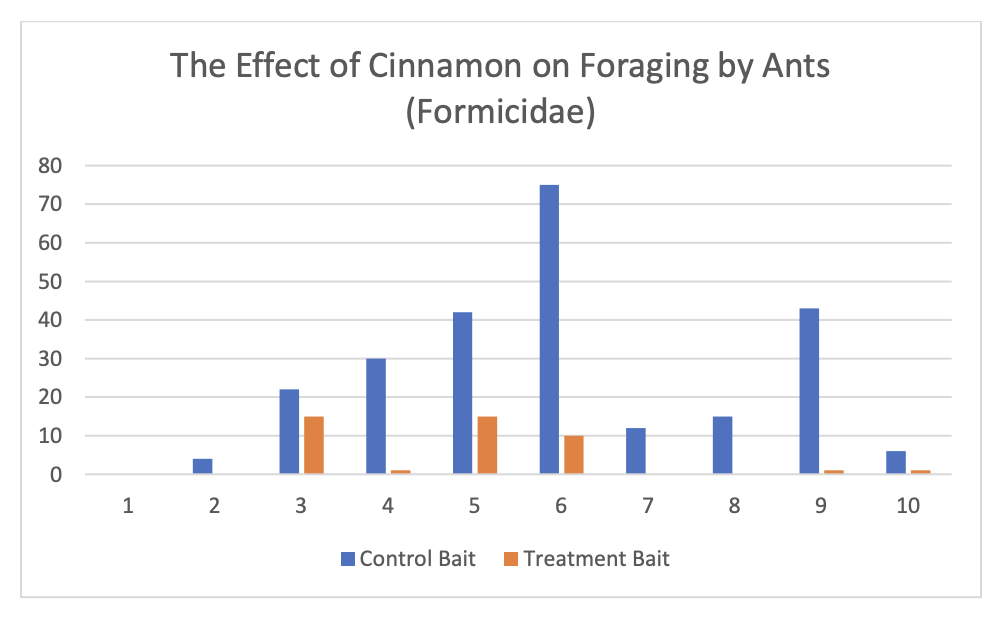
Below is one study that proved that cinnamon repels (or at least doesn’t tend to attract ants. However, more studies are needed because the “control” substance was Ritz crackers topped with sugar as compared to ritz crackers topped with cinnamon.
So while this may show that ants are not drawn to cinnamon, what isn’t clear is whether they were not drawn to cinnamon because they were drawn to the sugar topping more.
Chart of Study on Cinnamon as an Ant Repellent
| Control Bait (Ritz cracker topped with sugar) | Treatment Bait (Ritz cracker topped with Cinnamon) | Description of Ants Tracked |
|---|---|---|
| 0 | 0 | N/A |
| 4 | 0 | Large, black |
| 22 | 15 | Large, black |
| 30 | 1 | Very small, black |
| 42 | 15 | Large, black |
| 75 | 10 | Very small, black |
| 12 | 0 | Very small, black |
| 15 | 0 | Large, black |
| 43 | 1 | Large, black |
| 6 | 1 | Large, black |

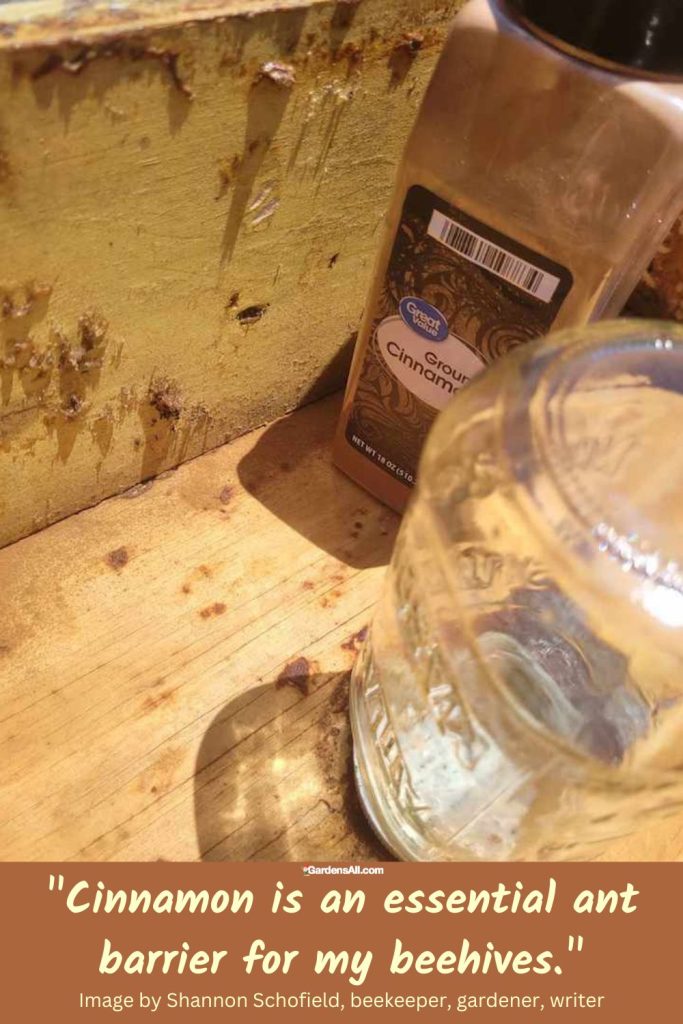
Cinnamon as a Beehive Ant Barrier
We wrote this article because when we published an article on How to Use Cinnamon for Plants, a friend who’s a beekeeper shared how she’s using it to deter ants from her beehives.
“Yes! It’s essential with my beehives. I put it on between their inner and top covers as well as on their porch to keep ants away. I don’t have to reapply much as the inner cover stays dry. I mainly use it for ants. Thank you for the other suggestions.”
~Shannon Schofield, beekeeper, gardener, writer
Many keepers use the cinnamon gel. It’s expensive so I just use ground cinnamon for ants.
This is a top feeding box for a bee hive. It’s just a box with no frames. The top cover has a small hole so I can set this syrup feeder on it, and a telescoping top cover (basically the roof) goes over this.
Ants love getting in through the top where there’s a lot of food and fewer guard bees. I keep ground cinnamon around the edges and have NO ants bugging my bees. I also keep pool salt under the hives with cinnamon.
That is good IPM [integrative pest management] for all that bugs my bees. 🐝😊🌺
See also, Shannon’s article on pollinator flowers for bees.
See other articles written by Shannon: Pollinator flowers and lessons from the garden.
Baking Soda and Cinnamon for Ants
Combining baking soda and cinnamon can provide a more aggressive approach for ant control.
- Prepare the Mixture: Combine equal parts baking soda and ground cinnamon.
- Use the Mixture: Sprinkle the mixture on the ants’ path and around the areas where you see ants most often.
Baking soda is harmful to ants. Once they ingest it, it reacts with the acidic substance in their bodies and kills them. Cinnamon, on the other hand, will deter other ants from following the trail.
Cinnamon for Ants in Potted Plants
Ants can be problematic for potted plants. Here’s how you can use cinnamon to control ants in this scenario:
- Remove the Ants: If the infestation is severe, consider removing as many ants as you can first.
- Apply Cinnamon: Sprinkle a generous amount of cinnamon on the top soil and around the base of the potted plant.
- Reapply As Necessary: You may need to reapply cinnamon after watering the plant or after a heavy rain if the pot is outdoors.
This method can help deter ants from entering the pot and causing harm to your plants.
Vinegar and Cinnamon for Ants
Vinegar can also be used in combination with cinnamon for ant control.
- Create a Vinegar Solution: Mix one part vinegar with one part water in a spray bottle.
- Apply Cinnamon and Vinegar: First, spray the vinegar solution on the ants’ trail, then sprinkle cinnamon over it.
Vinegar disrupts the pheromone trails that ants leave behind, which can disrupt their navigation. The addition of cinnamon further confuses the ants and deters them from the area.
See other ways to get rid of ants naturally.
Cinnamon for Ants in the Garden
Using cinnamon in the garden is an excellent natural way to control ants and protect your plants.
- Identify Problem Areas: Locate where ants are frequently seen or where their mound is.
- Sprinkle Cinnamon: Apply a generous amount of cinnamon directly onto the ant mound or along their trails.
- Apply Regularly: You may need to reapply the cinnamon after rainfall or regular watering.

Using Cinnamon Oil for Ants
One studies on cinnamon for fire ants showed that cinnamon oil had an excellent inhibitory effect.[5]https://pubmed.ncbi.nlm.nih.gov/17369041/
- Create a Cinnamon Oil Solution: Combine a few drops of cinnamon essential oil with water in a spray bottle. A good ratio would be about 10 drops of oil for every cup of water. Shake well to combine.
- Spray the Solution: Spray the cinnamon oil solution directly on the ants, their trails, and around the areas where you see ants most often. Be careful when spraying indoors, as cinnamon oil can stain certain materials.
- Use Cotton Balls: For a lasting effect, soak a few cotton balls in the cinnamon oil solution and place them in areas where ants frequently visit. The cotton balls will act as a slow-release system for the cinnamon oil, providing a long-lasting deterrent. To protect any surfaces, you can place them on a dish, plastic lid or something like a soda bottle lid or section of a plastic egg carton.
- Reapply As Necessary: Like with ground cinnamon, you will need to reapply the solution regularly to maintain its effect, especially after rain or watering your plants.
You may also benefit by reading our article on Cinnamon for Plants.
In Summary
Using cinnamon oil is an effective way to control ant infestations without resorting to harsh chemicals. It’s eco-friendly, safe for most plants, and safe to use around pets and children. However, always test a small amount first to ensure it doesn’t damage your plants or surfaces.
Remember, cinnamon acts as a deterrent, not a killer, so ants will likely relocate their colony. For this reason, continue to monitor your garden for new ant activities.

I’m LeAura Alderson, a garden, herb and plant enthusiast with a passion for discovering the many edible and medicinal benefits of the plants all around us, including the weeds, while transforming the land through regenerative permaculture practice. I am also a writer, editor and media publisher (now mostly retired due to replacement by AI), but which now allows more time to build our regenerative permaculture homestead farm.
References