
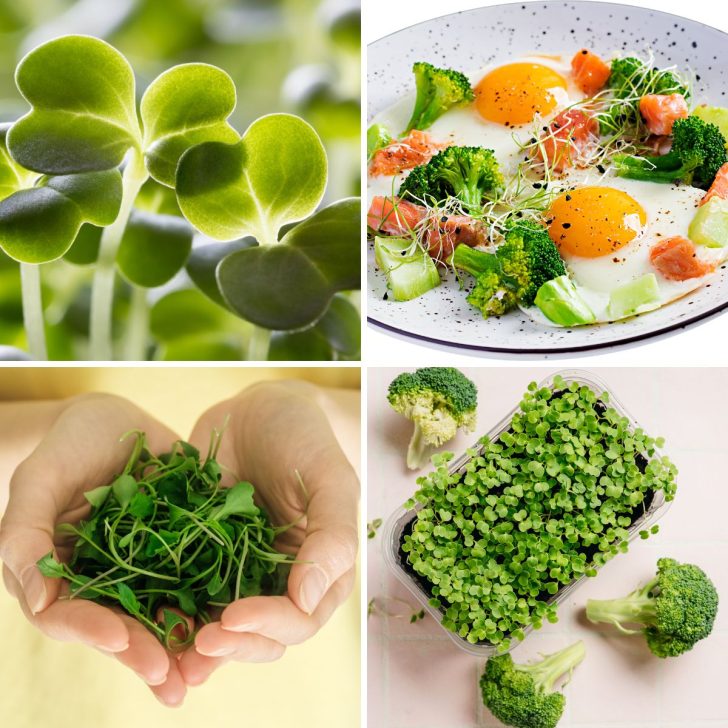
The broccoli microgreens nutrients and health benefits can vary, depending on which growing mediums are used. Naturally, this applies to all foods where the nutritional profiles of growing environments can affect plant health in much the same ways it can affect other lifeforms. However, no matter the growing medium, broccoli microgreens are nutrient dense with many health benefits.
In this article we include scientific research from three different microgreens mediums: compost (C), hydroponic with nutrient solution (HFG), and hydroponic with water only (HW).
The research discovered some key insights into the optimal growing conditions for maximizing broccoli microgreens nutritional value that are useful to know.
Broccoli Microgreens Benefits for Health and Wellness
Broccoli microgreens are not just a trendy garnish but a nutritional powerhouse with significant health benefits. Let’s dive in!
Rich Source of Antioxidants
Polyphenols and Carotenoids:
Broccoli microgreens are packed with polyphenols and carotenoids, two types of antioxidants known to combat oxidative stress in the body. Oxidative stress is linked to a host of chronic diseases, including cancer, heart disease, and age-related disorders. The high levels of these antioxidants in broccoli microgreens can help neutralize harmful free radicals and reduce inflammation.
You may also enjoy our article on polyphenols and flavonoids.
Vitamin C:
With a substantial amount of vitamin C, these microgreens support the immune system, skin health, and iron absorption. Vitamin C also has antioxidant properties and contributes to collagen synthesis, vital for healthy skin and joints.
Vitamin E:
Broccoli microgreens also contain vitamin E, another powerful antioxidant that protects cells from oxidative damage and supports immune function.
Nutritional Benefits
Vitamins A and K:
- Broccoli microgreens provide a good dose of vitamins A and K. Vitamin A is essential for vision and immune health, while vitamin K is crucial for blood clotting and bone metabolism.
Minerals:
- The presence of minerals like calcium, magnesium, and iron contributes to bone strength, cardiovascular health, and oxygen transport in the blood.
Potential Anti-Cancer Properties
Glucosinolates:
- These microgreens contain glucosinolates, compounds that can break down into biologically active agents with potential anticancer properties. Studies suggest that these agents can induce detoxification enzymes and inhibit the growth of cancer cells.
Supports Digestive Health
Fiber:
- The fiber content in broccoli microgreens aids in digestion, helps maintain a healthy gut microbiome, and may contribute to weight management due to its satiating effect.
Detoxification
Chlorophyll:
- Chlorophyll not only gives plants their green color but may also have a detoxifying effect in humans. It’s been suggested that chlorophyll can bind to potential carcinogens and interfere with how they’re absorbed within the human gastrointestinal tract.
Easy to Incorporate into Diet
Broccoli microgreens can easily be added to salads, sandwiches, smoothies, and more, making them a versatile and convenient way to boost nutrition intake.
Broccoli Microgreens Nutrients
If you like going deeper into the scientific research on broccoli nutrients, the following charts are a great start.
Please keep in mind that these are general guidelines and not prescriptive or exact. In fact, as you read through this article you’ll see some of the many variables affecting the nutritional profile of virtually any food, and in particular for the purposes of this article, microgreens.
Minerals per 100 grams Broccoli Microgreens in 3 Different Grow Mediums
Most everyone growing microgreens are doing so for the nutritional benefits they provide. So this research reveals that compost as a growing medium provides the greatest nutritional potency.
| Element | Compost (C) [mg/100g] | Hydroponic with Nutrient Solution (HFG) [mg/100g] | Hydroponic with Water Only (HW) [mg/100g] |
|---|---|---|---|
| Nitrogen (N) | 500.0 | 503.0 | 572.0 |
| Phosphorus (P) | 76.0 | 67.0 | 75.0 |
| Potassium (K) | 422.0 | 101.0 | 79.0 |
| Calcium (Ca) | 59.0 | 29.0 | 32.0 |
| Magnesium (Mg) | 40.0 | 33.0 | 36.0 |
| Sulfur (S) | 140.0 | 122.0 | 136.0 |
| Sodium (Na) | 66.0 | 22.0 | 22.0 |
| Manganese (Mn) | 5.09 | 2.42 | 2.90 |
| Iron (Fe) | 12.5 | 4.87 | 6.12 |
| Copper (Cu) | 0.523 | 0.331 | 0.379 |
| Boron (B) | 1.50 | 1.16 | 1.55 |
| Aluminum (Al) | 7.04 | 1.05 | 0.884 |
| Zinc (Zn) | 7.32 | 4.70 | 5.37 |
In the chart above on the broccoli microgreens mineral nutrients, you can see that the compost is clearly the superior growing medium for obtaining the maximum nutrients overall.
The volume of 100 grams of broccoli microgreens can vary based on how tightly they are packed. Typically, leafy greens like microgreens are not very dense, and 100 grams is often equivalent to about 3 to 4 cups when loosely packed. If you press them down, the volume would decrease.
For a more accurate estimation, it’s helpful to use a kitchen scale to weigh the microgreens. However, if a scale isn’t available, using the loose cup measurement is a reasonable approximation for most culinary and dietary purposes.
The compost growing medium is the clear winner for obtaining the maximum broccoli microgreens nutrients
Biochemical Data for Broccoli Microgreens (B. oleracea)
The term “biochemical data” refers to the specific nutritional compounds and their quantities within the plant tissue.
| Parameters | B. oleracea (Broccoli) [Units/100g] |
|---|---|
| Water content | 91.06 g |
| Dry matter | 8.94 g |
| Reducing sugars | 466 mg glucose |
| Total sugars | 1,648 mg glucose |
| Chlorophyll a | 73,783 µg |
| Chlorophyll b | 22,392 µg |
| Total Chlorophyll | 96,175 µg |
| Chlorophyll a/b ratio | 3.37 (dimensionless) |
| Total Carotenoids (TCar) | 21,730 µg |
| Total Carotenoids/Total Chlorophyll ratio | 0.23 (dimensionless) |
| Total Polyphenols Content (TPC) | 363 mg gallic acid equivalent |
| Total Anthocyanins (TAnth) | 17,251 µg malvidin-chloride equivalent |
| Reduced Ascorbic Acid | 9,827 µg |
| Total Ascorbic Acid | 12,410 µg |
| Ascorbic Acid/Total Ascorbic Acid ratio | 0.79 (dimensionless) |
| DPPH Radical Scavenging Assay (IC50) | 3.93 mg/mL (not typically reported per 100g) |
| Antioxidant Activity (FRAP) | 0.86 mmol Fe2+ |
What Does This Mean?
The high levels of polyphenols and other antioxidants in broccoli microgreens suggest a concentration of health-promoting substances that could contribute to disease prevention and overall wellness.
The presence of these compounds in significant amounts underscores the value of including these microgreens in a balanced diet. Broccoli microgreens potential benefits include reducing inflammation, protecting against chronic disease, and supporting healthy immune function. The microgreens offer these benefits alongside essential vitamins and minerals, making them a nutrient-dense food choice.
Broccoli Microgreens Vitamins
Broccoli microgreens packs as much as four times the number of cancer-fighting antioxidants as mature broccoli.[1]https://tellus.ars.usda.gov/stories/articles/baby-broccoli-brings-beneficial-boost
Vitamin Content in Broccoli Microgreens
NOTE: We found no data on the medium used for growing the microgreens with this vitamin content.
| Vitamin | Content per 100g | % of RDA |
|---|---|---|
| Vitamin A | 300 mcg | ~30% |
| Vitamin C | 51.0 mg | ~60% |
| Vitamin E | 24.1 mg | 160% |
| Vitamin K | 3 mcg | 3% |
This data reveals that broccoli microgreens are particularly rich in vitamins A, C, and E, making them a valuable addition to a balanced diet. They provide a significant proportion of the daily requirements for these vitamins, underscoring their nutritional value. Vitamin K is present in smaller amounts, yet still contributes to the overall nutritional profile of these microgreens.
You can find more on the healthiest microgreens here.
Factors Affecting Nutritional Profile of Produce
Nutritional profiles are based on an average of produce and yet actual nutrients can vary wildly based on a number of factors:
- Soil Quality: Rich and well-balanced soil enhances the nutrient content of fruits and vegetables.
- Farming Practices: The use of fertilizers and pesticides, and the choice between conventional and organic farming, affects nutrient levels.
- Ripeness at Harvest: Nutrient levels are generally highest when fruits and vegetables are fully ripe.
- Water and Weather: Factors like sunlight exposure, temperature, and rainfall influence the synthesis of vitamins and minerals in crops.
- Genetic Variations: Different varieties and breeding techniques can lead to variations in nutrient content.
- Harvest & Processing: The way crops are handled, stored, and transported after harvest can impact their nutritional quality, as some nutrients are sensitive to light, temperature, and time.
- Cooking Methods: The method of cooking can preserve or diminish the nutrients available in the final product.
- Grow Light Treatments: The type of light and its spectral composition used in growing plants can significantly affect their nutritional content.
Grow Lights Effect on Broccoli Microgreens’ Growth and Nutrients
Studies on broccoli microgreens have shown that different light treatments, such as varying percentages of blue, red, and green light, can alter the levels of chlorophyll—a key nutrient in plants. Light intensity and the specific wavelengths used can enhance or diminish the synthesis of certain nutrients, thus impacting the overall nutritional profile of the produce.
| Light Treatments | Chlorophyll a (mg/100g) | Chlorophyll b (mg/100g) | Total Chlorophyll (mg/100g) |
|---|---|---|---|
| Fluorescent/Incandescent | 41.92 | 18.86 | 60.78 |
| 5% blue/95% red | 67.33 | 30.87 | 98.20 |
| 5% blue/85% red/10% green | 76.29 | 32.98 | 109.27 |
| 20% blue/80% red | 107.91 | 42.17 | 150.09 |
| 20% blue/70% red/10% green | 102.57 | 38.18 | 140.76 |
| LSD (α = 0.05) | 27.48 | 7.47 | 32.66 |
It’s Complicated!
As you can see and imagine, the nutritional profiles of fruits and vegetable crops are shaped by a complex interplay of factors. Understanding and optimizing these factors can lead to more nutrient-rich produce, contributing to better dietary quality and health benefits.
Naturally, many of these conditions are hard to know unless you’re growing your own organic produce. So we do the best we can relative to consuming fresh healthy vegetables, preferably organically grown, and prepared using the healthiest way to cook vegetables.
However, the good news is that’s where microgreens come in. They are easy to grow at home and add powerful nutrients to any dish.
But Don’t Worry… Just Give Microgreens a Try, No Matter What Medium
So for individuals looking to maximize the nutritional intake from broccoli microgreens, using compost as a growing medium is the most beneficial. However, compost or quality soil is not always the most convenient method. The growing medium you choose can depend on other factors like available space, resources, and personal preferences for gardening methods.
For more, see our article on how to grow microgreens.
The Bottom Line
So the bottom line? Best to grow and enjoy microgreens in whatever way that you can, for they’re all mini morsels of vibrant nutrients that can add color, flavor and health benefits in every bite!

I’m LeAura Alderson, a garden, herb and plant enthusiast with a passion for discovering the many edible and medicinal benefits of the plants all around us, including the weeds, while transforming the land through regenerative permaculture practice. I am also a writer, editor and media publisher (now mostly retired due to replacement by AI), but which now allows more time to build our regenerative permaculture homestead farm.
References