
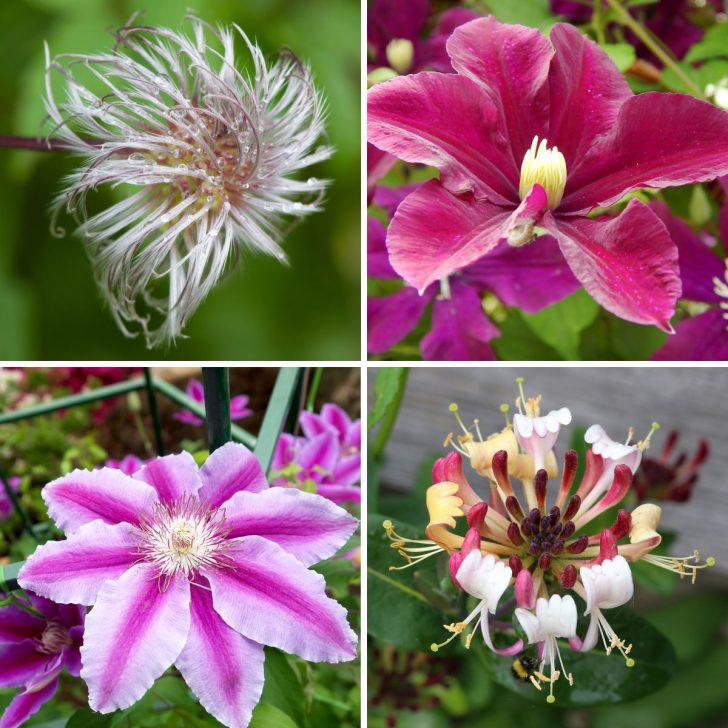
Clematis, with over 300 species and countless cultivars, offers a vast array of choices. Their pruning requirements have led to their classification into the three main clematis pruning groups. However, some might fit ambiguously between groups, with new cultivars introduced regularly.
So these are general guidelines for clematis pruning groups, and includes a “top 10” most popular clematis in North America per group.
Clematis Pruning Group 1 — Early-flowering Minimal or No Prune Group
Characteristics
Clematis pruning group 1 are those clematis varieties that bloom the earliest in the season, typically in late winter or spring. These produce flowers on the previous year’s growth.
When to Prune
For Group 1 clematis, pruning is not essential for flowering, but for maintenance purposes, they can be pruned just after they’ve finished flowering, usually in late spring.
How to Prune
The pruning is minimal, aimed at removing any dead or weak stems, shaping the plant, or keeping it within bounds. Over-pruning can result in reduced blooms the following year.
Deadheading clematis in pruning group 1 isn’t necessary for stimulating growth. See more on this further below.
10 Popular Varieties in Clematis Pruning Group 1
- Clematis alpina ‘Francis Rivis’
- Clematis montana ‘Grandiflora’
- Clematis montana ‘Rubens’
- Clematis montana ‘Elizabeth’
- Clematis macropetala ‘Blue Bird’
- Clematis montana ‘Mayleen’
- Clematis montana ‘Tetrarose’
- Clematis macropetala ‘Maidwell Hall’
- Clematis montana ‘Broughton Star’
- Clematis alpina ‘Pamela Jackman’

Clematis Pruning Group 2 — Mid-season Light Prune Group
Characteristics
Clematis Pruning Group 2 clematis bloom in late spring to early summer and often have a second, lighter flush in late summer. They produce their primary flush of flowers on the previous year’s growth and the second flush on new growth.
When to Prune
These should be pruned in early spring, before the new growth starts but after the risk of frost is gone. Some gardeners also give them a light prune after the first flush of flowers to encourage a robust second flowering.
How to Prune
Start by removing dead or weak stems. If the plant is overgrown or tangled, you can thin out some of the stems to improve air circulation. After the first bloom, cut back flowering stems by about a third to encourage new growth and potentially a second bloom.
Dead-heading can be beneficial for this group. You can read more on this further below.
10 Popular Varieties in Clematis Pruning Group 2
- Clematis ‘Nelly Moser’
- Clematis ‘Henryi’
- Clematis ‘Niobe’
- Clematis ‘The President’
- Clematis ‘Bees’ Jubilee’
- Clematis ‘Barbara Jackman’
- Clematis ‘General Sikorski’
- Clematis ‘Lincoln Star’
- Clematis ‘Miss Bateman’
- Clematis ‘Marie Boisselot’ (or ‘Madame Le Coultre’)

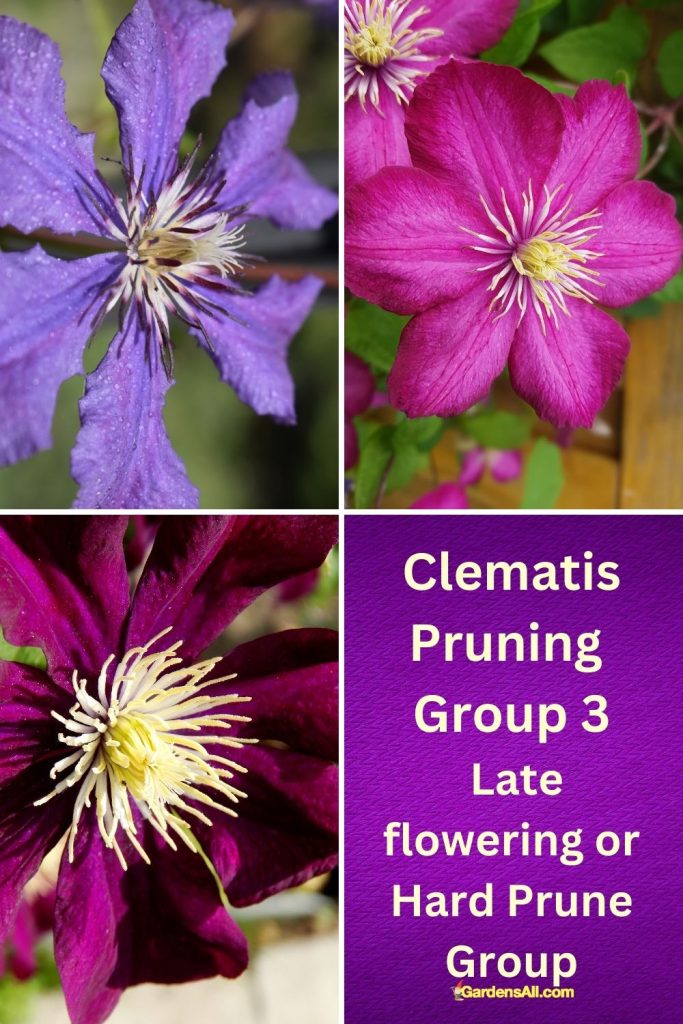
Clematis Pruning Group 3 — Late-flowering or Hard Prune Group
Characteristics
These clematis bloom in late summer to early fall, producing flowers on the current year’s growth.
When to Prune
Prune in late winter or early spring, typically around February, when buds begin to swell but before new growth starts.
How to Prune
This group can be pruned quite hard. Cut back all the old stems to a pair of strong, healthy buds, usually about a foot or 30 centimeters above ground level. This might seem drastic, but it ensures a fresh, vigorous growth that supports the current year’s blooms.
Dead-heading isn’t required for these. See more details in the next section.
10 Popular Varieties in Clematis Pruning Group 3
- Clematis ‘Ville de Lyon’
- Clematis viticella ‘Purpurea Plena Elegans’
- Clematis ‘Ernest Markham’
- Clematis ‘Jackmanii’
- Clematis ‘Comtesse de Bouchaud’
- Clematis ‘Rouge Cardinal’
- Clematis ‘Perle d’Azur’
- Clematis ‘Hagley Hybrid’
- Clematis ‘Etoile Violette’
- Clematis ‘Polish Spirit’
Contributions from the Community
“Group 3 clematis, late summer early fall blooms. Hard prune = major growth and blooms. took this pic yesterday. This clematis vine is only 2 yrs old.”


~Shari Wilson

You may also enjoy our article on Clematis ‘Princess Diana’.
Deadheading Clematis Vines — is it Necessary?
We’ve mentioned deadheading clematis in the clematis pruning groups above, but here’s a brief elaboration of each.
The process of removing faded or dead flowers from plants. It can be beneficial for various reasons, such as encouraging a second flush of blooms, preventing seed production, and maintaining the plant’s aesthetics.
So do clematis need deadheading? It depends on which group your clematis falls under.
- Group 1 (Early-flowering or No Prune Group): Dead-heading is not typically necessary for this group. Since they bloom on old wood, removing spent flowers won’t encourage a new flush of blooms. However, if you want to maintain a tidier appearance, you can remove the spent blooms.
- Group 2 (Mid-season or Light Prune Group): Dead-heading can be beneficial for this group. By removing the spent flowers after the first flush, you may encourage a more robust second flush of blooms later in the summer. Just ensure you’re only removing the spent flower heads and not cutting back the entire stem, as this can reduce the second set of blooms.
- Group 3 (Late-flowering or Hard Prune Group): For these late bloomers, dead-heading isn’t usually done for the purpose of encouraging more blooms, as they only have one bloom cycle per year. However, removing faded flowers can improve the plant’s appearance and prevent unwanted seed production.
While most clematis are willing growers and easy to care for, understanding clematis pruning groups is the key to maximizing your plant’s performance. With this knowledge, you can time your pruning to maximize flower production and keep your clematis healthy and thriving year after year.
You may also enjoy reading our article on pruning Rose of Sharon, or these on popular purple clematis varieties, and our latest clematis addition: Clematis ‘Princess Diana‘.

I’m LeAura Alderson, a garden, herb and plant enthusiast with a passion for discovering the many edible and medicinal benefits of the plants all around us, including the weeds, while transforming the land through regenerative permaculture practice. I am also a writer, editor and media publisher (now mostly retired due to replacement by AI), but which now allows more time to build our regenerative permaculture homestead farm.