

A Tiny Pink or White Flower With a Yellow Center
That perky white wildflower with a yellow center that looks like miniature daisies or chamomile, might be daisy fleabane. But some of them are pink flowers with a yellow center, (Erigeron philadelphicus). Others varieties have beautiful purple flowers.
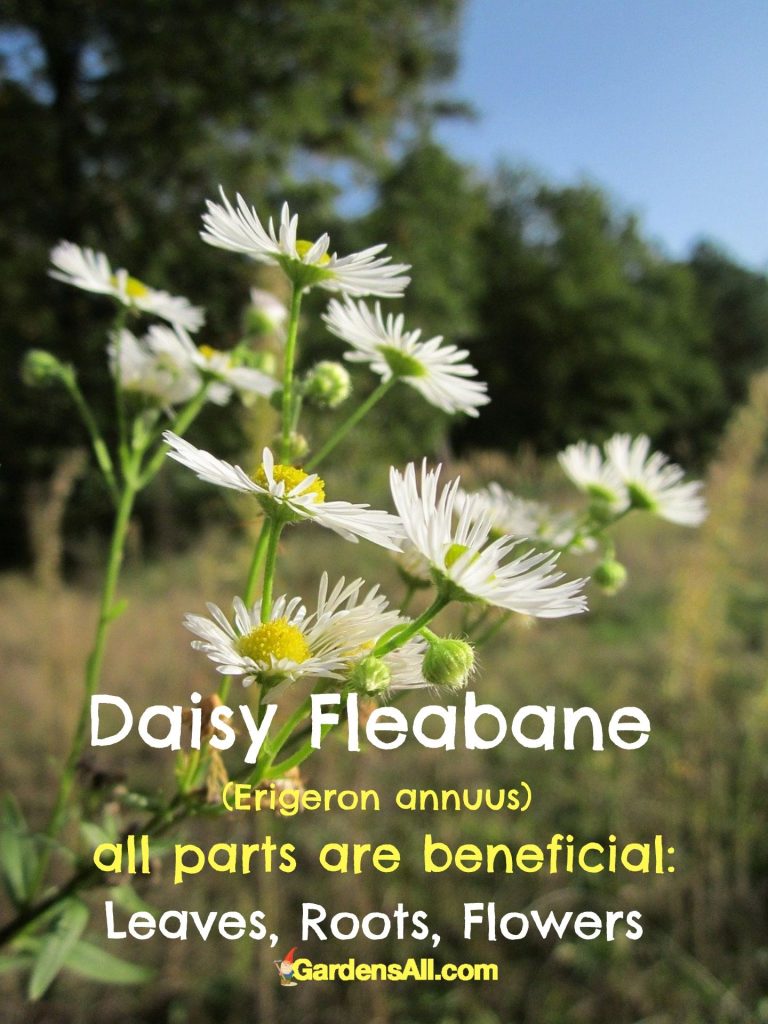
Eastern or annual daisy fleabane – (Erigeron annuus), is an early spring wildflower in North America. You’ll see daisy fleabane, in fields, roadside and drainage ditches. Fleabane grows best in full sun and alkaline clay soil, and can bloom spring through summer.
We see it on our walks on the roadside of our subdivision. It grows in tall stands of delightful clusters of low to medium tall stand of leggy stems with green leaves, and white flowers with yellow centers.
Fleabane especially enjoys growing in the lower, more moist sections of the drainage areas. However, in spite of the delicate appearing white flower, fleabane—like most weeds—is a sturdy and determined plant and can also tolerate dryer fields.
This year, where the white daisy fleabane were growing, we’re seeing pink and white flowers on the same plant!

A Note on Purple – “Wild Fleabane”
In some areas, daisy fleabane flowers are lavender or purple. These are called wild fleabane, Erigeron purpuratus.
Until this year, we’ve seen only the white flowers with yellow centers in our area of the northeast. But this year we had pink daisy fleabane, Erigeron philadelphicus, growing in the usual fleabane patches.

We’d love to see this in our fields, so we’ll be on the lookout for this lovely variety of fleabane, which should have the same benefits as the white fleabane, Erigeron annuus.

Is Daisy Fleabane (Erigeron annuus) Edible?
Yes! Fleabane leaves and flowers are edible and medicinal. While fleabane leaves are smooth, the stems can have a hairy texture that most people aren’t fond of in their foods, but which is reduced or eliminated in cooking.
Alternately, you can pluck the leaves and blossoms and omit the stems, or steam, sauté or cook them in soup as you would other cookable greens. To enjoy fleabane leaves raw, you can toss a few leaves into a salad with a blossom or two for garnish.
Is Fleabane a Beneficial Plant?
Yes! Daisy fleabane leaf extracts contain caffeic acid which is a stimulant and active compound that has protective and antioxidative benefits to cells. In addition, the flowers have been used in native healing traditions, while research has proven healing benefits of fleabane leaves and roots.[1]https://www.ncbi.nlm.nih.gov/pmc/articles/PMC6562390/[2]https://www.ncbi.nlm.nih.gov/pmc/articles/PMC3595701/

What Parts of Fleabane (Erigeron annuus) are Used?
- Leaves – Leaf water or extract is a beneficial antioxidant and improves obesity related diabetes[3]https://www.ncbi.nlm.nih.gov/pmc/articles/PMC6562390/
- Root – Extract of Erigeron annuus root is anti-inflammatory[4]https://www.ncbi.nlm.nih.gov/pmc/articles/PMC3595701/
- Flowers – Reduction of mucous
Daisy Fleabane, (Erigeron annuus) – all parts are beneficial: leaves, roots and flowers.
Is Daisy Fleabane Poisonous or Toxic?
Daisy fleabane can be mildly toxic to dogs and cats who consume parts of the plant. Fleabane can also cause skin rash[5]https://wagwalking.com/condition/fleabane-poisoning if sensitive skin comes in contact with the milky sap.
Humans with sensitive skin may also have skin reactions from contact with daisy fleabane. While not typically considered poisonous, if you or your pet has a strong reaction, seek medical assistance immediately.
Find more on plants poisonous to dogs here.
How is Fleabane Used
All parts of the fleabane plant are used, but the leaves and flowers are most active.[6]https://naturalpath.net/williamson/herb-of-the-day-eastern-daisy-fleabane/
Tea – Leaves, Roots and Flowers
Typically, only the flowers and leaves of fleabane (Erigeron annus), are used, however, you can also use the fleabane root for tea, either alone or with the flowers and/or leaves.[7]https://plants.usda.gov/DocumentLibrary/plantguide/pdf/cs_erph.pdf
Collect flow