

So you want to grow fruit trees that are not high maintenance? Smart! As with all species of plants, some require more maintenance than others. To help you in your quest, we’ve compiled this short list of the easiest fruit trees to grow.
How to Identify Easiest Fruit Trees to Grow
When it comes to food crops and especially fruit trees, the greatest threat to healthy trees and fruit harvests is disease and pests. Pests include birds, deer, racoon, and even bears! So the most important factors to consider when looking for easiest growing fruit trees, are pest and disease resistance.
Many varieties of fruit trees, once established, require little to almost no work from you again until harvest time. That means you can harvest dozens of pounds of food every year automatically without any additional planning or prepping.
Benefits in Planting Fruit Trees
- Food security – fruit trees are perennial plants that bear for many years, from 12 years to over 100 years.
- Investing in your future – buy and plant it once and with a little care, it will serve you for many years to come.
- Many uses for fruit – when the harvest rolls in, most people employ multiple methods for preserving their harvest:
- fresh
- frozen
- dehydrated
- freeze dried
- cooked
- canned
Investing in Your Future
Planting fruit trees is one of the smartest food investments you can make in your property. But surprisingly to newbies, they can be challenging to grow so we wanted to know: What are the easiest fruit trees to grow?
In this article we cover some basic types and varieties to set you on your journey of discovering the best for you and your needs.
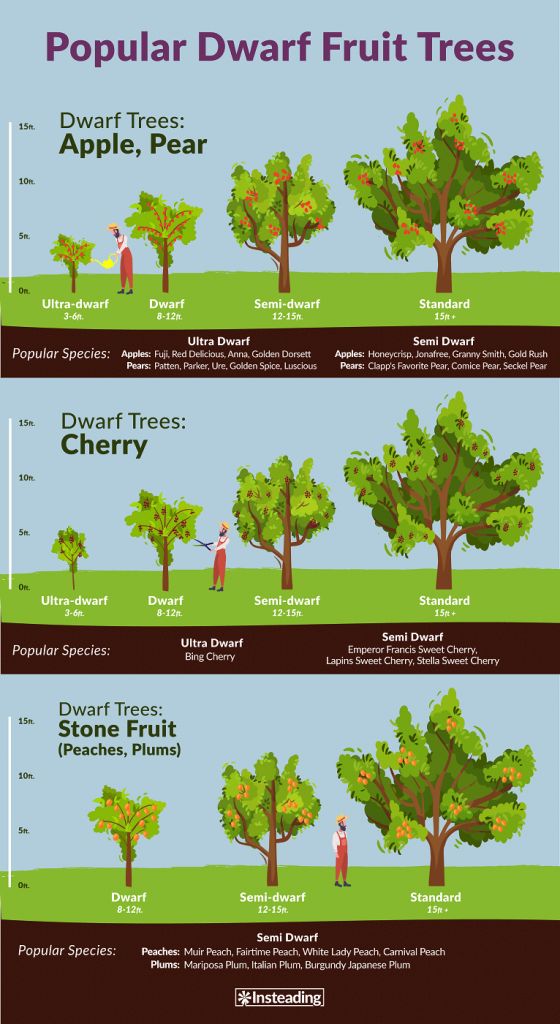
Image by insteading.com
Dwarf Fruit Trees Are the Easiest to Harvest
Keep in mind as you read this list that all fruit trees can be turned into dwarf or semi-dwarf varieties. All it takes is grafting your desired cultivar onto a healthy, appropriate rootstock. You can purchase your variety from a nursery as a dwarf or semi-dwarf, or you can do it yourself at home.
Semi-dwarf trees produce about fifty to seventy-five percent of the fruit of a full-sized tree, while a dwarf produces twenty-five to thirty-three percent of the fruit of a full-sized tree. The perk to dwarf and semi-dwarf trees is that it’s much easier to pick the fruit because the tree is smaller.
If you don’t like moving and climbing ladders, dwarf fruit trees can be an excellent alternative for you. Another reason why people choose these varieties is that they don’t obstruct any views or second-story windows of houses.
Dwarf fruit trees are essential for smaller yard gardens. Espalier fruit trees add beauty and functionality to your landscape and can be grown even in neighborhoods with strict homeowners association (HOA) rules.
Semi-dwarf trees produce 50-75% of the fruit of a full-sized tree.
Dwarf fruit trees produce 25-33% of the fruit of a full-sized tree.

EASIEST FRUIT TREES TO GROW
In the follow profiles, the age, size, life span and approximate fruit yield, where available, is an approximate average and can vary by tree, growing environment and climate conditions. So these are provided as guidelines rather than absolutes.
Where pounds of fruit produced is provided, it’s generally estimated as a range to include dwarf, semi-dwarf and full size, unless a specific sized tree is specified.
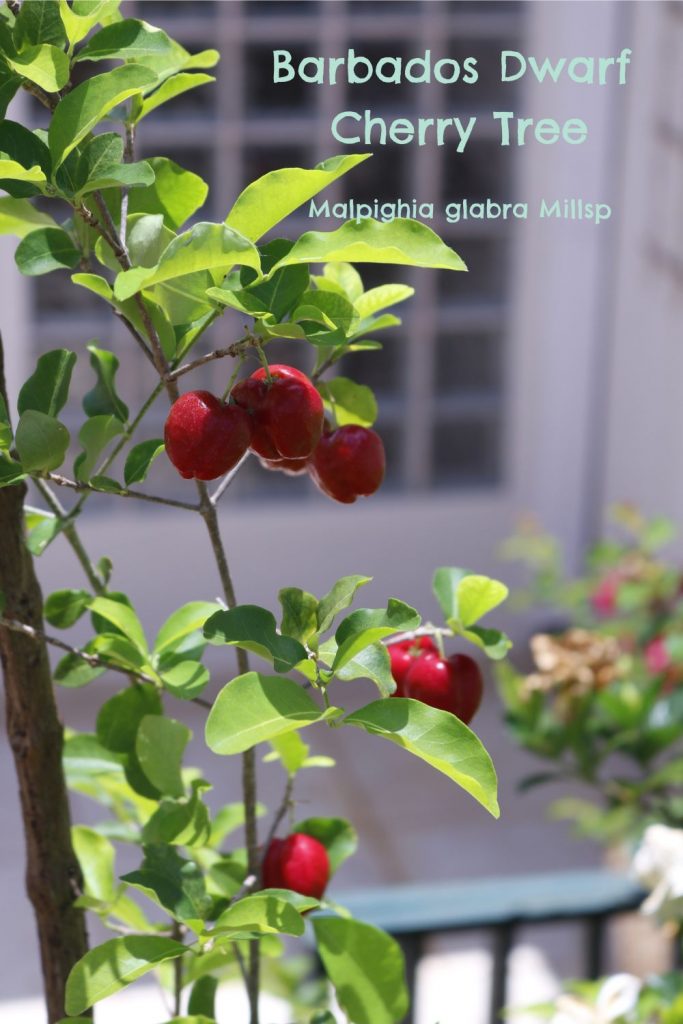
Barbados Cherry Tree, USDA Hardiness Zones 9b – 11
Can Grow Indoors in Pots in Winter
- Scientific Name: Malpighia glabra Millsp
- Years to First Fruit: 3
- Fruit-Bearing Years: 40 years
- Size at Maturity: 12 feet tall by 12 feet spread
- Pests & Disease: nematodes, plant bugs (attack & deform fruit), whiteflies, scale[1]https://edis.ifas.ufl.edu/pdf/FP/FP39000.pdf
As you may have guessed based on the name, the Barbados cherry is a tropical cherry tree that needs almost no attention from the gardener to thrive.
This tree was created to produce cherries that could survive extreme heat, the tropics, or even the desert. Because the tree was created to survive so much, the cherries do taste a little different from traditional cherries. However, they are delicious and remind most people of a cherry fruit punch with a sweetly tangy flavor.
The fruit is a dark maroon red and very sweet. These cherries don’t have pits; they have seeds and about one to three per cherry at that. They’re soft, though and can be eaten with the cherry without any issue.
This tree is said to be good for container gardening, so can be an indoor / outdoor cherry tree in non-tropical climates as it does not tolerate frost, especially as a sapling. It will produce cherries in a container and can be pruned to stay an appropriate size for indoor living.
Juliet Dwarf Cherry Tree, Cold Hardy in Zones 2 – 7
- Scientific Name: Prunus fruticosa x Prunus cerasus
- Years to Fruit: 4 years
- Fruit-Bearing Years: 30-40 years
- Size at Maturity: 6-8 feet tall and 5-6 feet spread
- Hardiness Zones: 2-7
- Pests & Disease: not prone to pests and disease
About Juliet Cherry Tree
This dwarf cherry tree is self-pollinating and produces sweet cherries that are cold hardy. The cherries can range from a deep, dark purple to bright, vibrant red.
This is the best cherry tree for cold climates, in my opinion, because the cherries are suitable for eating fresh, canning, freezing, or baking into a pie.
Since Juliet cherries are created by combining sweet cherries with sour cherries to make it cold hardy, there is a delightful tart undertone that adds a lot of flavor and interest to the fruit. Don’t worry though, it is still exceptionally sweet, and it’s hard for me to believe that it has a “sour” background.

Lambert Cherry Tree, USDA Hardiness Zones 4 – 8
- Scientific Name: Prunus avium
- Years to First Fruit: 2-3
- Fruit-Bearing Years: 30
- Pounds of Fruit: 50 lbs
- Size at Maturity: 25 feet tall by 25 feet spread
- Pests & Disease: resistant
This self-pollinating tree blooms late in the season and produces giant bright red cherries that taste sweetly crisp. They can be used for eating fresh, cooking, baking, or preserving in a can or the freezer. The Lambert cherry trees are pest resistant and do well in both partial and full sunshine.
They put up with long cold winters and lots of rain, clouds, and snow, and because of this, they are popular in the Pacific Northwest, especially around Flathead Lake in northwestern Montana. This is one of the most popular types of cherries found in grocery stores, as most of these cherries are transported around the country after harvest.
Lambert cherry trees produce as much as fifty pounds of cherries each year while in their prime.