
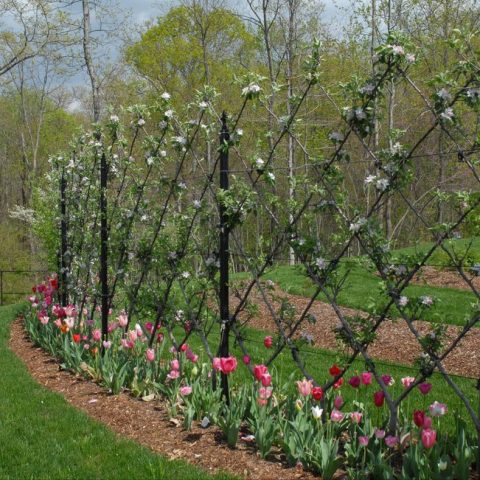
Small yard? Colder climate? Try espalier!
Many people would love to grow fruit trees, but for the space it takes. For others a warmer climate and higher grow zones might be needed. Even dwarf fruit trees can take up a lot of space in smaller yards. In such cases, espalier fruit trees may be the way to go.
When to Plant Fruit Trees
Fall and winter are the best times of year to plant fruit trees, which is perfect timing for gardeners. That’s the time of year when gardening, harvesting and preserving has slowed down or come to a stop, and that’s when we can start planting fruit trees. You can even go ahead and construct your espalier structures if you want to, or you can wait until spring, as it will be a few months or more before your new fruit trees are big enough to start training to for espalier.
What is Espalier?
The definition of espalier – as a noun:
- The art of growing a tree or plant on an object such as a wall, fence, stakes or other object.
- The object on which a plant is trained can also be an espalier
Espalier Definition – as a verb – espaliered, espaliering:
- Espalier is the practice or action of training a tree or plant to grow on another object
Other Terms for Espalier
- Trellis
- Cordon
Trellis and Cordon Trees
Cordoned trees is another form of espalier.
“Cordon fruit trees are simply trees grown as a single stem, with all the fruit swelling on short laterals immediately off this central stem.” GrowVeg.com
Trellised trees is the more familiar term in the US, but espalier also indicates the type of pruning for directed growth. You can trellis trees and plants to grow to a specific shape or in a specific direction, such as flat, or 2-dimensional, without also pruning them to produce grow and produce fruit differently as in espalier.
The origin of espalier isn’t certain, however, we know it’s been around for thousands of years. Ancient Egyptian hieroglyphic paintings portray espaliered fruit trees.

There are many reasons to espalier trees and plants, and no end to what kind of plants can be trellised and espaliered. For this article, we’re focusing on fruit trees.
Benefits of Espalier Fruit Trees
- MORE: Grow more fruit in less space, 30-60 lbs per season
- LONGER: Trains plants to produce more fruit earlier and for longer
- RESISTANT: Less susceptible to disease and pests, as air flow is improved and remedies more easily applied
- LONGEVITY: Helps trees to live longer due to less breakage and disease, up to as much as 150 years!!!
- MICROCLIMATE: Creates warm microclimate for growth with protection from weather, especially against a southern or western wall (brick or stone walls provide the most solar warmth benefit
- ATTRACTIVE: Creates artful designs and landscapes
- HARVESTING: espalier fruit trees are much easier to harvest:
- Harvest in one plane rather than a circling around a tree
- Espalier can be done without a ladder if trees are kept shorter
- If growing taller trees, it’s easier to place a ladder against the wall for picking
- The fruit framed against a wall is easier to see and pick
Mature espalier trees can average of 45 pounds of fruit per season. Now that’s a lot of great fruit for eating fresh, dehydrating, canning and preserving as jams, and freezing.[1]https://hort.extension.wisc.edu/articles/espalier/
Contributions From the Community
Someday you will be old. Espalier fruit trees from the beginning. No ladders or falls. Not as much twisting of your body for harvesting. Inspection of trees for bugs and diseases is much easier.
I’d also plant daffodils all along the base to repel deer, (see deer resistant flowers). The leaves & sap of daffodils contain raphides, which are needle-shaped calcium oxalate crystals that cut the tongues of critters. I’ve never seen any daffodils, blooms or leaves, eaten by any mammal. Include some Russian Comfrey Blocking #14 strain (clumper) along the base, too, to bring up soil nutrients from it’s deep tap root. IMPORTANT to use a clumping variety of Comfrey; other common types are invasive. Comfrey will die & self mulch in place during fall. Over a period of seasons, the soil around the trees will become loamy. During it’s green growing season, it shades the base of fruit trees, conserving ground moisture intended for the fruit trees. First, the daffodils will bloom then shrink, about the time the Comfrey starts to poke out from the ground. I’m old & disabled, but Permaculture Design Certified.
~Kelly S. Bracken, retired, permaculture design certified
Espalier trees typically produce more fruit per foot than ordinary fruit trees at an average 45 pounds per season.
SOURCE: Wisconsin Ext. Srvc.[2]https://hort.extension.wisc.edu/articles/espalier/

How Espalier Stimulates Growth
The ancient espalier technique was rediscovered by the early French and English when they found that slightly bent and horizontally trained fruit tree branches stimulated vigorous vertical growth of new spurs, which are stubby lateral branches that eventually flower and produce fruit.

Best Fruit Trees to Espalier
The best fruits for espalier are most varieties of apples and pears. However, you can also espalier fig, peach, cherries and pomegranate trees. You can also espalier plums, nectarines and apricots but they require a little more attention and pruning efforts.
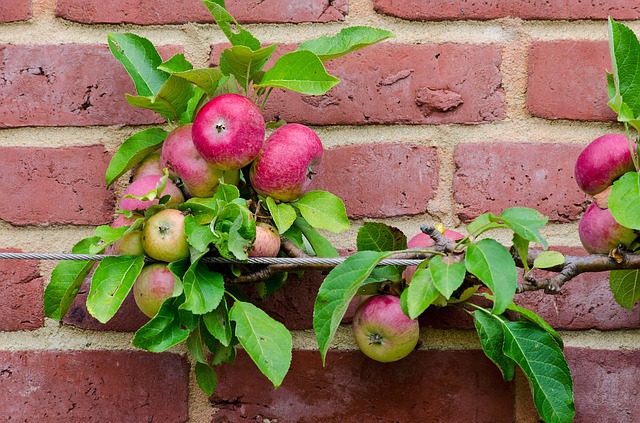
Apple Tree Espalier

Pear Tree Espalier

