
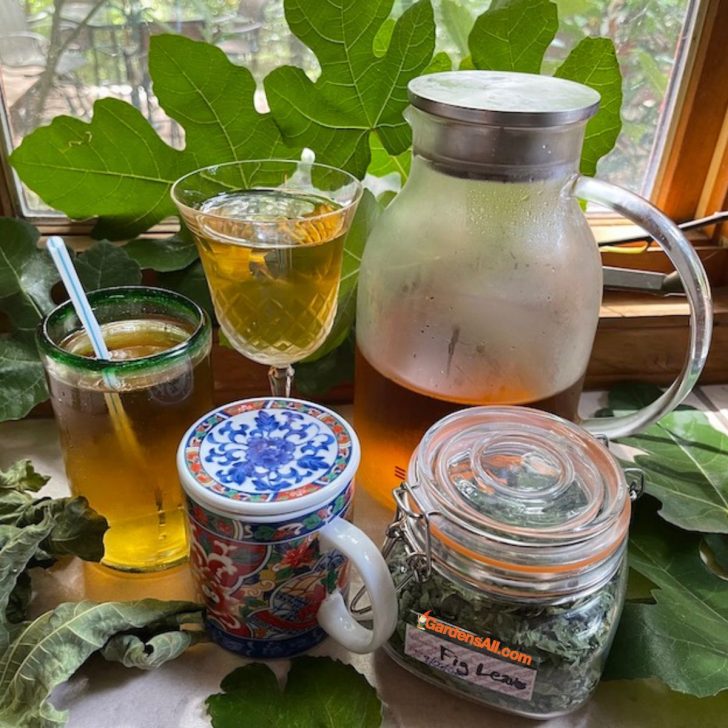
We love discovering the many edible and medicinal benefits of plants. You probably already know that figs are highly nutritious, but do you know about fig leaves tea health benefits?
Did you know that the fig bush — Ficus carica Linn (Moraceae) — is amongst the oldest living plants, and one of the first plants cultivated by humans? Chances are good that such ancient plants, like elders amongst us, have lots to offer!
Since we have a half dozen fig bushes, we were delighted to discover some of the many fig leaves tea health benefits.
We have one very old fig tree that doesn’t produce fruit because it’s under the shadow of a very large and majestic poplar tree. But it’s full of beautiful healthy green fig leaves, so you can be sure we’ll be harvesting all of those before leaf drop in fall.
If you’re not yet growing figs, you may decide to after reading this. Meanwhile, you can buy fig leaves tea to enjoy.

Fig Leaves Tea Health Benefits
Scientifically Proven Fig Leaf Tea Benefits
- Anti-diabetic[1]https://www.ncbi.nlm.nih.gov/pmc/articles/PMC6130661/
- Antibacterial – studies show fig leaf extract has antibacterial effect on E. faecalis a bacterial concern with root canals procedures.[2]https://www.ncbi.nlm.nih.gov/pmc/articles/PMC5891850/
- Anti-inflammatory[3]https://pubmed.ncbi.nlm.nih.gov/21644169/#:~:text=Abstract-,Ficus%20carica%20Linn.,piles%2C%20insect%20sting%20and%20bites.
- Anti-tumor[4]https://www.ncbi.nlm.nih.gov/pmc/articles/PMC6067789/
- Blood pressure – helps to stabilize blood pressure[5]https://www.herbalgram.org/resources/herbalegram/volumes/volume-14/number-8-august/food-as-medicine-fig/food-as-medicine-fig/
- Cancer –
- breast cancer chemoprevention[6]https://www.ncbi.nlm.nih.gov/pmc/articles/PMC6897490/
- colorectal cancer – Leaves and latex extracts of Ficus carica showed the strongest antiproliferative activities.[7]https://pubmed.ncbi.nlm.nih.gov/31472041/
- Cholesterol[8]https://www.herbalgram.org/resources/herbalegram/volumes/volume-14/number-8-august/food-as-medicine-fig/food-as-medicine-fig/
- Diabetes[9]https://pubmed.ncbi.nlm.nih.gov/9597370/[10]https://www.ncbi.nlm.nih.gov/pmc/articles/PMC6130661/
- Skin conditions[11]https://pubmed.ncbi.nlm.nih.gov/25593393/
- Warts – the milky latex sap in fig leaves and stems[12]https://www.ncbi.nlm.nih.gov/pmc/articles/PMC6897490/
Anecdotal Traditional Medicinal Uses of Fig Leaves
These are ethnic and regional uses for fig leaves that may not yet have supporting scientific studies:
- Anti-bronchial:
- cough
- Respiratory
- sore throat
- Antispasmodic
- Cardiovascular disorders
- Gastrointestinal
- Colic
- Diarrhea
- Indigestion
- Loss of appetite
- Weight loss
Ficus carica has emerged as a good source of traditional medicine for the treatment of various ailments such as anemia, cancer, diabetes, leprosy, liver diseases, paralysis, skin diseases, and ulcers. It is a promising candidate in pharmaceutical biology for the development/formulation of new drugs and future clinical uses.[13]https://pubmed.ncbi.nlm.nih.gov/25017517/
SOURCE: Traditional uses, phytochemistry and pharmacology of Ficus carica: a review
Fig Leaves Sap Warning
The milky white sap in the fig leaves and stems is a latex material used traditionally for the removal of warts. This means that it can also burn skin, and especially with prolonged exposure and/or in the sun.
So if you’re sensitive to the milky white latex, or otherwise have sensitive skin prone to contact dermatitis, avoid the sap of fig leaves which contain furocoumarins, which can irritate the skin. The main symptoms are burning sensation and pain, itchy erythema, and edema, which usually begin 24 hours after exposure.[14]https://www.ncbi.nlm.nih.gov/pmc/articles/PMC6340245/
Side Effects of Fig Leaves
Presuming you’ve no latex allergy, we’ve found very little indication of fig leaf side effects. There have been some scant indications that some people may have adverse reactions, however, we’ve found no research on this as yet.
The bottom line, all herbs are have potent compounds that can be overdone, and individuals can react very differently to the same herb, food or medicine. For instance, while most people enjoy the immunity boosting herbs like echinacea, others are allergic to it. Similarly, some experience tremendous benefits from turmeric and turmeric golden paste.
If you experience any adverse effects whatsoever, then cease consumption immediately and consult with your healthcare practitioner.
If you know of studies that elaborate on specific side effect, please let us know so that we may publish that here.
Fig Leaves Tea
How To Make Fig Leaf Tea
There’s no one way to make fig leaf tea. Here’s our favorite way:
Fig Leaf Tea Recipe
- 1 Tbsp. dried fig leaves (or 1.5 tsp. for milder tea)
- 10 oz. boiled water (8-12 oz, depending on the size of your mug)
- Sweetener of choice if desired.
For milder tea use less, or use more for stronger tea.
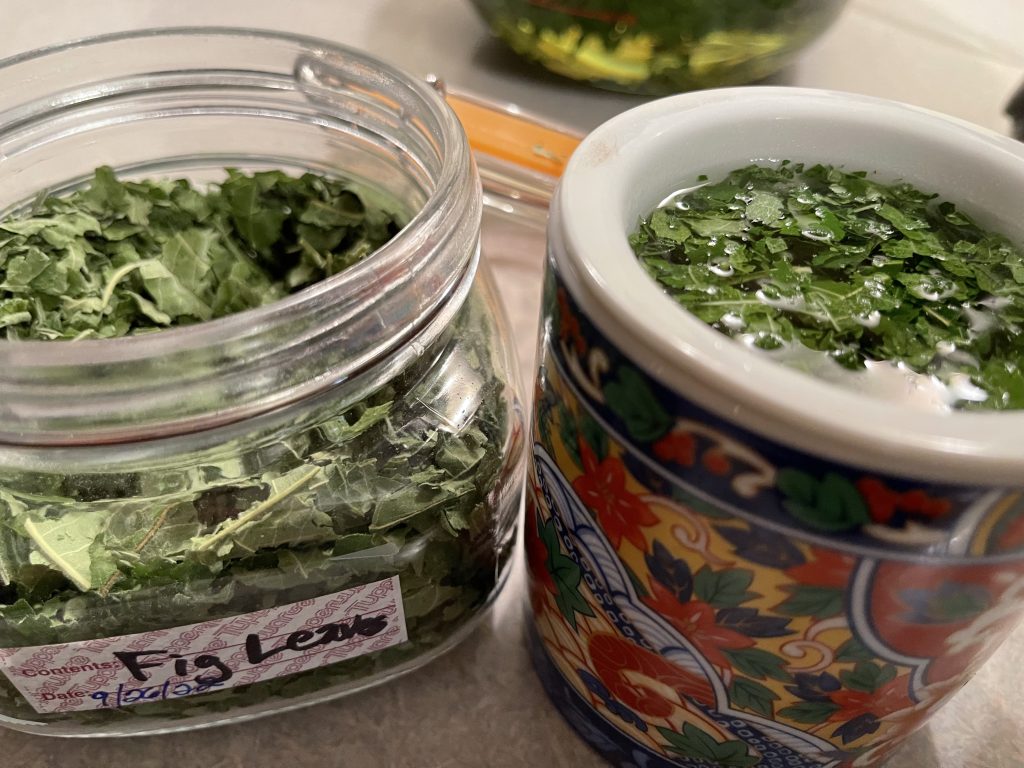
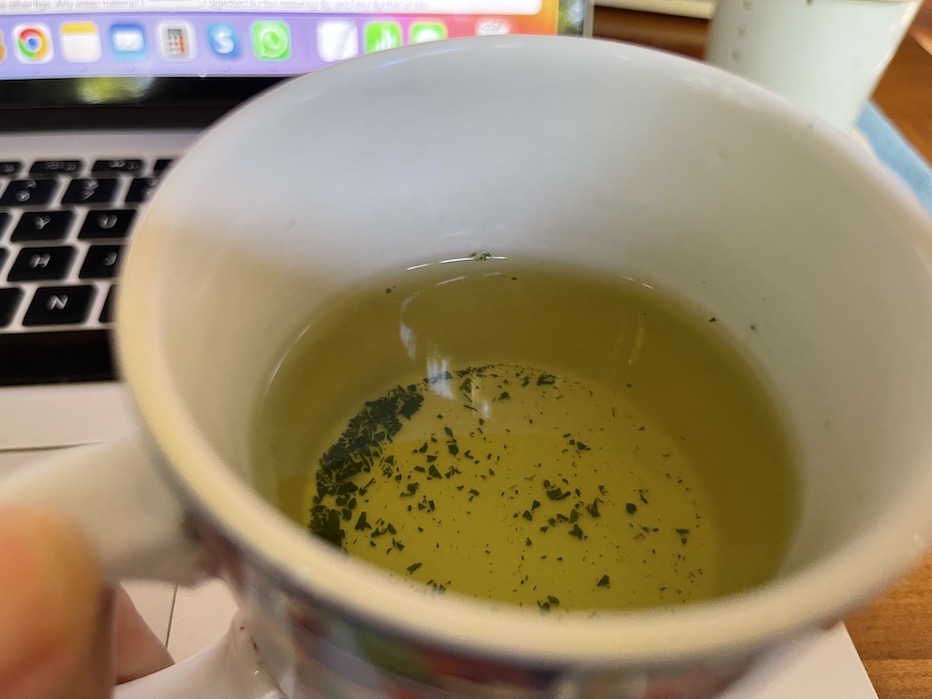
Pour boiling water over fig leaves and steep for 5-15 minutes. Strain liquid into mug and sip to enjoy. We like to use teacups with strainer and lids.


Medicinal Herbal Teas
We also like to make a pitcher of herbal tea blends, such as lemon balm, bee balm, avocado leaf tea, gynura tea and many other combinations, with or without stevia, honey or maple syrup for sweetener.
For a pitcher of fig leaf tea, here’s our basic recipe.
Pitcher of Cold Fig Leaves Tea
Recipe for 2 Quarts of Fig Leaves Tea
INGREDIENTS:
- 1 cup crushed dried fig leaves
- 4 cups boiling water
- 4 teaspoons stevia (optional, to taste, or other preferred sweetener)
- 4 cups cold water
INSTRUCTIONS:
- Bring 2 or more cups of water to boil
- Place crushed dried fig leaves tea into a 4 cup measuring cup
- Gently pour ~2-4 cups of boiling water over dried fig leaves; stir gently if needed so that all leaves are covered and steeping in water
- Steep for 10-20 minutes
- Strain tea into your pitcher (or if your pitcher’s opening is narrow, strain into a larger measuring cup, then pour into pitcher)
- Fill with cold water. Add to a glass of ice if drinking right away.
- Refrigerate up to a week.
NOTES:
Tweak quantities as desired if too weak, too strong, too sweet or not sweet enough.

Benefits of Figs – Roots to Fruits
Fig fruits are often used for the following benefits, (some of which may be anecdotal). However, fig plants are attributed as a remedy for more than forty different health conditions.
Partial List of Fig Tree Benefits
- Anemia
- Antimicrobial
- Cancer
- Cardiovascular
- Constipation
- Diarrhea
- Diabetes
- Digestive
- Eczema
- Endocrine system
- Hypoglycemic – blood sugar regulation
- Hypolipidemic – cholesterol lowering
- Immune function
- Infections –
- gastrointestinal
- urinary
- Inflammation
- Leprosy
- Liver
- Muscular
- Paralysis
- Reproductive
- Respiratory
- Skin diseases
- Ulcers
- Urinary
- Warts – milky sap
- Wildlife – 3x higher in calcium than any other fruit, figs are considered a keystone plant for fruit-eating wildlife[15]https://www.nature.com/articles/33580.pdf?origin=ppub
Ficus carica has emerged as a good source of traditional medicine for the treatment of various ailments. It is a promising candidate in pharmaceutical biology for the development/formulation of new drugs and future clinical uses.
SOURCE: PubMed study on Traditional uses, phytochemistry and pharmacology of Ficus carica[16]https://pubmed.ncbi.nlm.nih.gov/25017517/[17]https://www.ncbi.nlm.nih.gov/pmc/articles/PMC3789402/
You may also enjoy this article on how to grow figs.

I’m LeAura Alderson, a garden, herb and plant enthusiast with a passion for discovering the many edible and medicinal benefits of the plants all around us, including the weeds, while transforming the land through regenerative permaculture practice. I am also a writer, editor and media publisher (now mostly retired due to replacement by AI), but which now allows more time to build our regenerative permaculture homestead farm.
References