
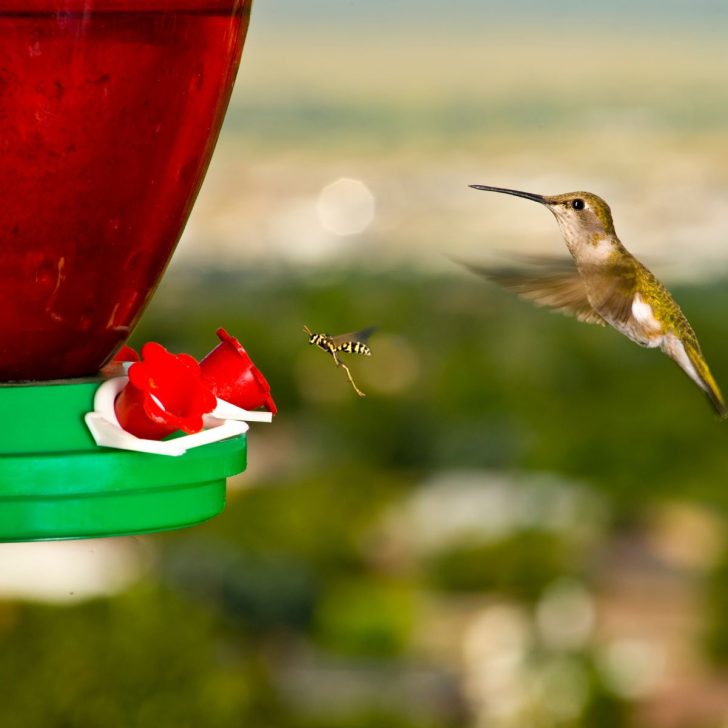
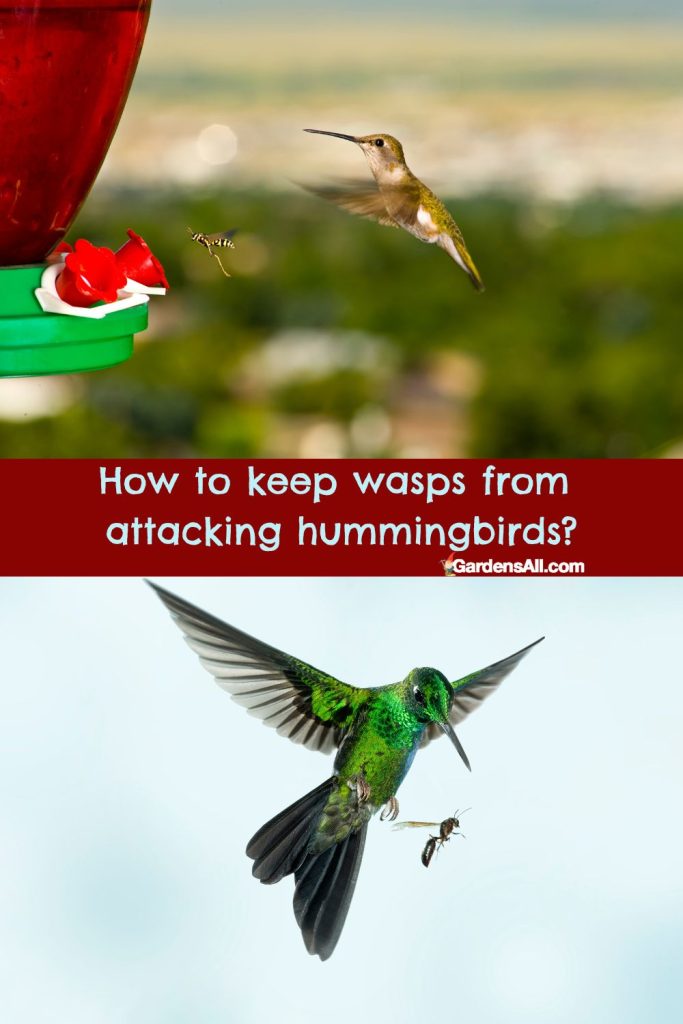
Wasps are naturally attracted to nectar. If you’re feeding hummingbirds, you may develop problems with wasps. So how do you keep wasps away from hummingbird feeders?
You don’t want them out their bothering hummers — or you — when you’re replacing the nectar! Coleman got stung on his ear this spring. It smarted like crazy and lasted for several days with swelling and pain, followed by itching.
However, there are several strategies you can try to keep wasps away.
How to Keep Wasps Away From Hummingbird Feeders
- Wasp-proof hummingbird feeders – Some feeders are designed to be wasp-proof or bee-proof. E.g.:
- BEE GUARDS: Many feeders now have nectar ports, AKA bee guards, that are too long and narrow for wasps to reach the nectar, but just the right size for hummingbirds.
- If the feeder/s you have didn’t come with it, you can buy hummingbird feeder accessories that will do the job.
- AVOID YELLOW: Wasps are attracted to the color yellow, and many hummingbird feeders have yellow nectar ports shaped like flowers. If you’re having wasp issues and your feeder has any yellow on it, you might want to consider getting a different one.
- BEE GUARDS: Many feeders now have nectar ports, AKA bee guards, that are too long and narrow for wasps to reach the nectar, but just the right size for hummingbirds.
- Move the feeder: Wasps are territorial and will return to the same location. If you move the feeder, it might take them a while to find it again.
- Keep it clean: A clean feeder is less likely to attract wasps. Wasps are attracted to the scent of fermented nectar, so clean your hummingbird feeder regularly; something essential for the health of hummingbirds anyway. See also, our article on reasons to avoid metal hummingbird feeders.
- Water barriers or moats: A water-filled moat can be an effective way to keep wasps away. Some feeders come with built-in moats, or you can buy one separately.
- Decrease sugar in the mixture: Wasps are more attracted to higher concentrations of sugar. You might be able to deter them by making your hummingbird food a bit less sweet. Try a 5:1 or 6:1 ratio of water to sugar instead of the typical 4:1.
- Peppermint Essential Oil: Spray peppermint essential oil over nests and decoys to deter wasps.
It may take a combination of these strategies, known as Integrative Pest Management (IPM) to effectively deter wasps from your hummingbird feeder.[1]https://www.epa.gov/safepestcontrol/integrated-pest-management-ipm-principles

Keeping Wasps From Attacking Hummingbirds
While wasps are generally more interested in the nectar in hummingbird feeders than the birds themselves, territorial disputes can sometimes occur. Here are some strategies to keep wasps from attacking hummingbirds:
- Provide Distraction Feeders: Set up additional feeders specifically for the wasps, placed at a distance from the hummingbird feeders. The wasp feeders can have a higher sugar concentration which wasps prefer. This can distract the wasps and keep them away from the hummingbirds.
- Use Decoys: Some people have success using decoy predators to scare away wasps. Items that look like a larger bird’s nest or a fake hornet’s nest can discourage wasps from coming too close.
- Promote Natural Predators: Encouraging the presence of wasp predators in your yard, like birds and spiders, can keep the wasp population under control. This, in turn, can help protect the hummingbirds.
See also: Birds that eat mosquitoes and bad garden bugs. - Safe Nesting Spaces: Providing safe spaces for hummingbirds to nest can help them avoid wasp attacks. Consider planting dense shrubs or installing nesting boxes where hummingbirds can find refuge.
- Professional Pest Control: If the wasp population in your yard becomes too large to handle on your own, you may need to consider professional pest control services. They can safely remove wasp nests and provide additional strategies for keeping the wasp population under control.
- Proper Timing: Refill and maintain your hummingbird feeders during times when wasps are less active, such as early morning or late evening. This will make the feeders more attractive to hummingbirds and less so to wasps.
- Plants Hummers Love: Plant more plants favored by hummingbirds instead of hanging feeders. You can hang some near windows and garden areas so that you can still enjoy seeing them, but on the flowers instead of the feeder.
And yes, you can use spray, but we try to avoid that if there’s another way.
The goal is not to harm the wasps, as they play a critical role in the ecosystem, including pollination and pest control. Instead, these steps are intended to deter them and reduce conflicts between wasps and hummingbirds.
We’d love to hear your tips and what worked for you. Here are some from the GardensAll community.
Contributions From the Community
First, CAUTION PLEASE:
“Gardens All please discourage folks from using foreign substances to deter insects from the feeder.
Sprays, oils, granular, of any kind need to be avoided as it is potentially harmful for hummingbirds and other birds. Thank you!” 🥰
~Wendy Gronemeyer
Editor’s Note: We have not had the time to research this, but it’s certainly something to be mindful of and confirm whether whatever remedy you plan to use is first safe for the wildlife you’re trying to attract.
Decoys
“Hang a few of these around too. It’s a paper bag filled with plastic bags. It’ll deter kinds of wasps and bees. It resembles a wasp nest. Bees don’t like competition so they’re likely to move on. It works great with IPM (integrated pest management).”
~Shannon Schofield, gardener, beekeeper, Shannon’s Sweet Tooth Farm, AL
“I’ve used a fake wasp/hornets nest this year, it has not only discouraged wasps, but I’ve also seen less carpenter bees. (Not a scientist, but I’m happy with this outcome).”
~Richard Hearlihy
“This works! A couple weeks ago a wasp was busily starting a nest over my front door. I hung 2 brown paper balls near it. He got very slow and within a couple hours flew away. I knocked down the small nest and he never came back. I left 1 ball tacked to the wall.“
~Cindy Hemm
It’s great to know that that the decoy approach seems to be working for Shannon and for Richard! And yes, as Richard says, we’re not scientist either. Rather, we’re armchair scientist/researchers, and also gardeners. But there’s lots to be said for “boots on the ground” running experiments “in the field”! And hey… if you try something that’s getting results for you, then it works! 🤔👨🏻🌾🤓
Homemade vs. Bought Decoys
“I bought some of those fake nest on amazon, had paper wasp build a nest in one. Guess I have smart wasp.”
~Shelley Taber
Sounds like the wasps liked the free fancy house, LOL!
We replied to Shelley that she might try the wadded up paper bag filled with plastic bags that’s been mentioned here by several folks as being effective. It may not be at attractive as a store bought decoy, but perhaps more effective.
There’s lots to be said for “boots on the ground” running experiments “in the field”! And hey… if you try something that’s getting results for you, then it works! 🤔👨🏻🌾🤓
Essential Oils
“Also try spraying peppermint oil where wasps like to build their nests. Many critters don’t like it.”
~Shannon Schofield, gardener, beekeeper, Shannon’s Sweet Tooth Farm, AL
Extra Plants
“I just keep plants around that hummingbirds like. You might get a few wasps or bees but they move from flower to flower and don’t congregate.“
~Jennifer Burchill, TX
Saucer Hummingbird Feeders
For ants use the moats. For wasps and bees use a feeder they simply can’t access. The all red saucer feeder where the nectar sits below the ports is ideal for this scenario. Thank you! 
~Wendy Gronemeyer
You may also be interested in this popular article on hummingbird moths. Since you love hummers, you’ll probably love these too!
Wishing you and your hummers well!

I’m LeAura Alderson, a garden, herb and plant enthusiast with a passion for discovering the many edible and medicinal benefits of the plants all around us, including the weeds! I’m a writer, editor and media publisher for our family of websites.
While I was certified in fitness and life coaching, I am NOT a health practitioner. However, I’m a lifelong health enthusiast, with a keen interest in healthy, organic foods and making home remedies and the content we share is from our own experience and usage as well as that extracted from scientific research so that you can explore further on your own.
Always seek the advice and guidance of your health practitioners first and foremost.
As a family we’re steadily expanding our gardening, experimentation and knowledge around all things gardening, edible landscaping, fresh organic foods and self sustainability with farming in our future. I also own and manage iCreateDaily.com, a site all about transformation through creation, and the power of positivity, optimism and mindset.
References