
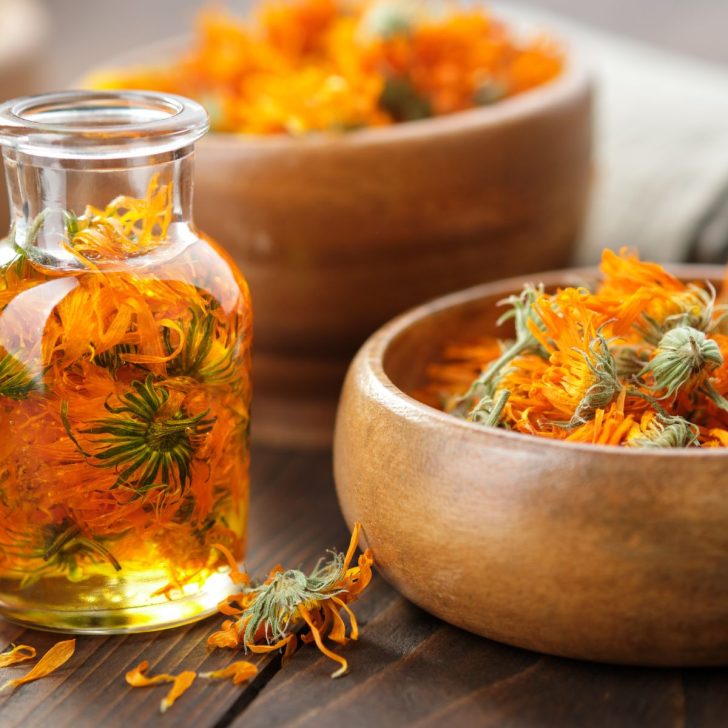
If you’re wondering how to make calendula oil, as with many things, there’s more than one right way. So in this article we’re going to share some of the most popular methods. The good news is that — as with most herbal oils — they’re all easy and so worthwhile!
Calendula, also known as pot marigold, is a flowering herb featuring vibrantly beautiful orange or yellow flowers. Not only is this herb aesthetically pleasing, but it also boasts numerous health benefits, particularly for skin health.
The most common way to harness calendula benefits for many uses is by creating calendula oil. This oil is straightforward to prepare at home, and you can use either fresh or dried calendula blossoms and leaves.
In this comprehensive guide, we will discuss various methods to make calendula oil, explore the nuances of processing the flowers, and touch on the differences between using fresh and dried flowers.
How to Make Calendula Oil Using Traditional Preparation Methods
Cold Infusion Method
- Processing:
- FRESH – For fresh calendula flowers and leaves, pick them in the morning after the dew has dried but before high sun, then rinse and dry. Use a sharp knife or scissors to avoid damaging the plant. The flowers can be used whole, or gently torn to expose more surface area.
- DRIED – For dried calendula blossoms and leaves, simply measure out the amount you need.
- Fill a clean, dry glass jar about halfway with the calendula flowers and leaves.
- Pour a carrier oil (like olive oil, almond oil, or grapeseed oil) over the flowers and leaves until they are completely submerged, with about an inch of oil above the plant material.
- Close the jar tightly and shake it well.
- Store the jar in a cool, dark place for about 5 weeks, more or less.
- Shake the jar every few days to help the infusion process.
- Strain strain the oil through a cheesecloth or fine-mesh strainer after the infusion and store the oil in a clean, dark glass bottle. The oil is now ready for use.

Hot Infusion Method
- Processing: Fill a glass jar about halfway with calendula flowers and leaves, either clean fresh or dried calendula. The processing method for the plant material remains the same as in the cold infusion method above.
- Pour your carrier oil over the flowers and leaves until they’re completely submerged.
- Place a towel at the bottom of a slow cooker, crockpot, or a saucepan. Put your jar on the towel and fill the pot with water up to halfway of the jar’s height.
- Warm if using a slow cooker or crockpot, set it to the lowest setting and let it warm for about 4-8 hours. If using a saucepan, keep it on the lowest possible heat and ensure the water doesn’t boil.
- Cool allow the oil to cool after warming, then strain it through a cheesecloth or fine-mesh strainer, and store the oil in a clean, dark glass bottle.
Fastest Methods for Calendula Oil Infusion
Double Boiler Method
- Processing:
- FRESH: Pick flowers and plants after the dew has dried. Wash them gently under cool, running water to remove any dirt or insects, or soak in a large bowl or pot of cool water. Dry thoroughly, then gently tear off petals cut them with a sharp knife or garden scissors to expose more surface area for the release of beneficial oils.
- DRIED: For dried calendula, measure out the necessary quantity.
- Combine your calendula and carrier oil (such as olive oil, almond oil, or grapeseed oil) in the top section of the double boiler. There should be enough oil to cover the plant material, with about an inch of oil above.
- Heat the double boiler over low to medium heat, ensuring that the water in the bottom section doesn’t boil. Let the mixture infuse for about 30 minutes to 2 hours.
- Strain the oil through a cheesecloth or fine mesh strainer into a clean glass jar for storage after it cools down.
Herbal Infusion Machine Method
An herbal infusion machine is on my wishlist for it abbreviates the making of herbal oils.
- Processing: Prepare your calendula flowers and leaves, either fresh or dried, as detailed above.
- Place the calendula and your choice of carrier oil into the herbal infusion machine.
- Set the machine according to the manufacturer’s instructions for oil infusions. Most machines will complete the process in about 1 to 2 hours.
- Strain the oil through a cheesecloth or the machine’s built-in strainer (if available) into a clean glass jar for storage after it cools down.
Hot Infusion Method – The Fastest Way to Make Calendula Oil
- Processing: First, prepare your calendula flowers and leaves. If you’re using fresh material, pick them in the morning after the dew has dried and gently tear them to expose more surface area. If you’re using dried calendula, simply measure out the amount you need.
- Fill a clean, dry glass jar about halfway with the calendula flowers and leaves.
- Pour a carrier oil (such as olive oil, almond oil, or grapeseed oil) over the calendula until it’s completely covered, leaving about an inch of oil above the flowers and leaves.
- Place the jar in a small saucepan and add water to the pan until it reaches about halfway up the jar.
- Simmer over low heat for about 30 minutes, making sure the water in the saucepan does not come to a boil. The heat will expedite the infusion process, but the water should be kept at a gentle simmer to prevent the oil from overheating.
- Monitor closely to ensure that the water doesn’t boil. You may need to add more water if it evaporates too much.
- Remove the jar from the saucepan and allow it to cool.
- Strain the oil through a cheesecloth or fine mesh strainer into a clean glass jar for storage.
- Use the oil as needed. Remember, this fast-track method might result in a less potent oil than the traditional methods, but it’s a good option when you need calendula oil quickly.
How to Make Calendula Oil Fast
The fastest way isn’t always the easiest way, and vice versa…the easiest way isn’t always the fastest.
The quickest way to make calendula oil is to use already dried calendula blossoms, then steep in warm oil. Some say to simmer dried blossoms in oil for 2-4 hours, and others some say for 12-24 hours.
If you have an herbal infusion machine, then this may also be the quickest and easiest way to make calendula oil (and other herbal infusions).
Can You Make Calendula Oil With Fresh Flowers?
While you can make calendula oil with fresh flowers, it’s not recommended. Calendula flowers are dense, which causes greater retention of moisture, which can cause herbal oils to develop mold.
So making calendula oil with fresh flowers works best if you use the heat infusion method and then strain and store your calendula oil in the refrigerator for a short time, such as a week or two before using. Alternately, you can lightly dry them before using.
Fresh flower calendula oil may be stored at room temperature, but you’d need to monitor it closely for signs of mold.
Dehydrate Your Calendula
Dried calendula is the safest option for making calendula oil. Check out our article on how to harvest Echinacea for more, as it will be the same process for calendula.
In Summary
Creating calendula oil at home is a simple and rewarding process, whether you choose the traditional cold or hot infusion methods, or one of the faster methods. The use of a double boiler or an herbal infusion machine can make the process even more efficient.
Both fresh and dried calendula blossoms, including their leaves, can be used, though each comes with its pros and cons. Either way, the resulting calendula oil will offer a nourishing and natural addition to your skincare routine.
We’d love to hear from you on what method you decide to use, how it works, and if you have any alternate approaches that work well, please let us know.

Remember to stroll through the many calendula benefits.

I’m LeAura Alderson, a garden, herb and plant enthusiast with a passion for discovering the many edible and medicinal benefits of the plants all around us, including the weeds, while transforming the land through regenerative permaculture practice. I am also a writer, editor and media publisher (now mostly retired due to replacement by AI), but which now allows more time to build our regenerative permaculture homestead farm.