
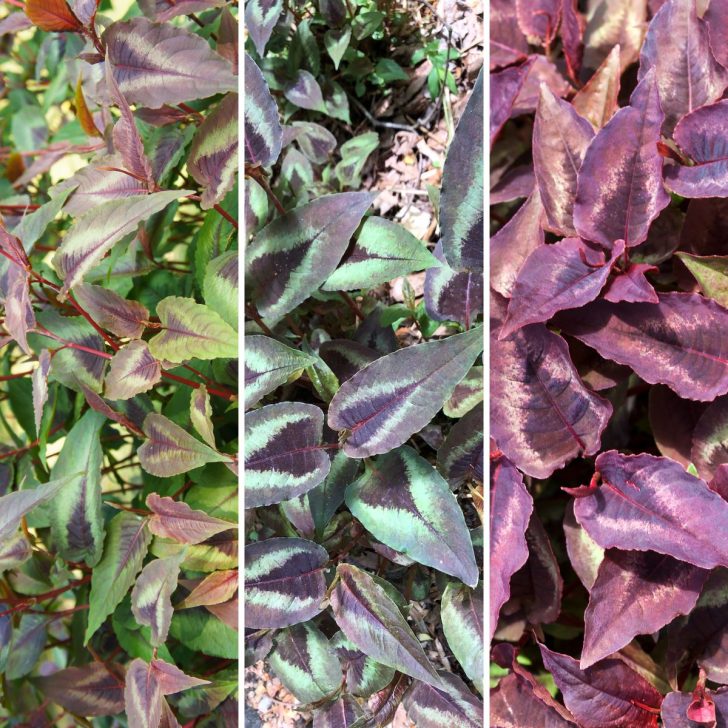
If you’re looking for a lovely backdrop, ground cover or cluster plant, the Persicaria ‘red dragon’ plant is lovely! Persicaria is a species of perennial plant that is prized for its striking dark green foliage with reddish-purple-blue-green coloration in chevron and heart shaped patterns. It has tiny white flowers that daintily decorate the intriguing leaves and attract pollinators.
In this article, we’ll take a closer look at the ‘red dragon’ Persicaria plant, including its scientific name, common names, description, growing information, advantages, and benefits.
Persicaria microcephala ‘Red Dragon’ Plant Description and Needs
- Size: 1-3 feet tall and 2-4 feet wide.
- Soil: Well-draining, moist soil.
- Sun: Full sun to partial shade.
- Water: Regular watering, but do not overwater.
- Zone: USDA hardiness zones 4-9.
- Propagation: through division in the spring or fall.
- Pest & Disease: Resistant to pests and diseases.
- Difficulty: Easy to grow and requires minimal maintenance.
If you like to scan full plant botanical family tree, you can find the full Persicaria ‘Red Dragon’ taxonomy near the end of this article.
Scientific and Common Names of Persicaria ‘Red Dragon’
- Scientific name: Persicaria microcephala ‘Red Dragon’
- Common names:
- Fleeceflower
- Red Dragon
- Knotweed
- Smartweed
Persicaria Red Dragon Plant Appearance
- Clump-forming perennial that typically grows to a height of 1-3 feet and a spread of 2-4 feet.
- Heart Shaped Leaves: It has an elongated heart-shaped leaves with matching heart-shaped color patterns that are:
- a deep red to purplish chevron shaped heart in the center
- followed by light white heart outline
- surrounded by dark blue-green
- with a burgundy chevron pattern in the center.
NOTE: Exact colorations vary in intensity and blend with some more subtle; others more pronounced.
- The plant produces small non-fragrant white flowers in the summer and fall that are held on long, upright stems. These add a delicate touch but are otherwise somewhat nondescript.

Benefits and Advantages
- COLOR: The Red Dragon Persicaria plant adds a pop of color to any yard and garden landscape with its striking foliage and bright red flowers.
- EASY: It’s an easy-to-grow plant that requires minimal maintenance.
- RESISTANT: Persicaria is resistant to pests and diseases.
- POLLINATORS: Red Dragon Persicaria plant is an excellent choice for pollinator gardens, as it attracts bees, butterflies, and other beneficial insects.
- ORNAMENTAL:
- backdrop: Its deep red foliage provides a dramatic backdrop for other plants in the garden.
- ground cover: Persicaria works well an ornamental a ground cover plant
A Non-Invasive Persicaria
In addition to the many benefits above, unlike some persicaria, the good news is that the Persicaria ‘red dragon’ is non-invasive. This plant is sterile, which means it cannot produce seeds and therefore will not spread uncontrollably like other members of the knotweed family.
Persicaria microcephala ‘Red Dragon’ Taxonomy
- Kingdom: Plantae (Plants)
- Clade: Tracheophytes (Vascular plants)
- Clade: Angiosperms (Flowering plants)
- Clade: Eudicots (True dicotyledons)
- Order: Caryophyllales (Carnations)
- Family: Polygonaceae (Knotweed family)
- Subfamily: Polygonoideae
- Tribe: Persicarieae
- Genus: Persicaria
- Species: Persicaria microcephala
- Cultivar: Persicaria microcephala ‘Red Dragon’
- Species: Persicaria microcephala
- Genus: Persicaria
- Tribe: Persicarieae
- Subfamily: Polygonoideae
In case you’re wondering:
What is a Plant Clade?
A clade is a grouping that includes a common ancestor and all the descendants (living and extinct) of that ancestor. Using a phylogeny, it is easy to tell if a group of lineages forms a clade. Imagine clipping a single branch off the phylogeny — all of the organisms on that pruned branch make up a clade.
REFERENCE: Evolution.Berkely.edu[1]https://evolution.berkeley.edu/teach-resources/clades-1-of-2-definition/
What is Phylogeny?
A phylogenetic tree, also known as a phylogeny, is a diagram that depicts the lines of evolutionary descent of different species, organisms, or genes from a common ancestor.
REFERENCE: Nature.com[2]https://www.nature.com/scitable/topicpage/reading-a-phylogenetic-tree-the-meaning-of-41956/
Conclusion
With its subtly exotic appearance and easy-to-grow nature, it’s no wonder this plant is a favorite among gardeners for accent landscape plants and ground covers.
If you’re looking for a low-maintenance, showy perennial that will add a pop of color to your garden, the ‘red dragon’ Persicaria plant is an excellent choice. With its striking foliage, sprinkling of delicate white flowers, and non-invasive nature, this plant is sure to be a favorite with novice and experienced gardeners alike.


I’m LeAura Alderson, a garden, herb and plant enthusiast with a passion for discovering the many edible and medicinal benefits of the plants all around us, including the weeds, while transforming the land through regenerative permaculture practice. I am also a writer, editor and media publisher (now mostly retired due to replacement by AI), but which now allows more time to build our regenerative permaculture homestead farm.
References