
How Long Do Seeds Last?
If you have old seeds on hand, you’re probably wondering how long do seeds last and if you can plant old seeds and still have them grow. Chances are that you can, and germinating and planting old seeds can save you time and money.
So yes! You can plant old seeds and often, they will germinate, even many years later. In this short article we’ll share general timelines and also, more importantly, how to test seeds for viability.
Tempted to Order New Seeds
Yeah… I know. When the new Garden Seed catalogues arrive and everything is so darned alluring, it’s hard not to order a whole new batch of everything!! I had to restrain myself and take a step back to reflect… having already ordered seeds in the past, only to discover that I had leftovers from a season (or two) before! 😜
We get it. It’s a lot more tempting to peruse glossy new seed catalogs with glamorous photos than to shuffle through old seed packets. It’s easy to order a fresh new package and get it in the mail and get to planting. Besides, seeds aren’t that expensive. But, seed costs can add up.
There’s always a roster of new and improved plants-to-be. The blurbs and illustrations invoke wondrous possibilities. Yet, what about those darlings from last year, or the year before? Don’t give up on or abandon planting your old seeds for the shiny new packets.
Just because they’re old doesn’t mean they’re not still good. Kind of like how I feel about aging. 👴🏼👨🏼🌾
Planting old seeds stored from successful garden plants can save you time, money and the grief of failed crops.
Advantages of Planting Old Seeds
There are many benefits to germinating and planting old seeds saved from previous growing seasons.
- You’ll probably remember if they were a good crop in previous seasons
- It saves a lot of time over hunting in catalogs
- Saves money by not buying new seeds
- Fewer seeds to store at season’s end that you end up not using again
- Gives the old seeds a chance to fulfill their destiny
- Conservation, preservation and frugality
How to Use Old Vegetable Seeds
You likely have seeds left over from last year, right? Now, if you thought to keep them stored in the dark in an airtight container placed in a cool location, that’s great! Those old seeds are waiting to fulfill their destiny and become next season’s groceries.
Properly stored, many seeds remain viable for years.
Baby food jars, mason jars, baggies, all do fine as containers.
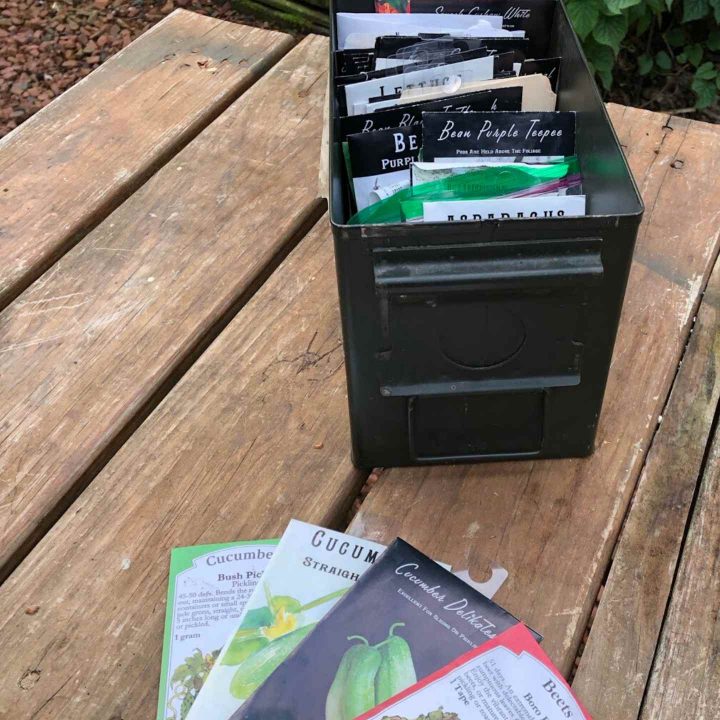
Our preferred system for mass storage and organization is a military surplus ammo box. It’s airtight and definitely stays dark. Plus, it’s quite easy to file seed packets in an orderly manner from Arugula to Zucchini.
Not sure if your leftover seeds will grow?
So Can You Plant Old Seeds?
Take This Seed Germination Test
How to determine the germination rate before planting old seeds?
Try sprouting ten or twenty seeds between moist paper towels and count the ones that germinate. Divide the count by the number of seeds you’re trying to sprout and . . .voila! You have the percentage odds of what will grow (or not).
Here’s a handy chart from Virginia Tech Extension Service that lists the average viability for common vegetable seeds. Use this chart as a guide and then test the leftover seeds prior to planting time to ascertain their value. Then, plant more or less accordingly.
Seed Viability Chart
Now of course there’s no natural (or manmade) law that says that seeds are no longer viable at any exact year mark. However, this is the common wisdom out there on seed viability.
| Vegetable | Years | Vegetable or Fruit | Years |
|---|---|---|---|
| Asparagus | 3 | Kohlrabi | 3 |
| Bean | 3 | Leek | 2 |
| Beet | 4 | Lettuce | 6 |
| Broccoli | 3 | Muskmelon | 5 |
| Brussels sprouts | 4 | Mustard | 4 |
| Cabbage | 4 | New Zealand spinach | 3 |
| Carrot | 3 | Okra | 2 |
| Celeriac | 3 | Onion | 1 |
| Cauliflower | 4 | Parsley | 1 |
| Celery | 3 | Parsnip | 1 |
| Chard, Swiss | 4 | Pea | 3 |
| Chicory | 4 | Pepper | 2 |
| Chinese cabbage | 3 | Pumpkin | 4 |
| Collards | 5 | Radish | 5 |
| Corn, sweet | 2 | Rutabaga | 4 |
| Cucumber | 5 | Salsify | 1 |
| Eggplant | 4 | Spinach | 3 |
| Endive | 5 | Squash | 4 |
| Fennel | 4 | Tomato | 4 |
| Kale | 4 | Turnip | 4 |
| Watermelon | 4 years |
You’ll find more on seed gathering, storage and keeping here.
Also, one book we solidly recommend is the bible of seed saving: Seed to Seed by Suzanne Ashworth.
Seed Swapping is Popular
To paraphrase a familiar adage, one gardener’s leftovers could be another gardener’s bounty. Check out local seed swapping events where you can share your surplus with others. These aren’t just a free way to get new seeds, it’s also a great opportunity to connect with local growers and share stories and garden wisdom.
In North Carolina our local Agricultural Extension agencies will occasionally host such events. There are also other organizations and groups who promote seed swaps. Check with your local extension service, as they likely know the events in your locale. You can of course also check with local gardeners and search Facebook for seed swapping groups in your city.
Storing Seeds
If not in the original packaging, be sure to put seeds in a clearly labeled container with info on purchase date, name, and—if tested—the germination rate. We usually keep seeds in their original packets but also have blank seed packets as alternatives.
Vegetable seeds don’t cost a whole lot, so it’s understandable why we gardeners buy fresher, perhaps more reliable, seeds for the current year. But we also like the idea of recycling, and appreciate having saved seeds for planting over several seasons. Our gardens are a blend of both new seed and more vintage seed plantings.
Plus, there just something important in giving a seed a chance to become what it’s supposed to be. Kind of like us. We all want a chance to living and grow and give life our best.
There’s more on storing seeds here.
Germinating Old Seeds
Grow babies grow!
When we planted our old seeds using our indoor greenhouse stand, nearly every little seed planted germinated!
We start with a great growing medium (Black Gold Seedling Mix), flats on heating mats placed under lights in a small indoor greenhouse.
In the photos that follow, we’ve planted some new and some old seeds from last year’s seed supply and they’re all doing fine. While year old seeds aren’t really old seeds, you can do this with much older seeds as well. In fact, Michigan Gardener successfully germinated old seeds from 1930!!
Seeds Planted in December/January
- Mizuna salad green (in foreground)
- Cruciferous Kale – (back center)
- Bok Choy – (far right, leftover seeds from previous year)
TIP: When you thin out your sprouts, eat them! Those sprouts are spicy, tasty, nutrient dense microgreens!

Don’t give up on old seeds. Plant them. Many are waiting to fulfill their destiny and grow into something good.
~GardensAll.com
You can find a good list on garden seed companies here, and more about storing seeds for best results.
We’re keen to know your take on planting older seeds. Please, post your comments and photos on the GardensAll Facebook page or you can send it to us.

Wishing you great gardens and happy harvests!


G. Coleman Alderson is an entrepreneur, land manager, investor, gardener, and author of the novel, Mountain Whispers: Days Without Sun. Coleman holds an MS from Penn State where his thesis centered on horticulture, park planning, design, and maintenance. He’s a member of the Phi Kappa Phi Honor Society and a licensed building contractor for 27 years. “But nothing surpasses my 40 years of lessons from the field and garden. And in the garden, as in life, it’s always interesting because those lessons never end!” Coleman Alderson