
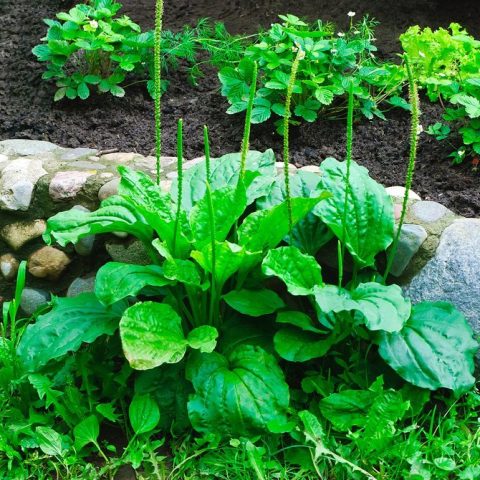
A Wild Medicinal Edible to Know and Grow
Don’t kill that weed! Plantago Major is an edible and medicinal plant and one of the best weeds for food and medicine.
Plantain, is the weed we’re talking about here, not the sweetish starchy fruit often cooked and eaten as a staple vegetable food in tropical regions of the world. That plantain is in the musa, or banana family.
What we’re talking about is the green low leafy plants known as common plantain, or “White Man’s Foot” by the Native American Indians. Chances are we’ve all trampled these plants in hikes or meadow walks and maybe even out in our yards. A common weed, plantain grows abundantly, all over the world, which is a good thing, because it is a plant with many uses.
We like plantain and are fortunate to have a lot of it growing wild in our yard and neighborhood. However, we also have dogs, so we’re actually growing some in our garden, where the dogs don’t tread.

Common Plantain, Plantago
- NAME: Plantago major
- GENUS: Plantago
- FAMILY: Plantaginaceae
Two Varieties of Plantain
- Broadleaf Plantain – (Plantago major), also known as White Man’s Footprint, because the Eurasians brought this plant to the “new world”.
- Narrowleaf Plantain – (Plantago lanceolata), also known as ribwort and buckthorn

Common Names for Plantago Major – Broadleaf Plantain
- Broadleaf plantain
- Buckhorn plantain
- Greater plantain
- Rippleseed plantain
- Waybread plantain
- White Man’s Footprint

Common Names for Plantago Lanceolata – Narrowleaf Plantain
- Buckhorn plantain
- English plantain
- Lanceleaf plantain
- Narrow-leaved plantain
- Ribgrass plantain
- Ribwort plantain

Plantago Uses Includes the Entire Plant
Edible and medicinal, this weed… herb… plant, can be eaten, steeped into tea and made into poultices and salves, using leaves, roots, seeds and flower spikes. In other words, the entire plant can be used.
Plantain is a good plant to have on hand and to know about, not only as a survival food, but also for an every day in-season contribution to salads and other foods.
If you’re going to plant plantain, we recommend the broadleaf plantain – the Plantago major, because there’s more vegetable matter in each leaf to put good use. However, Plantago lanceolata leaves are also wonderful plucked and eaten raw, added to salads, cooked like spinach, dried for tea and tinctures, or added to smoothies.

Uses and Benefits of Plantain – Plantago
There are many uses and benefits of the Plantago plantain. Plantain is a little bit like an aspirin: one plant (or one pill), many uses.
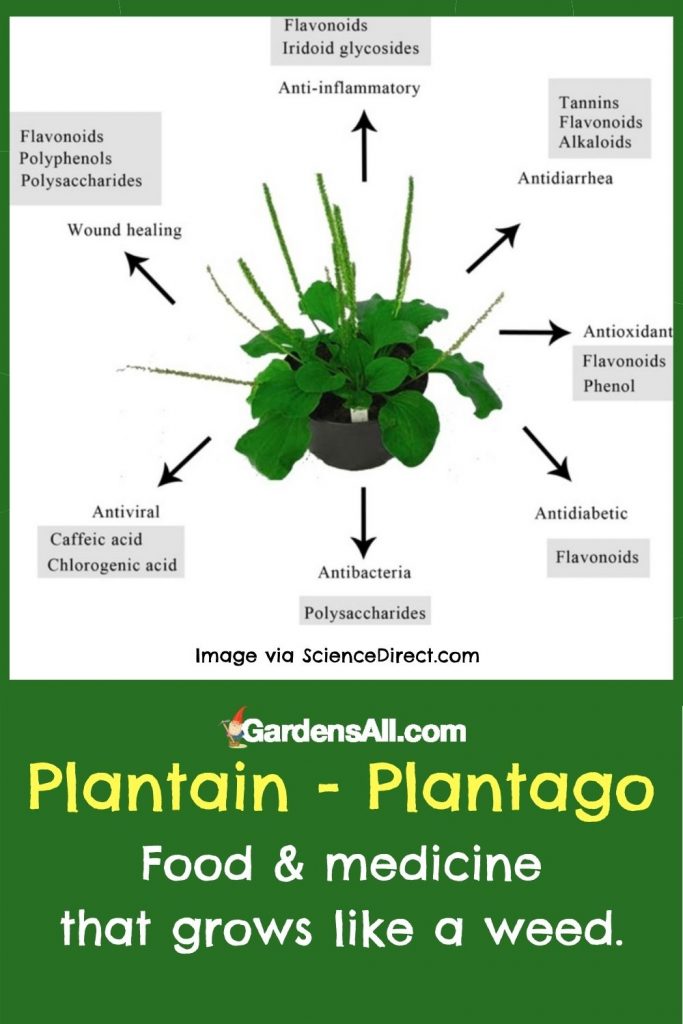
We have provided research links to many of the ailments that may benefit from Plantago major’s medicinal properties. Beyond that, it can be helpful to reference a list of plantain’s medicinal chemical compounds which we’ve listed below. Because again — as with aspirin or vitamins — one pill, can provide many benefits, so it’s the same for Plantago major’s medicinal compounds..
Plantain Poultices Uses
- Astringent qualities draws toxins from the body, including extractive for:
- acne
- splinters
- Bee stings
- Bug bites
Plantain Wash Uses
- Hemorrhoids
- Skin irritations
- Eczema
- Psoriasis
- Sunburn
- Diaper rash
- Acne
- Poison ivy/poison oak/sumac (this remedy using plantain and jewelweed is great)
Health Benefits of Plantain Include
- anti-inflammatory – Including liver damage inducing inflammation prevention[1]https://www.ncbi.nlm.nih.gov/pmc/articles/PMC4537734/[2]https://www.ncbi.nlm.nih.gov/pmc/articles/PMC2861812/
- antimicrobial –
- antihemorrhagic
- antioxidant[5]https://pubs.acs.org/doi/pdf/10.1021/jf401191q
- anti-toxic
- antiviral
- cooling
- coughs
- demulcent
- diuretic
- emollient
- expectorant actions
- GI issues
- lungs/respiratory
- vulnerary (heals wounds) – exhibits remarkable antioxidant and wound healing activities[6]https://jag.journalagent.com/tjps/pdfs/TJPS_13_2_1_16.pdf
Plantago Major Uses in Traditional Turkish Medicine
Medicinal properties of Plantago major have been collected from credible pharmacopoeias and textbooks of traditional Persian medicine (TPM) dating between the 10-18th centuries AD. The sources include “The Canon of Medicine, Vol. 2“, and electronic databases, such as Scopus, Medline and Web of Science were explored for this purpose.[7]https://www.elsevier.com/search-results?query=plantago%20major[8] … Continue reading
Plantain Nutrition
Plantain nutrients include:
- Vitamin A
- Vitamin C
- Vitamin K
- Calcium
Plantago Major’s Medicinal Chemical Compounds
- allantoin – wound healing and cell rejuvenation
- apigenin – anti-cancer, anti-inflammatory, antioxidant, antibacterial and antiviral activities and blood pressure reduction[9]https://www.ncbi.nlm.nih.gov/pmc/articles/PMC5629766/
- aucubin – powerful anti-toxin, antimicrobial, anti-inflammatory, promoting dermal healing[10]https://pubmed.ncbi.nlm.nih.gov/18210752/
- baicalein – anti-inflammatory, anti-cancer[11]https://pubmed.ncbi.nlm.nih.gov/?term=baicalein
- linoleic acid – reduces risk of cardiovascular disease[12]https://pubmed.ncbi.nlm.nih.gov/30971107/
- oleanolic acid – antimicrobial, hepatoprotective, anti-inflammatory, antiallergic, antiviral, antimicrobial, hepatoprotective, anti-tumor[13]https://www.tandfonline.com/doi/full/10.1080/14756360701633187
- sorbitol – diabetic approved sweetener beneficial for digestive health
- tannin – astringent, anti-diarrhea, antimicrobial, (over consumption of tannins can have detrimental effects)[14]https://pubmed.ncbi.nlm.nih.gov/9759559/#:~:text=Tannins%20have%20also%20been%20reported,are%20critical%20to%20these%20effects
Plantain is approved by the German equivalent of the FDA for internal use to ease coughs and mucous membrane irritation as well as topical use for skin inflammations.[15]https://www.prairielandherbs.com/plantain.htm
RESOURCES: Additional research resources beyond those footnoted.
- National Center for Biotechnology Information, NCBI published paper on Plantago research
- ScienceDirect.com
- RealFarmacy.com
Plantain is a medicine that grows like a weed.
The Best Time to Harvest Plantain
Plantain’s medicinal and nutritive components are at their peak in early fall. However, drying plantain loses much of the medicinal benefit. Currently the best use of plantain is fresh or freshly harvested. Unfortunately, drying plantain steadily loses concentrations of the bioactive compounds.[16]https://pubs.acs.org/doi/abs/10.1021/jf011490x
We figure that dried plantain is better than none, but it’s unfortunate since drying takes a lot of time and energy, so to lose a good portion of the plant benefits makes for diminishing returns. So make good use of the fresh plantain in season. You may also try freezing it, though frozen vegetables also lose a good portion of antioxidant benefits.[17]https://pubs.acs.org/doi/abs/10.1021/jf020936m
Still, better frozen than none at all. For fresh frozen herbs, we like to blend to juice or puree it then freeze in ice cube trays, which can later be added to smoothies, juice and water. We freeze cucumbers in this way as well.
Plantain was considered one of the nine sacred herbs of the ancient Saxons, and called the “mother of herbs” in Anglo-Saxon poetry.

Plantago – A Versatile “First Aid” Ointment
Plantain Salve Recipe
Makes about 2 cups
INGREDIENTS:
- 1 cup fresh plantain leaves, chopped
- 1 1/2 cups olive oil or melted coconut oil
- 1 tablespoon + 1 teaspoon grated beeswax, tightly packed
- 1/2 – 1 teaspoon of essential oil of choice, such as rosemary, tea tree, vitamin E oil, or lavender
NOTES:
Always gather herbs from areas not sprayed by chemical pesticides and not near roads or non-organic farms.
There are several methods for making salve. Heather of MommyPotamus.com shows two recipes, both using fresh plantain leaves, one is slower and involves steeping. The other is a “quick cook” method and involves warm-cooking in a slow cooker.
Or, for a plantain salve recipe using dried plantain leaves, you can find that by Stacy of ADelightfulHome.com.
We agree with Stacy: making your own medicinal salves is like canning your own food or fermenting your own sauerkraut or pickling your own cucumbers. There’s just that special rewardingly virtuous—and empowering—feeling that comes from being responsible for the growing, preserving and preparing of your own nourishment and well being.

Identification and Benefits of Narrow Leaf Plantain Video
Filmed in spring at the end of March in zone 7a at our Pilot Mountain Cabin property with herbalist, Elizabeth Morgan of DandelionSoap.com. Here she briefly touches wild lettuce and then moves on to show and explain plantain and how to use it.
Plantain for Reducing Cholesterol
Elizabeth says that plantain reduces cholesterol. To make plantain for oil, tincture, salve or tea, Elizabeth advises drying the leaves first, as they bruise easily and turn black.
NOTE about the video: Elizabeth struggles with dyslexia, so she mixed up the words in this video when she means “macerate” the leaves to use for bandages. Regardless of mixing up words, her knowledge and plant passion runs deep and she knows what she’s talking about and has been immersed in plant lore since she was a wee thing with her granny❣️👏🏼🌟
How to Make Plantain Infusion for Plantain Salve
Video by Tina Miller
Pretty cool, right?!
And here’s part 2 of Tina’s video on how to make plantain salve.
How to Make Plantain Salve – Part 2
Video by Tina Miller
We’re looking forward to harvesting and making plantain salve this summer, as well as tossing plantain leaves into salads and sandwiches.
Now remember, this cannot be construed as medical advice. We are sharing information, and it is up to you to test and verify what is safe for you and to seek appropriate health guidance. Meanwhile… we’re heading outside to look for some plantain!
Our other most favorite weed? Dandelion!
Now for a deeper dive into the super useful plantain, you might be interested in what to do with plantain seeds.
Uses and Benefits of Plantain Seeds
You can also use plantain seeds! The seed heads, picked green and tender, make great pickles. If picked brown and fully ripened the seeds are very mucilaginous and react like chia seeds.
The seeds soaked in water releases the mucilage properties as with flaxseed oil. It’s a natural oil that can be used to soften and moisten skin.
Any mucilaginous liquid from the soaked seeds can also be used as an egg substitute in cooking as well as an oil for cooking.
You’ll enjoy this informative video by Billy Joe Denny on how to extract the mucilaginous properties of plantain seeds.
If you enjoyed this, you’ll enjoy reading about more weeds you can eat here. You may also enjoy this article on wild violets benefits.
Stay healthy and keep on growing!

We are an online gardening publication sharing all things garden related! Including urban farming, family gardening, homesteading, gardening for profits, and more. We’re all about growth!
References