


Water jugs, water tanks, water bobs…
Water storage containers are essential for emergency preparedness and with the recent hurricane Zeta power loss, we definitely put ours to good use.
That and some super handy LED lanterns that we need to write more about soon. We especially favor the ones with a dimmer dial for adjustable brightness in order to conserve batteries when you just need a little bit of static light.
You do NOT want to ever run out of water. When you’re out of water, things go downhill quickly. A few years ago our well went out twice. It worked great for 25 years before the pump finally gave out. Then it went out a second time within the same year. It turns out that was an installer error.
Weeellll… that’s another story. If you have a well and want to read more about that, here’s our well story.
Whether you’re on a well or on city water, you need to be prepared for outages that leave you high and dry.
No Water Means No…
- Flushing the toilet
- Bathing
- Brushing teeth
- Coffee/tea
- Drinking water
- Washing dishes
- Washing clothes
- Cooking most things
- No good!!
Without water, things turn bad quickly. Remember Katrina? Major deep duty! So be prepared!! Keep stored drinking and potable water on hand. No, it’s not convenient to have water containers sitting around or in storage, but having water when you need it can be life or death at worse and a matter of convenience and cleanliness at best.
Here are the containers we’ve used so far that saved us when our wells went out, and when the power goes out in storms.
Water Storage Containers
100 Gallon Water Bob
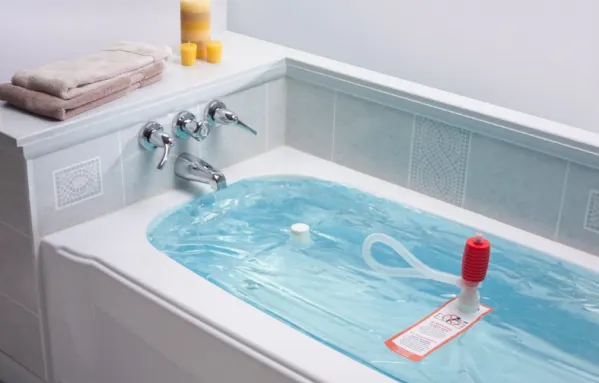
This is a simple yet ingenious idea! Our largest water container, the Water Bob, is more like a soft water storage tank with a surprisingly large 100 gallon capacity. We had it only about half filled the last time our water went out but that really helped.
We tend to keep it mostly full in an extra tub in the winter. But they are unwieldy and harder to manage than a stiff water container, however, they store so much smaller. There is the issue of needing to dry it out well before repackaging to store it so that it doesn’t get moldy. However so long as it’s mostly empty, if you recap it any residual water drops on the interior should be fine. At least it has been so far for us.
Water Bob Pros
- Stores small
- Holds large quantity of water at 100 lbs
- Relatively easy to use and pump
- You can refill smaller containers from the Water Bob
Water Bob Cons
- Can be unwieldy if not in a standard sized tub
- Takes time to empty and dry out when no longer needed
- You have to empty it to move it
- The pump isn’t as simple as a hard container, but it’s adequate
- 100 gallons is heavy so be sure your floor supports are strong.
CAUTION: If you get one of these, be sure your floor can handle that extra weight! No one needs those horror stories of a waterbed… or tub, collapsed through the floor! Brings to mind the comedy movie, Money Pit.
Water weighs 8.34 lbs per gallon, so 100 gallons weighs 834 lbs when full!!

55 Gallon Water Drums


If you have a basement for storing 55 gallon drums, these are definitely worth having on hand. Some of these food-grade drums come with pump kits, or you can purchase a siphon pump separately.
We have more on where to find free or cheap 55 gallon drums at the bottom in this article.
6 Gallon Water Jugs
We have two portable containers like the Jerry-can type 6 gallon jugs. Easy to handle and transport, these work really well. We plan to invest in a few more of these.
If you have a garden tub with a high faucet, they’re fit right under it for easy filling.

Water Bricks

When we build (or install) our greenhouse, we’re thinking to place wire shelving on top of “water bricks“. These are good stackable containers, especially the ones like those pictured here. These water storage containers have extra caps on all sides for easier access, as well as spigot caps. That way our shelving supports would also serve double duty as stored water.

These water bricks are 3.5 gallons per brick and easily stack and link together.
Hmmm… these would likely add some nice passive solar heating benefit as water storage “walls” in a greenhouse too! So if you have a greenhouse, that could be a great place to store large water bottles.
1 Gallon Water Jugs

We also keep a few gallon water jugs around that we use for watering plants, and these are clean and drinkable as well. You can save money by reusing one gallon water jugs, especially the translucent spring water bottles and milk jugs. Since this is 
Or if you want the safer plastic you can buy BPA free water jugs.
We’ve covered more on non-potable water storage barrels here.
Install a Well if You Can
If you have well water or are considering drilling a well for preparedness and back up. You may enjoy this article on lessons from our well installation and repairs.
Even if you’re on city water, if you have the land, adding a well for backup can be a very worthy investment for a number of reasons.
Benefits of Wells
- Well water is often far better than city water, and without the chemicals
- You can use it for watering the garden
- Well water is free after the price of the well, which saves on utility bills in the long run
- You always have water, as long as you have a working pump
- Solar well water pumps are available and worth it for preparedness if you can afford it
And yes… while we had to have our well pump repaired — twice within 18 months due to installer error — it worked fine for over 25 years without issue, so that’s 25 years of no water bill, that more than made up for the well repairs.
Water Bottles for Drinking Water

Of course these won’t last long before needing refilling, however, having full bottles on hand can really help in dire situations.

We try to keep our reusable water bottles filled and in the fridge, ideally two per person, (though not every family member heeds this advice. 🤦🏻♀️ But just that simple step of each person having their own drinking water for a day or two, helps a lot.
We’ve used the Camelbak Eddy, which has the straw, for years and still do. But we do a lot of biking and for that plus ease of cleaning, we’re using Zorri flip cap BPA free water bottle now. When you have straws to cleaning, it adds a step and you need a long thin brush to clean your straw and straw spout well, else bacteria can build up there.
If you go for the bottles with straws, you’ll need a bottle cleaning brush as well as a straw cleaning brush, or a kit that has both.
Bottled Water
You can store a case or two of bottled drinking water as well, however that’s a whole other murky topic. This extensive bottled water study reveals that all the bottled water that was tested contained varying degrees of contaminants.
We also searched for the healthiest bottled water and found an article that rates the healthiest bottled waters based on the pH level, the source and filtering system, as well as the kind of plastic used. What they did not seem to do is include actual analysis of water samples. We’re still searching through a lot of internet fluff to try to ge