

Look for Those Perky Purple Flowers and Heart Shaped Leaves
Many consider wild violets weeds, but we love them! These early spring plants with purple flowers and deep green heart-shaped leaves, deserve a second glance for the many wild violets benefits.
From food for pollinators and people, to a lush edible ground cover, you may decide to keep it instead of kill it if you spot some in your lawn.
You might at least want to get to know it a bit more for its uses as a source of food, nutrients and medicine.
Some of the wild violets benefits include medicinal and restorative tea, flowers that sweeten tea and desserts, and leaves that add fresh leafy greens that are rich in nutrients.
Wild Violets Names
The genus Viola (Violaceae) consists of approximately 500 species widely distributed throughout the world.[1]https://www.semanticscholar.org/paper/Ethnomedicinal-%2C-phytochemical-and-pharmacological-Muhammad-Saeed/c68b2fa7107866688fb3e54eeb9418ef842d7a3b
Scientific Names for Wild Violets
- Botanical Names:
- Viola odorata
- Viola papilionacea
- Viola sororia
- …and approximately 125 more species of Viola
- Family – Violaceae
- Genus – Viola
Some Wild Violet Common Names
- Bird’s-foot violet, (Viola pedata)
- Bog white violet, (Viola lanceolata)
- Canada violet, (Viola canadensis)
- Common blue violet, (Viola sororia)
- Common meadow violet, (Viola sororia)
- Downy yellow violet, (Viola pubescens)
- Hooded blue violet, (Viola sororia)
- Johnny jump-up, (Viola tricolor)
- Labrador violet, (Viola labradorica)
- Long-spurred violet, (Viola rostrata)
- Northern blue violet, (Viola sororia)
- Purple violet, (Viola sororia)
- Southern woodland violet, (Viola hirsutula)
- Stream violet, (Viola hirsutula)
- Sweet violet, (Viola odorata)
- Wild violet, (Viola sororia)
- Wood violet, (Viola odorata)
- Woolly blue violet, (Viola sororia)
According to the US Forestry Service, there are 125 recognized species of the genus Viola (Violaceae) native to the United States. Here are some of the most common wild violet species:
10 Most Common Wild Violets in the US
- Viola sororia (common blue violet, common meadow violet, hooded blue violet, and more)
- Viola odorata (sweet violet)
- Viola pubescens (downy yellow violet)
- Viola pedata (bird’s-foot violet)
- Viola tricolor (Johnny-jump-up or wild pansy)
- Viola canadensis (Canada violet)
- Viola labradorica (Labrador violet)
- Viola hirsutula (stream violet)
- Viola lanceolata (bog white violet)
- Viola rostrata (long-spurred violet)
REFERENCE: USDA Forestry Service[2]https://www.fs.usda.gov/wildflowers/plant-of-the-week/viola_nuttallii.shtml#:~:text=Violets%20are%20distinct%20enough%20to,genus%20Viola%20in%20North%20America.
What Do Wild Violets Look Like?
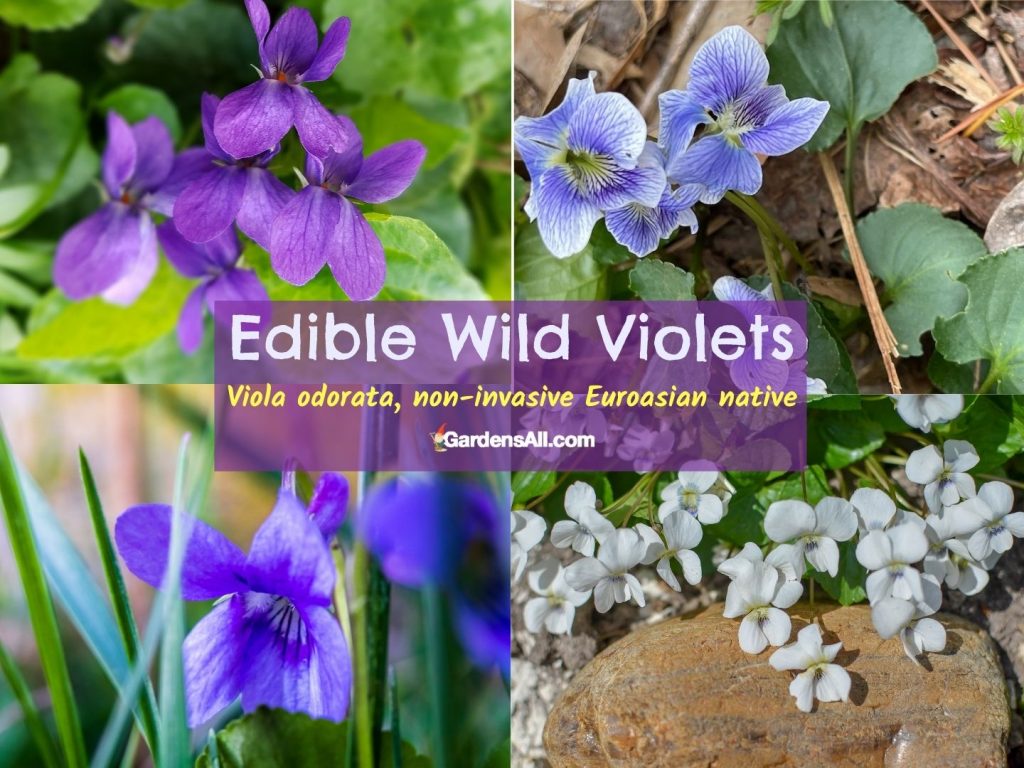
Wild Violets are earth-hugging edible ground cover plants with tiny orchid-like flowers with 5 petals. The wild violet flowers vary in color from deep purple to lavender to white, and in varying hues in that spectrum.
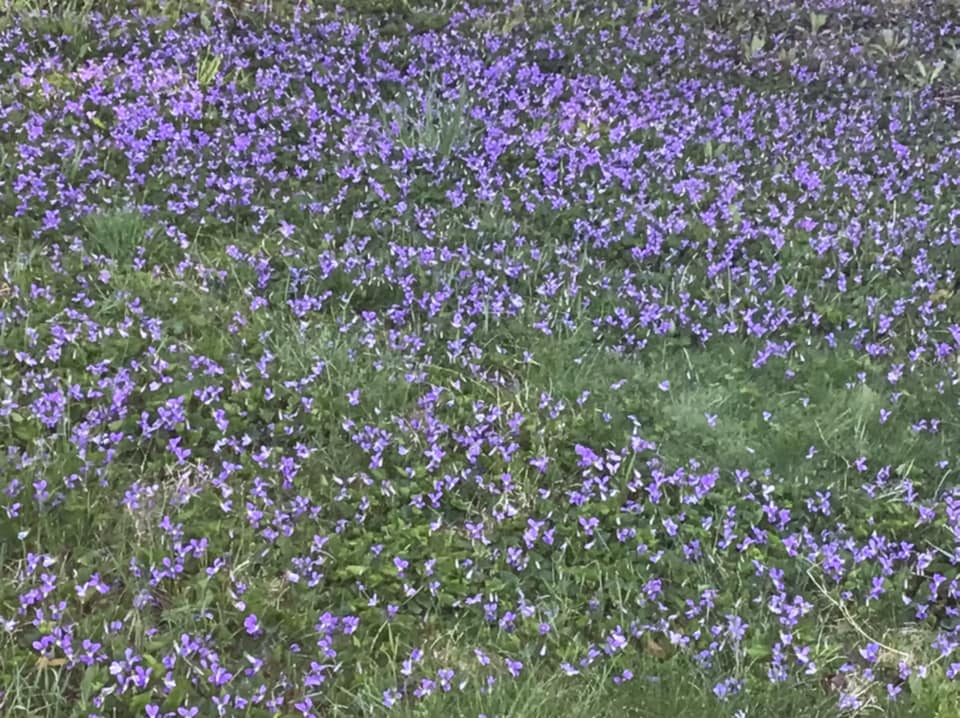
When Do Wild Violets Bloom
Wild violets are a low-growing perennial weed with purple flowers that blooms in spring and early summer, fast on the heels of dahlias and crocuses. Wild violets typically start blooming in March in the mid-range hardiness zone 7a. So adjust that to earlier or later for warmer or colder zones.
Whenever we harvest wild violets, (or any other wild plant), we’re careful to leave at least half for the wildlife and natural plant cycles.
Edible Wild Violets Benefits and Uses
- LEAVES – contain beneficial compounds for relaxation and skin
- Raw – Leaves great in salads
- Cooked – in soups, in recipes calling for greens like spinach or chard
- Dried or fresh for teas
- FLOWERS –
- candied
- raw in salads
- infused into vinegars and syrups
- dried of fresh for teas
- POLLINATORS –
- the fritillary butterflies are good pollinators,[3]https://www.fs.usda.gov/wildflowers/pollinators/pollinator-of-the-month/fritillary.shtml and must lay eggs on violets
- the mining bee Andrena violae, common to the Eastern U.S., only visits violets![4]https://www.discoverlife.org/20/q?search=Andrena+violae
“Like monarchs, whose caterpillars only feed on milkweed, the fourteen species of greater fritillary butterflies, (genus Speyeria) and sixteen lesser fritillaries (genus Bolloria) will only lay their eggs where there are violets for their larva to feed upon.”
SOURCE: Xerces.org[5]https://xerces.org/blog/plants-for-pollinators-violets
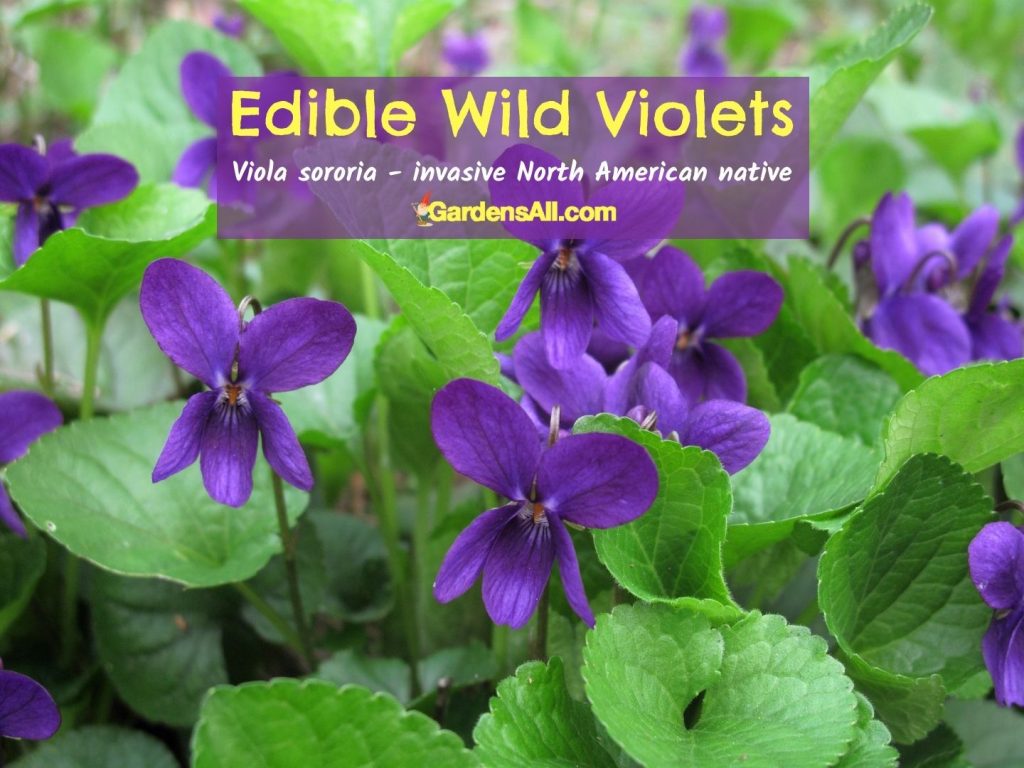
Violet blossoms are long favored for flavoring vinegars, oils and syrups, and especially candied for beautiful sweet treats that decorate cakes, cookies and confections.
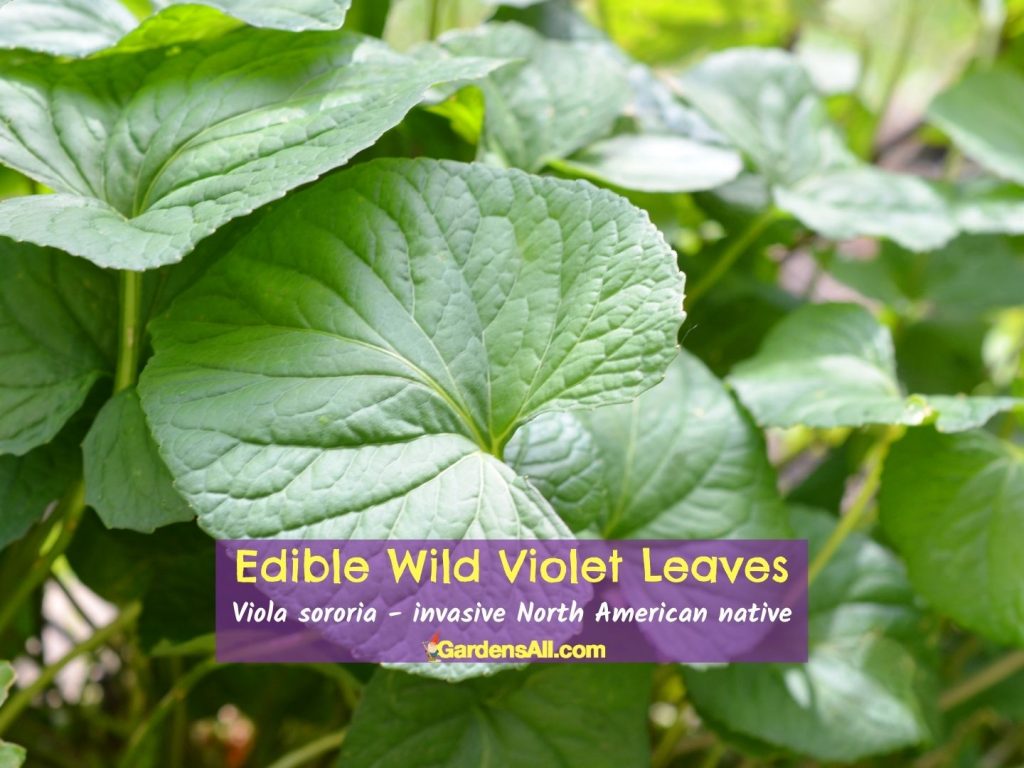
The fresh leaves and edible flowers are good in salads, and the leaves can be used raw or cooked as you would spinach or chard.
Our favorite ways to enjoy wild violets is fresh in salads and dried for wild violet tea.
6 Proven Wild Violets Benefits
Wild violet (Viola odorata) is a plant with a long history of use in traditional medicine. Here are some traditional wild violet benefits supported by scientific research.
- Analgesic for Pain relief: Wild violet has analgesic properties, which means it can help relieve pain. It has been used to alleviate headaches, menstrual cramps, and other types of pain.
- Antibacterial properties: Wild violet contains compounds that have antibacterial properties. These compounds can help fight off infections and boost the immune system.[6]https://wjpr.s3.ap-south-1.amazonaws.com/article_issue/1598854840.pdf
- Anti-inflammatory properties: Some species of wild violets, such as early blue violet (Viola adunca), contains compounds such as salicylic acid and rutin that have anti-inflammatory properties. These compounds can help reduce inflammation and alleviate symptoms of conditions such as arthritis and eczema.
- Digestive health: Wild violet has been used as a digestive aid to treat constipation, bloating, and indigestion. The plant contains mucilage, a substance that can soothe the digestive tract and help improve bowel movements.
- Insomnia: Wild Viola sororia taken as nasal drops (or spray) was found to reduce insomnia in all 50 chronic insomnia patients in 2014 study.[7]https://www.ncbi.nlm.nih.gov/pmc/articles/PMC4341349/
- Respiratory health: Wild violet has been used for centuries to treat respiratory ailments such as bronchitis and asthma. It contains compounds that can help clear the respiratory system and relieve coughs. The leaves and flowers can be made into a tea or syrup and consumed to help soothe respiratory symptoms.[8]https://pubmed.ncbi.nlm.nih.gov/30518183/
- Skin health: Wild violet contains compounds that can help improve skin health. It has been used to treat skin conditions such as acne, eczema, and psoriasis. The plant can also help reduce the appearance of fine lines and wrinkles.[9]https://www.ncbi.nlm.nih.gov/pmc/articles/PMC5378959/
Overall, wild violet has a range of health benefits that make it a valuable addition to traditional medicine. However, it is important to note that more research is needed to fully understand the extent of its therapeutic potential.
What Do Violets Look Like
What Our Ancestors Knew
We’ve written in another article about how historically, settlers set out for their new life with hardy plants like dandelions, plantain, violas and other edible weeds as survival food. They knew that these plants are determined to grow, no matter what, and they knew they had food value as well as potent nutrients and medicinal benefits.
What Happened to Our Roots?
The only reason most don’t consider these as food today is thanks to the industrial era. That’s when we we left the fields, farms and and home gardens for the city factories and grocers.
City grocers sold the foods that traveled well and kept well for the longest time. These were also the ones that were easiest for farmers to mass produce. Subsequently, the food supply chain removed the food choices common to country and woodland folks familiar with foraging.
A generation or so later and people no longer recognize wild plants as food. And yet humanity has been consuming and using wild plants as food and medicine far longer than we have the modern foods commonly found in the supermarkets.
How quickly things can turn around and lose touch with our roots and with nature. However, things can — and are — turning around again for another cycle, which is where we are now.
Today, more and more people are discovering the many edible and beneficial foods and medicines all around us. Which brings us full circle to the wonderful edible wild violets!
See also, our article on the other beneficial weeds with purple flowers.
If however, after all that, you still want to get rid of your violets… here’s an idea that might help.
How to Keep Wild Violets From Spreading
Our friend, Will Ferrell, who’s contributed articles (or to articles) for GardensAll, such as this one on Primula, and this one on Camellia sasanqua, had this to say about wild violets:
“Good to know that about the mining bee, (mentioned under pollinators above). Another reason the violets will stay in my lawn, though I do wish they wouldn’t seed so incontinently everywhere else too.“
~Will Ferrell, retired dentist and avid gardener
As for how to minimize the spreading habit of viola, you might try looking for the hidden seed-filled “flower” or fruit under the leaves before they burst open and reseed in fall. If you can remove those before they spill out, that should reduce the invasive quality of some viola plants.[10]https://awkwardbotany.com/tag/elaiosome/[11]https://sidewalknature.com/2021/11/09/violets-go-ballistic/
Contributions from the Community
Making Things With Wild Violet Flowers and Leaves
By Laura LaChance Stubbs
(Shared in our Planting for Retirement, Facebook group).
I pick and dry wild violet leaves and flowers in spring and summer and dry them for making potpourri, and salve for everything from lip balm, jelly, bug bites and hemorrhoids!
Mixed with some essential oils like eucalyptus, wild violets can help with coughs and colds used as a chest rub and inhalant. You can also make wild violet tea, which can also help with with insomnia.
CAUTION: Wild violets also works as a mild laxative for some, so with this as with any plant, herb or medicine, test a small amount to see your individual response. For teas, that could be a quarter to half cup or a partial strength infusion. For salves and topicals, that can be to test a small patch of skin to be sure there’s no allergic reaction before applying more.
Also, it’s not just the flowers. Some recipes call for infusing the leaves so be sure to collect both. I go out every day and pick wild violets flowers and leaves in my yard. It doesn’t take long to dry, so I’ll have a jar full of violet blossoms and leaves in a couple days. My goal is to collect enough to fill a quart mason jar of each, so I’ll have it when I’m ready to experiment with different things.
I’m doing the same thing with comfrey and calendula, which are good for making a pain balm that works on sore muscles, bug bites etc.
These are easy things to grow, collect, dry and save for later. Most of the recipes call for beeswax, olive oil, avocado oil, etc.
~Laura LaChance Stubbs, gardener, homesteader, Etsy seller, @ AbbysHouse2020 and lstubbs Candles by Laura
Wild Violet Identification
Here, in early spring in USDA hardiness zone 7a, Pilot Mt., NC., herbalist, Elizabeth Morgan of dandelionSoap.com, identifies and discusses mugwort (Artemisia vulgaris), and mugwort benefits.
Wild violet’s purple blossoms look like a sweet pea blossom, which family they share.
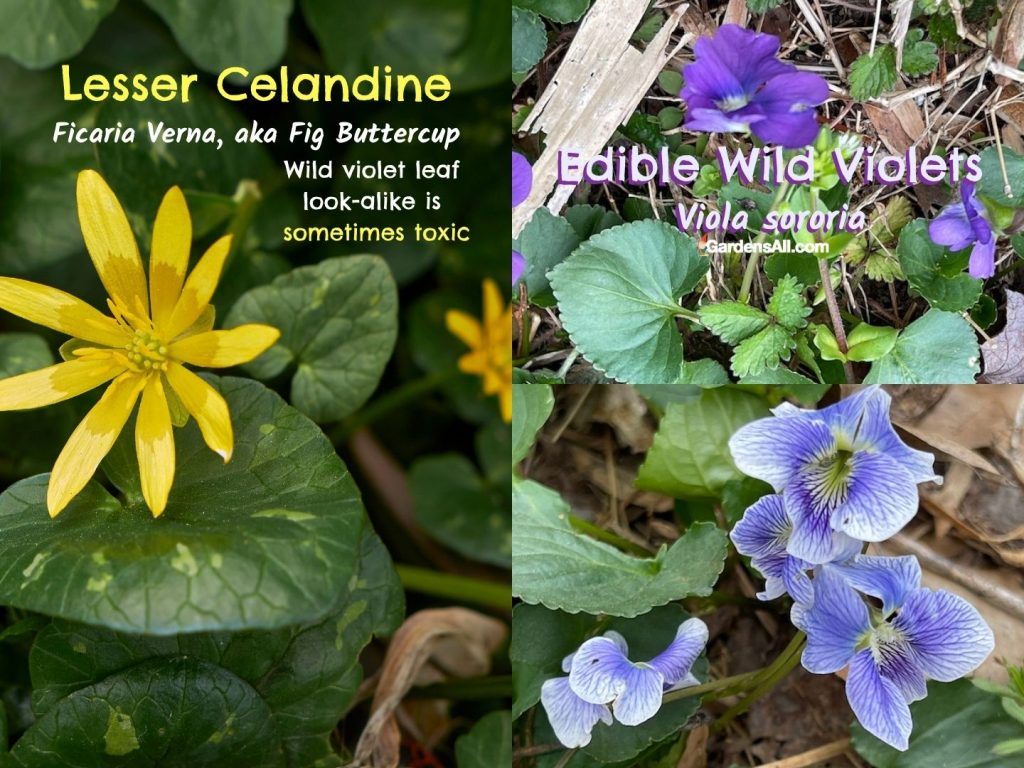
A Wild Violet Look-alike: Lesser Celandine, May Be Poisonous or Toxic
The one wild violet look-alike, that other websites say to avoid is called lesser celandine (Ficaria verna). However, it is only the leaves that resemble each other for the flowers are completely different in color and shape as you will see further below.
But IS lesser celandine poisonous? Yes, no, and maybe. The answers vary, so clearly, there’s a lot of confusion over whether or not it is poisonous or toxic. Which is why most advise avoidance as it’s always better to be safe than sorry.
Most website are citing Ficaria verna as being poisonous or toxic. However, BBC Gardeners World[12]https://www.gardenersworld.com/how-to/grow-plants/ficaria-verna-subsp-verna/ are citing Ranunculus ficaria, as NOT poisonous, and in fact, they’re saying that the leaves are edible.
BBC Gardeners say that Ficaria verna is not harmful to animals and humans alike. However, another report cites the death of livestock grazing on a pasture full of it.
“Fresh plants contain compounds [of Ficaria verna] that are known to be toxic to most mammals (cited in Axtell et al., 2010). Leaves can be used in salads, but they turn poisonous as the fruit mature on plants (ISSG, 2015).[13]https://www.aphis.usda.gov/plant_health/plant_pest_info/weeds/downloads/wra/ficaria-verna.pdf
SOURCE: USDA Animal and Plant Health Inspection Service, August 12, 2015 Version 1
What Does Lesser Celandine, Ficaria verna, Look Like?
The yellow star-shaped flower does not resemble wild violet flowers in the least, however, the heart or kidney shaped leaves of lesser celandine do resemble wild violet leaves.
When there are flowers on the plants, identification is much easier. When the flowers are gone, harvest only with care and guidance, or certainty after checking and double checking good reference materials.

I’m LeAura Alderson, a garden, herb and plant enthusiast with a passion for discovering the many edible and medicinal benefits of the plants all around us, including the weeds, while transforming the land through regenerative permaculture practice. I am also a writer, editor and media publisher (now mostly retired due to replacement by AI), but which now allows more time to build our regenerative permaculture homestead farm.
References