

Go for the gold! Black gold! And we don’t mean Jed Clampett’s kind of black gold in The Beverly Hillbillies. Rich compost is a garden essential, and if you’re wondering how to make organic compost, the good news is that it’s simple!
Why Make Compost?
Organic compost is like gardener’s gold. Healthy plants begin with healthy soil and making compost reduces the need for expensive fertilizers.
Whether you just have a compost pile, make your own compost bin or buy one if you’re short on space and time, you will want to make compost to give your garden the best chance at thriving. In other words, prioritize composting as a gardening essential.
Compost can be “cooking” year round. Even in winter, there are things you can do with compost in winter to nurture and protect it. Composting is like making rich soil and it’s a year-round process that will see you into spring ready for planting with a rich heap of compost, primed and ready for the growing season.
If you’re new to gardening and haven’t yet gotten into composting, you will want to. Composting is It’s a habit worth cultivating in yourself and your family. Just train them to remember to save those vegetable scraps instead of tossing it in the trash.
Let the kids know that throwing food down the disposal or in the trash is like throwing away “black gold”. As expensive as good fertilizer can be, to throw scraps away instead of turn it over to the compost bin is like throwing money in the trash or down the disposal!
And just as homegrown is more nutritious than store bought, same thing with home cooked compost, it’s better than money can buy. Learning this lesson will not only nourish your garden but gardening and composting with your children which foster a sense of conservation, recycling and understanding of the cycles of life in the garden.

Making compost from kitchen and garden waste can save you a bundle in soil conditioning costs, while helping to reduce your waste footprint, too. Composting is really such a cool natural… organic process. It’s what nature does… return everything to the soil from whence so much life comes.
In the Back to Eden gardening article,[1]https://www.gardensall.com/permaculture-gardening-woodchip-mulch-natural-methods/ we learn how important mulch is for contributing to healthy soil. That’s especially true with compost contributing to healthy garden plants.

Of course, you will need to buy some fertilizer, especially in the beginning as you’re building up your own compost reserves, and for that we use Milorganite. Not only is Milorganite an organically processed (though not certified) product by a 90 year old company and process, Milorganite is a great fertilizer and a deer deterrent!
However, if you have a LARGE garden area or even planning for a market garden, (growing produce to sell at farmer’s markets or roadside), you’ll want to invest in a truckload of good soil from your local farm supply store.
That’s the advice of Jean-Martin Fortier and his wife, Maude-Hélène Desroches, author of The Market Gardener book, whose micro farm is earning six figures a year!
Start composting by setting up a kitchen compost bin. Depending on your kitchen space you can choose a countertop model like this one gallon Amazon #1 best seller countertop compost bin.

We’ve just used a stainless steel bowl in our kitchen for years, but have our eye on this cute compost bin with an inner removable bucket. This compost bucket is artsy and functional with that homestead cottage flare, yet reasonably priced. #GiftList!

However, I think we’ll go for the very practical—and economical version—that my brother and sister-in-law just use. They have a small trash can line with a plastic grocery bag and have it sitting in one side of their double sink. They love the simplicity of being able to just remove the bag and take it to the garden and dump the compost
My brother just uses a small plastic trash can lined with a disposable plastic grocery bag.
Or… a few other options might appeal to you, such as if you have extra space inside your cabinet door, you might like a compost container like this is a 1.5 gallon capacity cabinet mounted compost bin option pictured below. They also come in a 2 gallon capacity version.
These could be used with—or without—a plastic liner bag. To bag or not to bag has pros and cons… advantages and disadvantages, so you’d just need to decide which system works best for you.
If you do go for a compost liner bag, you might consider these biodegradable compostable bags made specifically for this purpose.

Our current composting process goes through three stages from kitchen to garden:
- 1 Countertop receptacle while cooking (there are many kinds of countertop compost bins)
- 2 “Backdoor” receptacles, for which we’re using two 5 gallon buckets outside our back door) on rotation, with screw on lids.
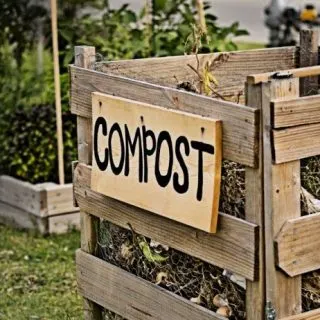
- 3 Wood compost bins for processing in the garden, (we built our own out of scrap lumber. Some folks build them out of pallets), but you can also buy them on Amazon if you have more budget than time, or aren’t able to do much rough carpentry work).
Our Kitchen-to-Garden Composting System
- One countertop kitchen compost bin – we’re now using this one by Oxo (though ours is spring green). and we really like that it’s simple and easy-to-clean
- Two 5-gallon buckets
- Three wood compost bins – which you can see pictured in this article
We’re using the plastic 5 gallon buckets because we already had some on hand. If you’re starting from scratch and don’t already have those, we’d recommend a metal or stainless steel compost bin instead. The 5 gallon buckets work well, but the main drawback is that the lids with all the grooves are harder to scrub clean.
These are easier to access than the lids of 5 gallon buckets, even though we have the five gallon bucket lids that twist on and off, it’s easier to just pedal-lift a lid.
You could use a plastic kitchen trash can with the swinging push lids, however, we would not recommend it because it’s too easy for ants and other insects to be attracted to and access the contents and for odors to escape. So you could use something like this 5.28 gallon can with foot pedal opening as an alternate.
