
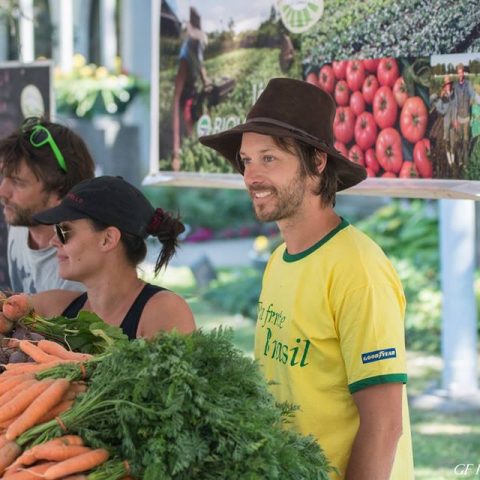
Small scale farming can be productive, fun and profitable.
If you think you need a lot of land to earn a decent living from farming, we’ve got good news. You don’t! We learned so much about what’s possible with the small scale profitable micro farm from “The Market Gardener”, Jean-Martin Fortier, who’s known for earning six figures on just two acres.
Not all farmers are poor.
We’ve probably all heard the stories of hard working farmers who gave up on their dreams when they couldn’t make ends meet. Abandoned dreams are heartbreaking.
It doesn’t have to be that way.
“There has never been a better time to get into farming.”
Jean-Martin Fortier

Yard Gardens and Urban Farming
Gardening is becoming increasingly popular. As baby boomers retire and have more time to pursue other interests, many of them are taking up gardening. The benefits of gardening, (aka garden therapy) are many, and the healthy activity and sunshine for vitamin D, is just the beginning.
Strolling through a fresh and flourishing garden in the cool of summer mornings is a meditation that refreshes the spirit. There’s nothing like plucking and munching on a crisp purple pole bean, a sweet cherry tomato, sprig of parsley and some sweet purple basil.
There’s something about fresh picked produce that satisfies cravings and seems to soothe and invigorate at the same time. It’s as if our very cells perk up and take in a deep breath of fresh air.
The New Farmers: Millennials, GenX and Baby Boomers
Gardening may just be a new kind of green movement, and one that definitely contributes to sustainable living and self reliance. While contributing positively to the ecosystem of your yard and neighborhood.
The past couple of decades have seen a growing interest in gardening amongst Baby Boomers, Millennials and GenX-ers alike, and especially heightened as a result of Covid-19. People are becoming increasingly interested in nature, self sustainability, and having healthier foods for themselves and their families.
Many are eager to learn how to make money from home doing things they love to do. Most of us never considered farming as a viable option, yet today Farmer’s Markets are flourishing with small farms and boutique crops as people from all walks of life are gardening and growing for profit. Some are earning supplemental income and others are earning full time income from backyard gardening, urban homesteads or small farms.
Some are doing—or dreaming of doing—more than subsistence agriculture. Many seek ways work from home as well as how to make money online from entrepreneurial endeavors. Backyard farmers are able to create “value added” products to farming. Some are turning hobbies into profits by selling online through markets like Amazon and Etsy, as well as selling at Farmers’ Markets.
One lady in the Planting for Retirement (PfR) Facebook group makes framed dried flower art and sells from her website as well as on Etsy. Another PfR member makes herbal remedies which she sells through local stores and events as well as online.
People who are into farming, tend naturally toward other handmade goods, such as such making soap, candle making, jams and pickled products, dried and living floral arrangements, and woodcrafting.
There are many possible revenue streams that branch off from the bounty of backyard gardening.
The Profitable Micro Farm, and a Return to the Way it Used to Be
Then there are successful farmers like, Jean-Martin Fortier, author of, The Market Garden: a Successful Gardener’s Handbook for Small-scale Organic Farming. Jean-Martin, along with his wife, Maude-Helene Desroches, have been farming very profitably for over 15 years now.
We purchased The Market Gardener book a few years ago. We’re not yet ready to farm our acreage beyond our little garden patches, but when we are, we’ll be ready.
We’ve read through it The Market Gardener from front to back, and have tagged a number of pages we’ve come back to time and again. It’s incredibly well laid out, easy to follow, easy—and interesting—to read as a book, and to reference regularly as a handbook or farmer’s guide.
“Why not replace mass agriculture with agriculture by the masses.”
~Jean-Martin Fortier, author-The Market Gardener
Yes… Let’s! See how to create a profitable micro farm on just 1.5 acres!!!

If You Don’t Yet Have Enough Land, You Can Still Get Started
Here at GardensAll, we still just have two small gardens. Our “upper garden” and “lower garden”, that we keep expanding, but sunlit space is limited because we live in the woods.
So we’re not yet ready to be growing for profit as our current garden space is just enough for growing supplemental food for our family. Our future plans involve another area of land for larger scale growing when the time comes.
If you don’t yet have the land, there are things you can still do toward preparing for your dream. Now… before you’re ready to start, is the best for a deep dive research into all aspects of growing for profit.
To succeed, It’s important to get into farming—or any business—with your eyes wide open.
Those who approach farming and market gardening like a business rather than merely a hobby, are the most likely to create a profitable micro farm.
~GardensAll.com
How to Create a Profitable Micro Farm
Too many people start a business from their passion for doing what they do, more than from a good business plan. This applies to all areas of business endeavors.
By business plan, we don’t mean fancy documents with more pages than will ever be read again. We do mean, good research, evaluation and planning, because that — along with consistent and productive work — makes all the difference in a successful outcome.
Ideas rarely arrive in linear fashion. Rather, they sprout like weeds in spring determined to grow. Plant your best ideas in the fertile soil of daily effort.
~LeAura Alderson, right brain, left brain on iCreateDaily.com
Research the Fresh Produce Wholesale and Retail Market
We’ve all seen them (or even experienced it first hand)… the shiny new shop or restaurant in town. A few years later, there’s a sign on the door: “Out of Business“. The shop stands empty, awaiting the next hopeful proprietor. We’ve probably also seen the thriving market stands amidst the not-so-thriving.
To succeed, you need to research which crops to grow based on a number of factors. Here’s a starter list to help ignite your thoughts and research. And remember, many of these answers are readily available to you for free from your local extension service website articles and PDFs. And what you can’t find that they’ve already published you can call and ask them about it.
Research and Practice Now Saves Heartaches Later
Research will reveal resources and revenue opportunities for your profitable micro farm. Research before investing resources and plan before planting, for the greatest chance of success.
Most growers love to talk about their farms because it is their passion. Those who love to share may talk your ear off. Those who are closed and afraid of competition won’t want to share. This will inform you who you want to spend more time getting to know.
A little planning now will save a lot of heartache later. Research, planning, setting daily goals and working to complete them will get you closer to achieving your goal of achieving a profitable micro farm.
For instance, you may want to be a lavender farmer, but find that it’s hard to grow in your soil. Or, perhaps the market for lavender is saturated and thus low in profit. Subsequently, you may learn that growing microgreens to sell is a profitable niche for your area and you have space in your basement to do that or mushroom farming.
Start Growing As Soon as You Can
Doing careful research up front, followed by diving in and gaining experience and knowledge growing for your own use, you’ll be setting yourself up for a profitable micro farm enterprise. Learning through doing, through trial and error, is the best way to hone your knowledge and systems.
Even if you don’t yet have the time or land to become a market gardener, everything you learn and grow from this point forward, will move you closer to achieving your goals.
Daily steps in the direction of your dreams is a proven path to success.
~LeAura Alderson, Cofounder-iCreateDaily.com
Want to be a Profitable Micro Farmer? Questions to Ask and Research
There are many things to consider. You’ll see in The Market Gardener book ‘The Annual Sales’ chart on page 14 shows the most profitable plants, sales rank by bed and even the garden space occupied by each crop.
Here are some research ideas from the Market Gardener and GardensAll
How to Decide What to Grow
- Your Micro Farm Goals:
- Do you want to be a micro farm selling a variety of produce at farmers market venues?
- Or, do you want to farm one or two large crops to start?
- Make a list of the farm foods you enjoy most. (You probably don’t want to grow foods that aren’t also your favorites!)
- Identify the ones you’d most enjoy growing in quantities.
- Contact your local Agricultural Extension Office to ask about the local micro farm market:
- which crops are most profitable, all things considered:
- what crops are popular
- length from seed to harvest
- revenue earned per crop per square foot (or linear foot). E.g., Sometimes the crop that takes the most space earns less that one than one that takes less space.
- which are easiest to harvest and bring to market
- which are longest lasting
- what “value added” products are popular to sell, such as calendula salve, teas, tinctures, soaps, loofahs, gords, jams and baked goods?
- what grows well in your area and in your soil
- What’s selling well in your area
- who are some of the successful micro farmers in your area
- ask for any other tips they may share
- which crops are most profitable, all things considered:
- Visit your local farmers’ markets weekly:
- start networking with other local growers
- ask sellers their advice to a newbie
- support their farm by buying some goods from them while you’re there chatting
- inquire about farm visits to the sellers most willing to share information
The Market Gardener Interview
The Good News
So we were thrilled to finally have the opportunity to interview with Jean-Martin, to connect and to learn from him directly and to share that conversation with you.
The 1.5 hour visit