
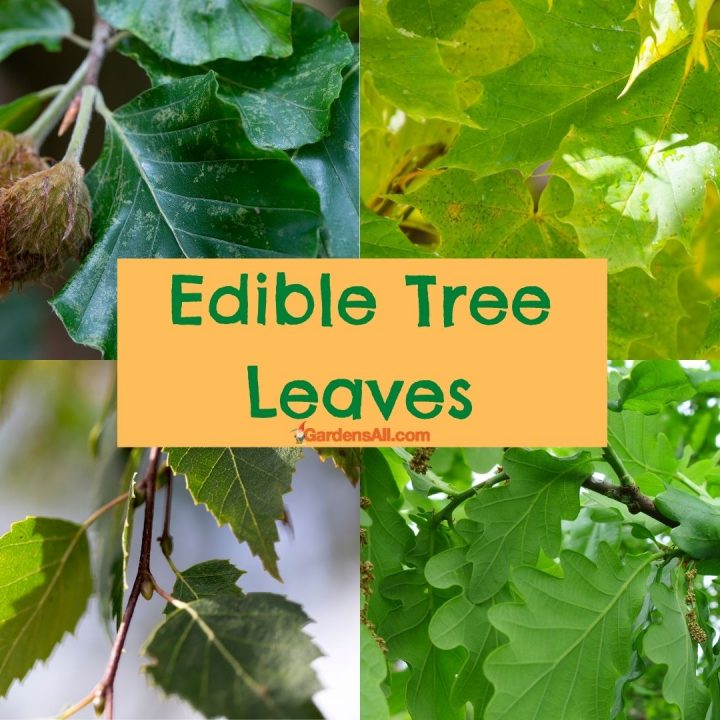
Have You Ever Wondered if There Are Tree Leaves You Can Eat?
If you’ve ever looked at the shrubs and trees around you and wondered if any of them have edible tree leaves, you’re on a fun and useful track of discovery. If you were lost in the woods… or in a food shortage, it’s important to know the edible plants and trees to turn to for sustenance that you wouldn’t normally think about using.
I was fortunate to grow up in Hawaii where everyone living in a house, has fruit trees in their yard, and anyone can often forage for food on public and uninhabited land. Tropical climates make for abundant year-round growing of papayas, bananas, mangos, guavas, lilikoi, pineapple, coconut, and so many other wonderful fruits and vegetables.
Beyond that, many also grow trees with edible leaves and regularly go outside and harvest edible tree leaves and other parts for food and medicine.
But edible tree leaves can be found beyond the tropics, and it’s possible you already have some in your yard.
When to Harvest Edible Tree Leaves
Spring is the best time to harvest edible tree leaves, because they’re freshest, more tasty and digestible as young fresh leaves. However, for tea and medicinal uses, we like to harvest and dry the tree leaves before leaf drop in fall.
That way the tree and creatures gets the benefit of its leaves throughout the growing season, and then we get the benefit of using some of those leaves before they’re lost and reclaimed to composting.
EDIBLE TREE LEAVES, PODS, BARK AND FLOWERS
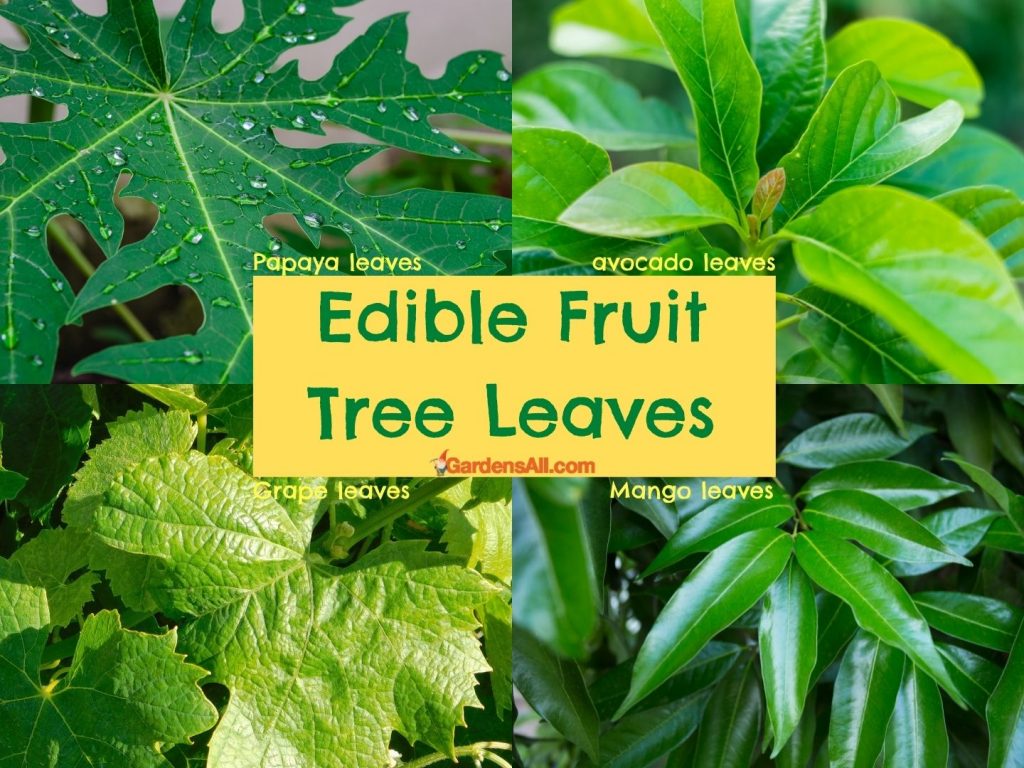
Fruit Trees With Edible Leaves
Most fruit trees leaves aren’t only used for culinary purposes, but also have edible and health benefits.
- Avocado tree leaves – young leaves in salads and soups; culinary uses similar to bay leaves
- Banana tree leaves – fresh as food platters, steamed as food wrappers and culinary herb, imparting a subtle sweetness; fresh or dried for tea[1]https://mommypotamus.com/banana-tea-for-sleep/. Banana leaves are used medicinally as bandages and to aid healing.[2]https://www.ncbi.nlm.nih.gov/pmc/articles/PMC8574063/
- Fig tree leaves – dried for tea, used as an herb in cooking, typically removed; tender leaves are eaten as leafy greens. Also, toasted, young leaves taste like coconut! Bake at 375°F until crunchy then crush or powder and use as you would coconut.[3]https://www.facebook.com/ForagingTexas/posts/5406721402680661
- Grape leaves – used as food wraps and for stuffing; can be eaten as greens, cooked or fresh when young; used as a culinary herb; dried for grape leaf tea[4]https://www.thinking-drinking.com/blog/grape-leaf-tea
- Mango leaves – young leaves are eaten cooked or fresh; mango leaves are dried for nutritious tea; medicinally beneficial as an extract[5]https://www.ncbi.nlm.nih.gov/pmc/articles/PMC7468873/
- Papaya Leaves – edible and medicinal purposes, used fresh, cooked, dried for tea and as tincture[6]https://specialtyproduce.com/produce/Papaya_Leaves_16679.php[7]file:///Users/leaura%20alderson%20laptop/Desktop/molecules-26-06922-v2.pdf
- Tamarind Leaves – All parts of the tamarind plant are edible, beneficial and have medicinal benefits.[8]https://www.sciencedirect.com/science/article/pii/S2221169115300885
While not a fruit tree, strawberry leaves deserve honorable mention because they have lots of benefits as food and tea.
Deciduous Trees and Hardwoods With Edible Tree Leaves
- BEECH, AMERICAN, Fagus grandifolia –
- inner bark is edible,
- leaves, are edible when young and soft
- marcescent beech leaves (golden brown winter leaves) are used for tea (avoid if pregnant)
- nuts:
- edible roasted with skin removed, (beech nut skin contains a poison called fagin)[9]http://www.jodrugs.com/toxicologies/3598-plants-fagus.aspx[10]https://practicalselfreliance.com/foraging-beech-nuts/
- pressed for oil
- seeds are sweet and edible and can be eaten or crushed into a butter.
- BIRCH, Betula pendula & Betula lenta:[11]https://www.americanforests.org/magazine/article/edible-trees-foraging-food-forests/
- Bark – inner bark is edible:
- raw
- boiled
- ground into flour
- Essential oils
- Leaves –
- spring leaves – cooked
- dried leaves – for tea; some say these have analgesic properties, however, we haven’t yet found research to validate that claim [12]https://pubmed.ncbi.nlm.nih.gov/2594828/
- Sap – mild but short-lived antibacterial and anti-inflammatory benefit;[13]https://pubmed.ncbi.nlm.nih.gov/2594828/ See more on birch tree syrup and water
- Bark – inner bark is edible:
- CHERRY – The blossoms, bark and leaves of SOME cherry trees are edible and used for flavoring, teas, cocktails and syrups, and in Japanese cuisine.
CAUTION: Some are poisonous, so be sure to identify the cherry tree and research the specific genus before consuming any part of it. - GOJI BERRY, Lycium barbarum –
- Berries – fresh and dried
- Leaves – food and tea
- HAWTHORN, Crataegus monogyna –
- Berries
- Flowers
- Leaves, fresh in salads and nibbles
- LINDEN, AMERICAN, Tilia americana – Northeastern US & Midwest US:
- flowers
- leaves, young
- sap
- shoots
- LINDEN, LITTLE LEAF, Tilia cordata – Northeast & Central North America:
- leaves, young
- buds
- shoots
- MAPLE, ACER, Acer palmatum[14]https://www.americanforests.org/magazine/article/edible-trees-foraging-food-forests/ –
- bark, inner:
- cooked
- raw
- leaves, young
- sap for water and maple syrup
- seeds
- bark, inner:
- MIMOSA, Mimosa pudica, leaves and flowers are edible; bark used medicinally[15]https://agnetwest.com/practical-uses-mimosa-tree/
- MORINGA, Moringa oleifera – bark, pods, leaves, nuts, seeds, and flowers are all edible. Roots are said to be toxic.
- MULBERRY Morus rubra – Northeastern US:
- mulberries (fruit) – many uses similar to blackberries and raspberries
- leaves, only young curled leaves – added to soups and salads
- shoots – only young and tender shoots
- OAK TREE LEAVES, Quercus robur – folk usage included all parts of the oak as edible: leaves, flowers, fruit (acorns), and gum from the oak tree trunk.[16]https://www.eatweeds.co.uk/oak-quercus-robur
- REDBUD, Cercis canadensis – leaves, flowers and seed pods
- SASSAFRAS, Sassafras albidum – traditionally, all parts of the sassafras tree are used. See more below.
- WAX MYRTLE – (Myrica cerifera) – evergreen; has culinary and medicinal benefits, and the waxy berries are also used for making candles
- leaves
- berries
- WILLOW – young leaves can be eaten as a survival food, but isn’t typically pleasant otherwise
Red Bud Blossoms
You can also enjoy some redbud leaves and blossoms in your salad. The blossoms impart a sweet pea like flavor.
“I enjoy redbud leaves in my spring salad.”
~Debie Baugher
You may also be interested in trees to tap for syrup and water.

Other Trees and Shrubs With Edible Leaves
Hydrangeas do have medicinal benefits, but can also be toxic, so use only if well informed and under the guidance of a healthcare professions. You can read more about hydrangea benefits in this article on shade tolerant hydrangeas.
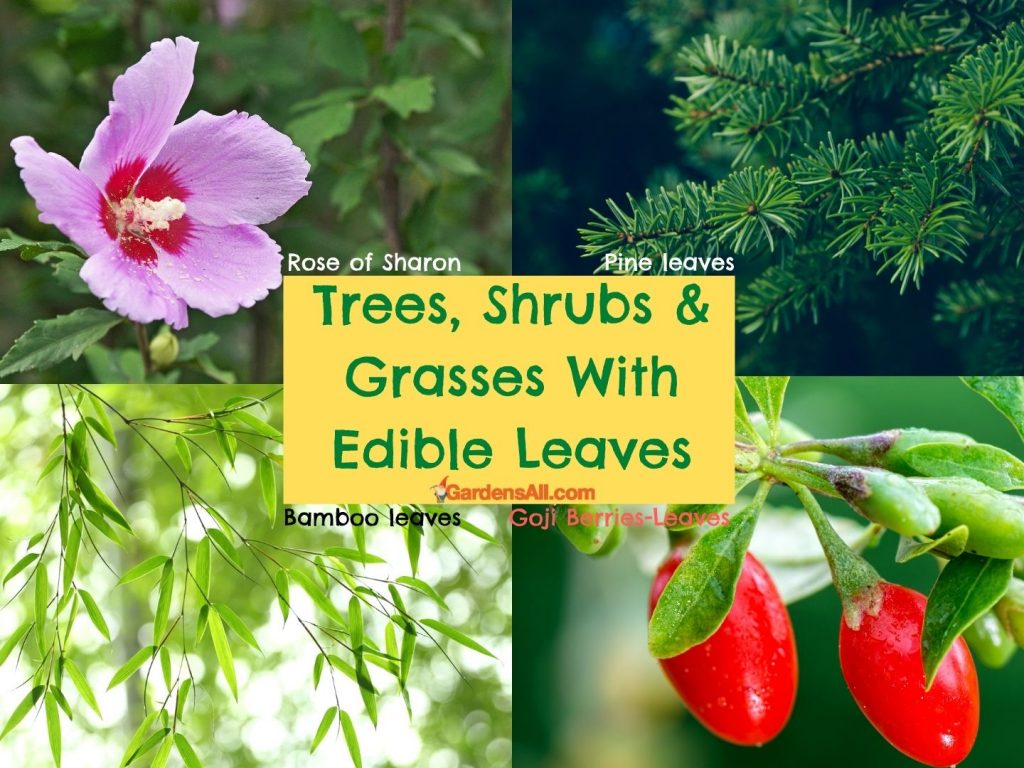
- BAMBOO –
- Shoots
- Leaves – cooked, young leaves in salads and also dried for tea
- Stalks, while not edible, make very useful garden tools, such as tomato supports and our bamboo bean teepee trellis.
- PINE –
- Bark: inner bark – cooked[17]https://www.outdoorlife.com/blogs/survivalist/2011/11/survival-foods-can-you-really-eat-tree-bark/
- Extract
- Sap
- Needles – chew for juices with vitamin C; spit out the refuse
- Pine nuts from pine cones
- ROSE OF SHARON,Hibiscus syriacus – Originally from China; now global:
- flowers – fresh in salads; dried for tea
- leaves – fresh leaves in salads and sandwiches; mucilaginous properties good for thickening soups and sauces; dried for tea
See more on hibiscus benefits here.
Redbud Trees, Cercis canadensis
The Redbud Tree Botanical Name
- Cercis canadensis (former scientific name)
- Cercis siliquastrum
- Siliquastrum canadense (new scientific name)
Redbud Common Names
- American Redbud
- Eastern Redbud
- Judas Tree
- Mexican Redbud
- Redbud
- Texas Redbud
An early to mid spring blooming flower that delights the eye with beautiful purple blossoms, is the Redbud Tree. The beautiful purple flowers that grow directly from the tree trunk and limbs, contrast wonderfully against the grey redbud tree bark like a match made in heaven.
As if that wasn’t enough, the flowers are soon followed by perfectly heart shaped leaves that range from a deep red, to burgundy to dark purple color.
Pluck redbud leaves in early spring when young and tender.
You can cook young leaves as you would spinach, and use them fresh tossed in salads. The vibrant color and lovely heart shape add vibrant color and nutrients, similar to the amaranth leaves we also enjoy using.
Edible Redbud Flowers
Redbud blossoms have a delightful flavor, and incredible floral aroma. At first, it’s a bright sweetness, with a touch of young vegetable flavor (like sweet peas or new corn). Then secondary notes of sourness/tartness come in. The flowers are excellent sprinkled into salads, added to baked goods and as a key ingredient in smoothies.
Edible Redbud Tree Seed Pods
Late spring offers the soft green seed pods that can be eaten like green beans.
Pluck the pods in spring when young and still purple of just barely green, tender and pliable. Avoid the older more mature and dried pods as they are too fibrous to be edible.
SOURCES: Foraged Foodie
Sassafras Tree Leaves, Sassafras albidum
Traditionally, all parts of the sassafras tree are used: roots, stems, leaves, bark, flowers, and fruit, for culinary, aromatic and medicinal purposes. There is some concern over high levels of safrole, a toxic chemical in sassafras, so do your homework and proceed cautiously.
However, keep in mind that folk use of sassafras — as with many natural remedies — has been primarily as a medicinally, which means limited and moderate use. You can find on Amazon, a sampling of some of the many sassafras products available.[18]https://www.rxlist.com/sassafras/supplements.htm
Botanical Names of Sassafras
- Sassafras albidum
- Sassafrax, Saxifrax
- Sassafras officinale
- Sassafras variifolium
Sassafras Common Names
- Ague Tree
- Bois de Cannelle
- Cinnamon Wood
- Common Sassafras
- Kuntze Saloop
- Laurier des Iroquois
- Laurus albida
- Saloop
- Sasafras
See also, edible leaves of fruits, vegetables and flowers!
Trees Leaves You Should NEVER Eat
- Cherry Trees – Some cherry blossoms and leaves are edible; some are not. Be sure to research the botanical names of the cherry tree you’re considering.
- Horse Chestnut
- Yew –
- English
- Pacific
How to Test Plants Carefully in Survival Circumstances
DISCLAIMER: This is NOT advice or recommendation and you should only use this approach if you’re in dire circumstances.
But if you’ve ever wondered how anyone came to know about any plants and their edible and medicinal properties, it began with our ancestors testing and tasting carefully.
Fortunately, thanks to them, we have abundant resources for safely identifying safe plants.
However, if you’re ever in dire circumstances without a plant guide, here is how experts and ancients did it:
- Smell it – if bad smelling, avoid
- Skin – test on small area of skin to test for contact poisoning
- Lips – if it passed the skin test with no signs of irritation after 15 minutes or so; press to lips to test
- Taste – if it passes the lips test with no reaction after 15 minutes of so, take a tiny taste, then spit out
- Swallow – if there’s no reaction to the taste test after 15 minutes of so, take a tiny bite, chew well and swallow
In general, while many tree leaves are not the most desirable food source, many have nutrients and medicinal and health benefits. Beyond that, it’s good to know for survival and should hard times fall, that there are many options for sustenance in nature. Similarly, there are many edible leaves of vegetables, fruit and flowers you can eat that most people don’t know about, as well as weeds you can eat.
Please Share Your Experience
This article is a WIP… work-in-progress as we are steadily adding new information as we have time to dive into the research on this fascinating subject. If you know of or have used edible tree leaves in any capacity for food, tea or medicinal remedies, whether from our list or something we’ve not yet added, we’d love to hear from your experience.

I’m LeAura Alderson, a garden, herb and plant enthusiast with a passion for discovering the many edible and medicinal benefits of the plants all around us, including the weeds, while transforming the land through regenerative permaculture practice. I am also a writer, editor and media publisher (now mostly retired due to replacement by AI), but which now allows more time to build our regenerative permaculture homestead farm.
References