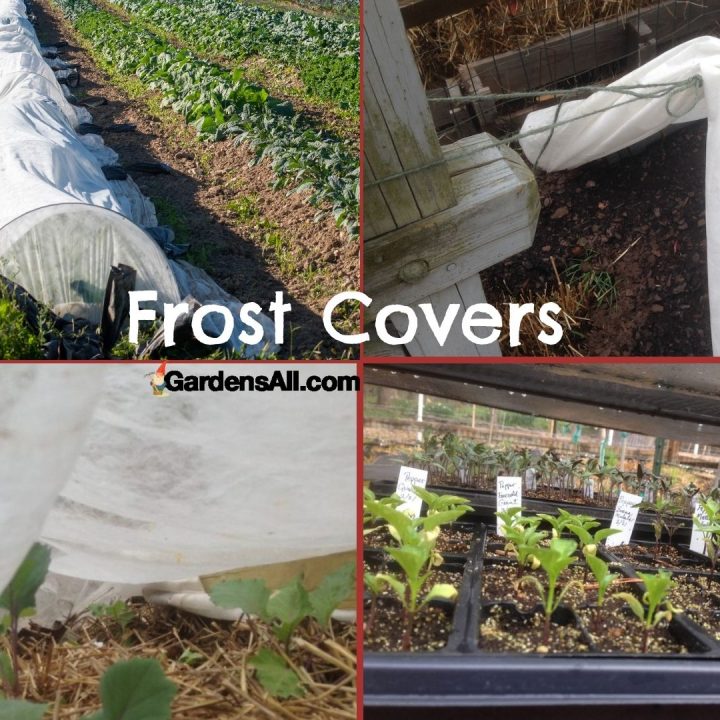
As soon as the first local “Frost Alert” has been issued and it looks like our more tender crops will be taken out by Mr. Jack, we get out the frost covers to keep our fall and winter crops growing.
Living here in the western Piedmont of North Carolina, we have the fortune of gardening well into fall. What expands our growing season, even through winter, are simple plant covers or row covers for frost protection.
Into late fall, we still have a bumper crop (for our little space) of sweet peppers and Japanese eggplant bushes yielding their last for the season. Meanwhile, our collection of winter vegetables and greens are perky and happy growing under the frost covers.
What Temperature Is Frost?
You can have frost above the freeze line of 32°F / 0°C.
Our observations regarding frost indicate it’s not just the temperature. Temps can be as high as 38 to 41 degrees and we’ll get patchy frost.
At times when the temps approach freezing, there will be little to no frost. Conditions such as clear skies, little to no wind, a down hill (lower) elevation, and soil moisture all have an impact. From 38 degrees down to just above 32 degrees, chances of frost increase. Of course, from 32 degrees and below it’s frost/freeze territory. [1]https://www.weather.gov/arx/why_frost
These first few cold snaps usually prompt us to layout frost blankets that will stretch the growing season just a little more. Before we delve into frost protection, let’s consider a few resources that can guide our decisions as to when and how we begin to extend our growing season.
If you’re in the colder more snowy growing zones with lots of snow, frost covers may not work as well, but you could try using the heavier frost blankets to extend as much as possible.
Your Plant Hardiness Zone
Eventually, we just have to roll with the seasons. North Carolina has plant hardiness zones ranging from 8B in the Coastal plain down to 5B in the mountains. We happen to be in Zone 7A. Of course, these are averages, but you get a general picture. It’s like gambling with the USDA as your odds maker. Plant sellers and customers who follow the Hardiness Zone Maps and assume “normal” temps will prevail are essentially gambling.
Back in the early 80’s, while working in the Asheville area as a landscaper, a severe cold snap killed off a slew of hollies. The Burford hollies (Ilex cornuta) were decimated. Rated as hardy within Zones 7 to 9, the Burfords had been planted for decades around many of the stately homes we serviced. Some had grown to be like small trees.
We spent most of that spring and early summer, removing the dead hollies and replacing them with hardier plants. It was a bust for many homeowners, but a boon for our company.
The object lesson here is to know the risks of assuming normal. We suggest selection of plants based on a margin of safety-at least a zone lower, if not two. We take a chance on a Zone 7A plants now and then, but are much more comfortable with 6A.
For a more specific hardiness map of your location there are USDA maps that can be zeroed in via zip code. These local maps take into account elevations. Usually, the higher the elevation the colder the zone. Hence, our upper garden is likely more like a 6B since it’s at a higher elevation and close to Pilot Mountain State Park.
Finding Frost Temperature for Your Area
We remind ourselves occasionally that the Ag Zones don’t specify frost dates. For that info, we go to the NOAA for state by state climate data.
You can look up frost and freeze data on their home page by clicking on your state and then finding the closest town/city/airport that is collecting data. There you’ll find projected dates of last and first frosts and freezes. Only this time, they’re more specific. Below is a section on North Carolina.

For our own area (near the Greensboro Airport), we see that the first frost date is pretty accurate. The weather forecasts a potential first frost on October 22.

Plant Covers
Once we have an idea of upcoming weather conditions, we’re better informed on when to start using plant covers to extend our growing season. A proven method is the use of various thicknesses of frost cloth.
These covers don’t just keep the cold from intruding. They also keep the ambient warmth from radiating outward. In this way, garden row covers are like cloud cover that interferes with the earth’s heat radiating into space. Laser thermometer measurements indicate a cover can conserve as much as 12 degrees more heat.
We borrowed this chart from a maker of agricultural row covers to illustrate the types of coverage and frost protection. The more weighty the fabric, the more protection but also the less light transmission. Weather conditions permitting, consider using your heavier fabrics mainly overnight and leaving the crops open to sun during the day.
Frost Cover Chart
Here’s a handy chart from the AgFabric folks that can help you determine the level of protection and how it affects light transmission. .

Frost Blankets vs. Floating Row Covers
What’s the difference between the two? Frost blankets are thicker and serve more specifically to help keep the plants warmer. Floating row covers are thinner and lighter weight, and while they also keep the frost off, they can be used during the day for growing under as well.
Floating Row Covers
Floating row covers are rather gauzy materials that are often used for barriers against insects. They are lightweight enough to rest directly on the plant without damage.
On our fall crops, we already have one layer. With the onset of “Frost Alerts”, we add an additional layer of the same lightweight fabric.
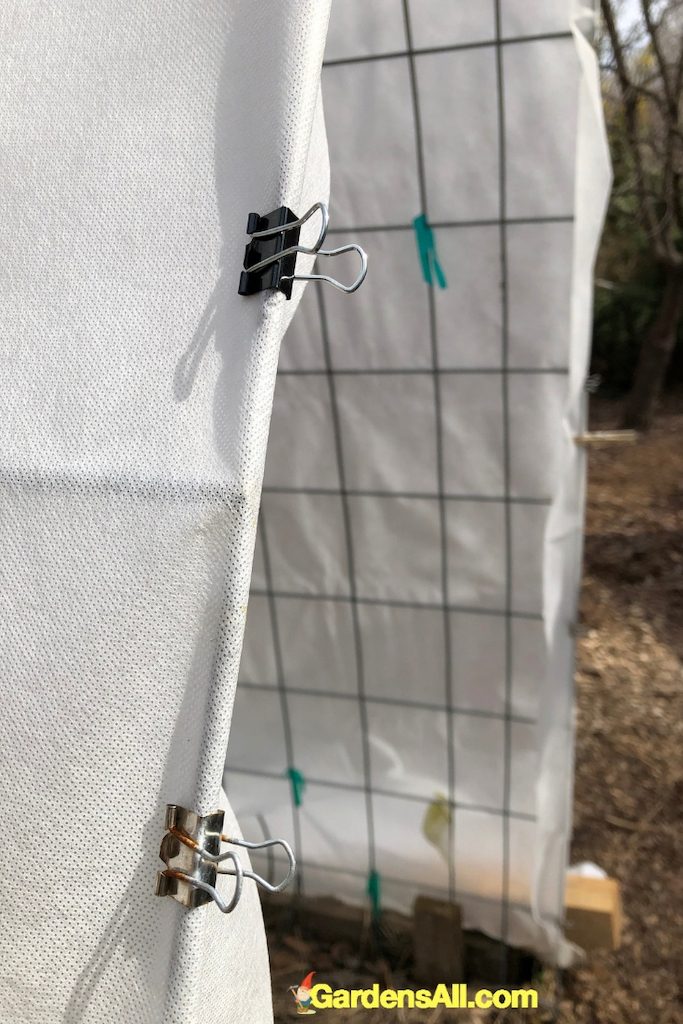
We prefer to tent ours over a taut string or wire. Then, we pin the sides with landscape staples. The ends can be closed off with clothespins or metal binder clips.
Metal hoops, sold by on-line row cover suppliers, can be used to create a floating row tunnel. There are also various pre-fab tunnels that offer varying levels of frost protection.