

We love the meaning of wabi sabi, which means imperfect and flawed beauty. This is especially relevant in the garden and natural environment.
Our orderly selves would like tidy lawns and lines, neat garden rows with clean pathways, and borders and orders of plants of choice without weeds. Yet the garden presents to us the lessons of nature in the imperfection of flawed beauty.
The First Garden Was (Just) Good
According to the Old Testament, when the Lord created the heavens and the earth which would include (we presume) the Garden of Eden, then the Lord looked upon it and “saw that it was good.” Note, there’s nothing in there about being “perfect”. So, the very first garden created by the very first Gardener was just. . . good.
For me this brings to mind the Japanese phrase, wabi sabi. The meaning of wabi sabi is the flawed beauty of imperfection.
Note, there’s nothing in there about being “perfect”. So, the very first garden created by the very first Gardener was just. . . good, not perfect.
What is Wabi Sabi?
The Japanese developed an entire philosophy about the “imperfect garden”.
In this tradition, known as Wabi-sabi, we might see a perfectly manicured Zen garden design disrupted by a randomly tossed handful of dead leaves.
The Wabi Sabi Way
The Wabi-sabi “way” encompasses the notion that, in reality, “nothing lasts, nothing is finished, nothing is perfect.” That sure sounds spot on given our gardening and landscaping experience.
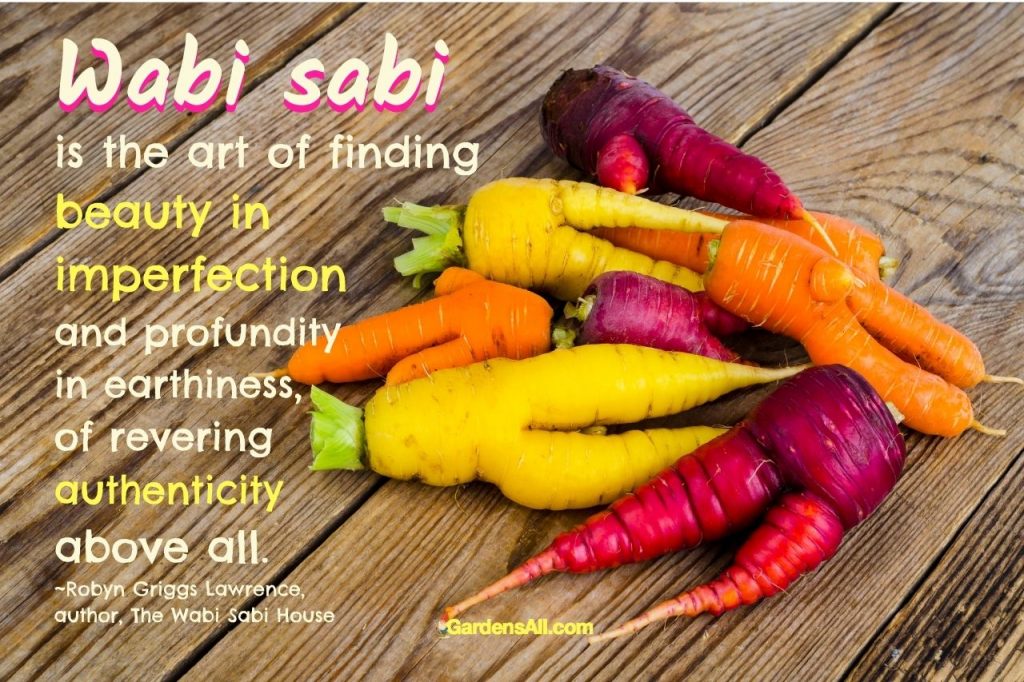
Wabi-sabi is the art of finding beauty in imperfection and profundity in earthiness, of revering authenticity above all.
~Robyn Griggs Lawrence, author, The Wabi Sabi House
Every year, we strive for perfection and envision a garden utopia flourishing into a slice of paradise. The illustrations in seed catalogues tempt us into believing, it can be done. We plant our seeds with high expectations. And, we all know what eventually happens. There will be a few failures and disappointment.
Wabi-sabi is the way of imperfection which is the way of nature. The garden is beautiful in its imperfection, and it’s those imperfections that make improvements possible.
~Coleman Alderson, GardensAll.com
Well, friends, one lesson this dirt jockey has learned is that no garden or gardener is perfect. Well, maybe Martha Stewart on a good day. But it’s likely she’s missed the perfection mark a time or two. Philosophically, I’m with the Creator and will settle for “good”. This doesn’t mean there’s no room for learning or improvement. In fact, it’s those imperfections that make improvements possible.
We grow, we fail, we learn, we try again and, hopefully, along the spiraling way, we improve.
~Coleman Alderson, GardensAll.com

Mistakes and Wabi Sabi – Far Better than Faking Perfection
So, far from candy coating or airbrushing our gardening this season, please, allow me to prove beyond a doubt that I am, indeed, an imperfect gardener, with an appreciation for the wabi sabi of it all. Perhaps, sharing these less than stellar moments will help our gardening friends avoid the same situation or, at least, nod in empathy having been there and done that.
Early into the season, we found damage on our kohlrabi and broccoli plants due to two types of cabbage worms. Dipel (bacillus thugiensis–BT) to the rescue! We dusted, and that seemed to halt the problem. But early this week, having forgotten to dust a section of our cabbage and kohlrabi, (growing under a shade cloth), we discovered mostly skeletonized leaves and LOTS of cabbage worms.
They’d wiped out about a dozen of our plants, and, in a small garden, that’s a big hit. The crop was way beyond saving, so we pulled every plant up, set them in a bin and dusted them with Dipel. Later, we planted tomatoes in the vacant straw bales. We always keep a few tomato transplants on standby, so at least the space will have been rotated into something productive.
Kohlrabi Leaves Devastated by Cabbage Worms

Cross-Striped Cabbage Worm

Gardening Lessons Learned
The lesson? When treating an issue in your garden, make sure you’ve taken care of all your plants.
Check out our Russian Kale image below. It was growing and producing for nearly two months. It had a bout with cabbage worms too, but the Dipel took care of them.
The leaves were mostly hole-free and now we enjoy a bounty of kale about every week. We keep on top of the Dipel and slug treatments, and that’s made all the difference, along with the location. We planted it in the more shaded areas of the garden where it produced well, even through summer.
When we chose to practice organic home gardening, it’s a given that some of our produce would have blemishes, holes, and other irregularities. So right from the start, we’d joined the legion of Imperfect Gardeners.
We stepped totally into the Wabi-sabi gardening mode. Everything else is just a lesson to learn from and chalk up to experience, AND, most importantly, in wabi sabi tradition, the patches become the strongest part.

Battle of the Vine Borer Wages on
After all of our efforts to stave off the squash vine borers, we lost two of our vines. Both squash vines had multiple borers from the base on up the stem. Ripping out a plant started indoors from seed months ago is always a tough job. But, we’re not alone. We know some really experienced truck farmers who keep planting squash and pumpkins in cycles to stay ahead of the losses as the season progresses.
We’ve seen blight creeping up the lower leaves of our “perfect” tomato plants just as the tomatoes themselves take shape. The race is on to get ripe tomatoes before the entire plant is blighted. The tomatoes themselves may take on odd “cat-faced” shapes, especially the Cherokee Purple heirlooms, but often, even the imperfect ones that taste great.
So, we planted more squash “replacements”, even though it’s getting late to do so. Plus, we’ll be more proactive and vigilant in looking for signs of borer damage.
An additional measure we’ve deployed is the use of squash vine borer traps. Commercial pumpkin growers use them, and we ordered a couple. Are they effective in luring the specific squash vine borer moth to its demise? Well, perhaps so. We catch some each year, and we figure it’s got to help.
Squash Vine Borers in SVB Trap

By Failing – the Road to Better Is Laid
So, as a fully self-declared member of the ‘Wabi Sabi Imperfect Gardening Club’, I know I’m in the best of company. By, being imperfect, by making those mistakes, by failing, the road to better is laid.
Each failure can be a stepping stone that lays the path to better gardening.
~Coleman Alderson, GardensAll.com
Looking upon this volunteer sunflower, it’s easy to see it’s missing a few petals. But it bloomed and if given voice, would care not a whit that it’s missing the perfect proportion of petals. It’s still a flower. It has seeds, and will carry on till the frost comes. The seeds will still feed the birds and, perhaps, some stray seed will become next year’s volunteer blooming with a complete set of petals. That possibility of improvement is what really matters. We gardeners tend to be eternal optimists. If not this year, then maybe next season, right?
Wabi Sabi Sunflower:
This imperfect flower… if given a voice, would care not a whit that it’s missing some petals. It’s still a flower, lovely in its imperfection.
~Coleman Alderson, GardensAll.com

Gratitude for Garden Blessings
So we can look upon our garden and see that it is good. And we’re grateful for whatever bounty we receive. And we know that, just like our garden patch, we garden aficionados are good, and growing ever better!
Unlike our ancestors, when crops fail, it rarely means starvation for us. So it gives us an opportunity to face new challenges and overcome, and in so doing, we are strengthened and renewed.

Drop us a line with your take on the wabi sabi imperfect garden concept.
May your gardens flourish and your harvests be bountiful, and when you look upon your little Eden, may you see that it is good.
~Coleman Alderson, GardensAll.com
Tally hoe! Let’s Keep on Growing!


G. Coleman Alderson is an entrepreneur, land manager, investor, gardener, and author of the novel, Mountain Whispers: Days Without Sun. Coleman holds an MS from Penn State where his thesis centered on horticulture, park planning, design, and maintenance. He’s a member of the Phi Kappa Phi Honor Society and a licensed building contractor for 27 years. “But nothing surpasses my 40 years of lessons from the field and garden. And in the garden, as in life, it’s always interesting because those lessons never end!” Coleman Alderson