

Meet Helianthus Tuberosus
We’re in our 8th year of growing sunchokes, the Helianthus tuberosus plant, and are glad that our plantings are slowly expanding. Common names include Jerusalem artichoke, sunchoke or sun choke, sun root, and lambchokes.
Some people can’t imagine growing Sunchokes any more than they can imagine growing dandelions on purpose. That’s because this native North American edible weed, is considered invasive in some areas.
Others, view it as a gift of a plant.
If you enjoy natural remedies and healing plants, or have issues with blood sugar and diabetes, sunchokes can be a powerful natural homegrown remedy ally in your pursuit of better health.
Delicious, Nutritious, Healthy Gourmet Food
However, we’ve planted both and value them for their incredible food versatility as well as the powerful health benefits of each. And both, dandelion and sunchokes are not only highly a nutritious health food, they’re also a popular gourmet food for many restaurants.
This powerful and homely little sun choke root has a wide array of uses. Jerusalem artichokes are beneficial in stabilizing blood sugar as well good for gut health, due to the prebiotic properties of inulin.
Long lasting with many uses, both edible and medicinal, growing sunchokes may be an important addition to your garden and beneficial to pollinators. Sun chokes are also attractive as a tall flowering backdrop flower for landscapes, reminiscent of sunflowers, very tall daisies and Maximilian sunflowers.
What is a Sunchoke?
Sunchokes, Helianthus tuberosus, are a native North American perennial root vegetable in the sunflower family.
Sunchoke Common Names
- Sunchokes
- Jerusalem artichokes
- Sunroot
- Earth apples
- Topinambour*
*Topinambour is the French name for Jerusalem artichoke, and is pronounced: toe-pee nahm-BORE.
Growing Sunchokes
If you want to grow a lot of sunchokes, that’s fine, just be forewarned: sunchokes are known to be invasive. If you’re not sure, start by growing your sunchokes in large pots, such as barrel pots, or a long trough style planter against a blank wall with good sun exposure looks lovely.
Whenever we share about sunchokes on the GardensAll Facebook page we have mixed comments of appreciation or aversion, depending on the person’s exposure to growing sunchokes. Because of the invasive nature, many consider them a nuisance of a weed.
Those who get into the annual habit of harvesting sunchokes fall in love with this amazing plant and its sturdy, long lasting tuber with lots of health benefits. So if you’re in an area where sunchokes grow rampantly wild, or if they’re overtaking your yard, consider that nature is providing them for you.
How to Get Rid of Sunchokes? (Are You Sure You Want to)?
A few people have shared that Jerusalem artichokes grow like weeds in their area and are invasive and hard to get rid of.
So if you’re overrun by sunchokes, you might actually want to invite the deer in (maybe lead them in with a trail of apple cores and scraps..?)
They may just be able to destroy the entire crop of what can be an incredibly hardy weed that’s virtually impossible to get rid of. Of course you’d have to take care of your other plants, so this would only work if your sunchokes are in a separate field from your yard and garden.
Jerusalem artichokes grow so prolifically via underground runners and shoots that it’s very hard to get rid of them. But if you have an abundance, rather than fighting them, you may decide to harvest and eat them, dry them, make tea with them, and/or sell them!
Selling Sunchokes
If you’re a market gardener, or planning on gardening or farming for profit, you might consider selling sunchokes as a viable specialty crop.
Sunchokes are currently retailing for an average price of $10.00/lb. Depending on the seller and whether it’s organic, food quality and/or based on buying larger or smaller quantities, the price may be more or less.
The Sunchoke Market – for Wholesalers and Market Gardeners
Typical tuber yields are approximately 15 ton/acre, with a range of 5 to 25 ton/acre. The variety and time of harvest determine the yields for both the tops and tubers. Total per plant yield ranges between 4 to 8 lb for tops, 3 to 6 lb for tubers, and 1 to 2 lb for roots.
~Purdue University[1]https://hort.purdue.edu/newcrop/afcm/jerusart.html#:~:text=Typical%20tuber%20yields%20are%20approximately,to%202%20lb%20for%20roots
How to Keep Sunchokes From Spreading
So if you do plant sunchokes, aka, Jerusalem artichokes, you may want to plant them in barrels or raised beds. Another option is a deep underground barrier fence at approximately 2 feet deep, since sunchokes tubers can sprout from as deep at 18″.[2]https://commonsensehome.com/before-you-plant-sunchokes/
Sunchoke Height
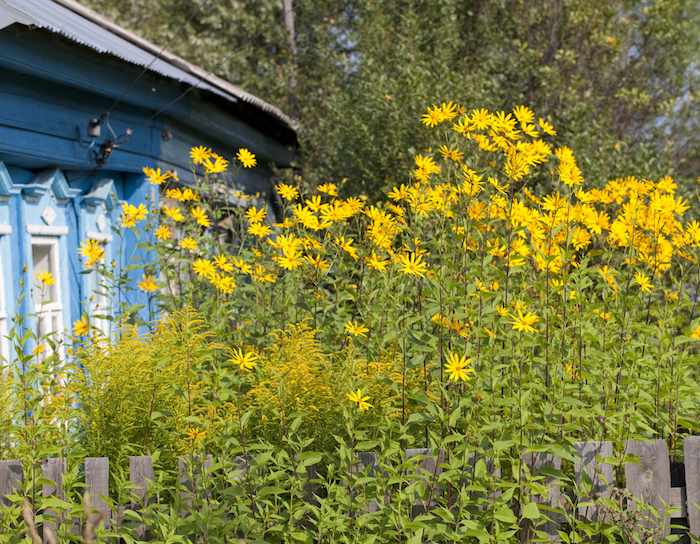
The herbaceous Jerusalem artichoke plant grows on tall stalks between 5′-10′ tall, with yellow daisy or sunflower like flowers at top.
Leaves for Tea
Native American Indians used the leaves for tea to relieve rheumatic pains. They reportedly also ate the heads (blossoms) of the plants as well. We suspect that both blossoms and leaves can be made into tea but have yet to find a definitive answer on that or the medicinal benefit. If you have reliable information on this, please let us know.
If you have knowledge as to this, please let us know.
Sunchoke Flowers
The sun part of the name sun choke, is derived from its lovely yellow blossoms. A cousin of the sunflower, sunchoke blossoms are attractive to pollinators with long lasting blooms from around June through September in growing zone 7a.
How do Sunchokes Taste?
The edible sunchoke tubers resemble ginger root in appearance, with a texture reminiscent of a water and chestnut. The sunchoke has a slightly sweet, earthy, nutty flavor such as you might get if you crossed a raw potato with a carrot.
Other Sunchoke Uses
The plant can be grown for human consumption, alcohol production, fructose production and livestock feed.
The edible sunchoke root (Jerusalem artichoke), goes great in salads, soups and stir fry, and is also delicious roasted, sautéed, pickled and dried for chips and tea.
Heritage and History of Jerusalem Artichokes
The Jerusalem artichoke, is a member of the sunflower family, due to the aforementioned sunny yellow blooms. However, Jerusalem artichoke has no known relation to Jerusalem.
The Jerusalem artichoke name is thought to have descended from the Italian word for sunflower, girasole. Over time and across borders, the pronunciation evolved into “Jerusalem”. And while sunchokes shares a distant kinship with the actual artichoke via the daisy clan, it is not, per se, an artichoke.
In North America, the native sunchoke was a significant staple for the Paleo-Indians as well as latter age Native Americans. Noting the value of such a high yield perennial, the European colonists took to cultivating it and sending tubers back to Europe where it took hold as a food source and a livestock fodder crop.
Growing Sun Chokes – AKA -Jerusalem Artichokes
Sunchokes are easy to grow—too easy according to some—with a USDA Hardiness range of Zone 4-9. This perennial plant is well suited for a wide variety of habitats. In cultivation, they prefer a neutral (7ish) pH, a fair degree of sun and ample space to attain their full measure of up to 10 feet tall and 3 feet wide.
They like a rich, well drained soil and can survive drought, but they thrive better when watered. It takes an average of 130 days from planting to harvest. A 5′ x 5′ foot patch can yield 100 pounds plus. One sunchoke plant can produce up to 200 tubers, though the average is 75.[3]https://www.motherearthnews.com/organic-gardening/vegetables/growing-jerusalem-artichokes-zmaz10onzraw
There are several varieties to choose from based on color, shape, flavor, and sizes.
Sunchoke Varieties
- Red Fuseau – mentioned above
- Stampede – highly productive yielding large white knobby tubers
- Mammoth French White – a late variety that puts on large white, knobby tubers.
Jerusalem Artichokes yield approximately 1 pound per square foot of garden space.
About Growing Perennial Sunchokes –
- PERENNIAL
- SUN: Full sun to mostly sunny
- SIZE:
- Height – grows to around 10 feet
- Circumference – to 3 feet
- SOIL: rich, well-drained 7 pH
- DIFFICULTY: Easy to grow in zones 4-9 (invasive)
- DROUGHT RESISTANT: Yes but not extensively; prefers regular watering.
- HARVEST: 130 days from planting to harvest.
- PEST RESISTANT: Not deer resistant
