

“Here’s our organic farm satellite view from space! 500 acres surrounded by conventional farmland. Feels like I’m living on an island. Seeing is believing. I tell people and they don’t get it.” Bryan Wagner said in a text message when he shared this image.

We get it.
You get it, don’t you?
Better for the crop, better for the land, better for the ecological system and infrastructure of the soil… the soul of the soil, and it’s better for our bodies.
This is food our bodies were intended to eat, and judging by the stark contrast in this image, it’s not just better for our bodies. Organic is better for the farmer and the companies they sell to.
Organic is where it’s at. So if you were a big mega farm corporation viewing the contrast here, why wouldn’t you go green? This should be a no-brainer, right?
But that’s what Bryan means by “people don’t get it.” Imagine being surrounded by land farmed with chemical pesticides and fertilizers that’s damaging the soil and the ecosystem. It could certainly feel like you’re an island surrounded by a sea of insanity.
The only reason now that “big farma” isn’t green is entrenchment in habit, and the assumption that it’s the cheapest way. In the long run it’s more costly than we can imagine. Or maybe we can imagine it if we consider the rampant disease and out of control health of this country, fueled by denatured foods and toxified by chemical pesticides and fertilizers.

Organic Farming is Hard — at First
If you’re relatively new at organic gardening, don’t give up. It is hard at first because it takes time to reestablish the garden of earth with all the millions of intricacies of biodynamic interactions.
To help encourage and fortify you in your journey, you may also enjoy learning about this permaculture documentary that follows the story of a young city couple’s journey to transform damaged land into a biodynamic oasis.
Also, old favorites that use the principles of nature: the Back to Eden gardening method and Ruth Stout’s no till gardening.
An Oasis in the City
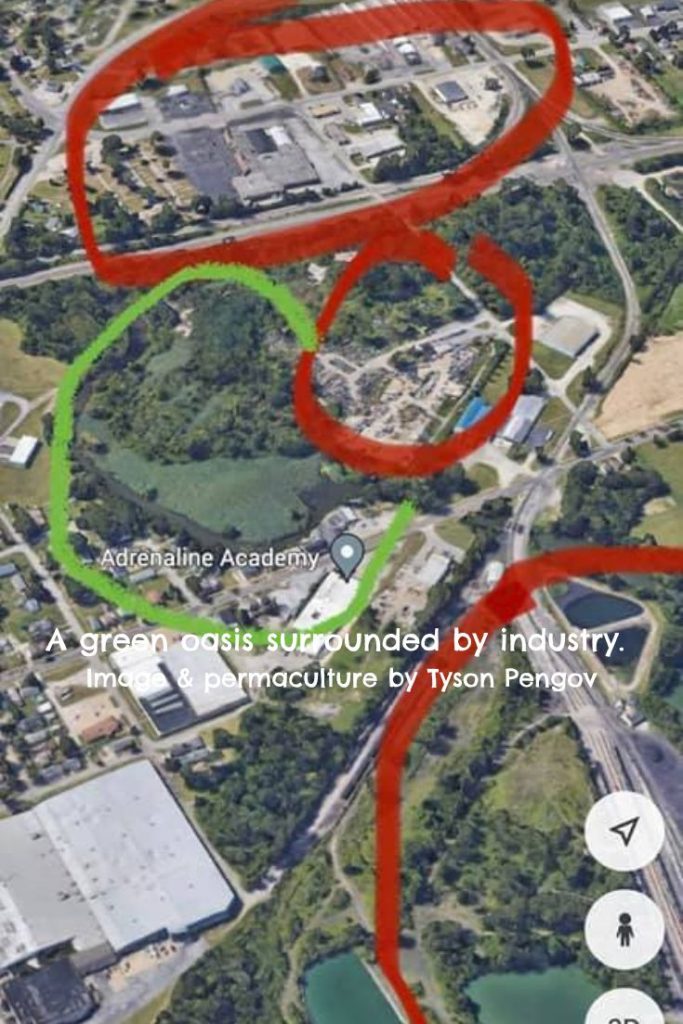
GardensAll reader, Tyson Pengov shared his fantastic organic biodynamic oasis.
I live in the middle of an industrial zone next to a junkyard, the coal docks, a couple industrial parks, and even a couple factories all with trains rolling through the middle.
I have a food forest, permaculture, bee hives with over 100 fruit trees in my garden area
~Tyson Pengov
Wow! So awesome! That green patch and circle is Tyson’s place, a permaculture oasis in the middle of a heavily industrial area.
CONGRATS and gratitude to Tyson for his valiant efforts to create a natural sanctuary and biodynamic oasis there. What’s good for him and his family is wonderful for the entire area as well.
If you don’t have it, you can create it!
Prodigal Organic Farmer
Bryan grew up on a farm… lived through his family losing a farm and is now almost full circle returned to his roots, managing another farm. Actually, we could say “full spiral”, because this circle isn’t a closed loop, but rather an ascending one. Bryan is now doing better than what he grew up knowing to do because he’s learned a new method of farming.

Bryan Wagner is an inventor and organic farmer on 500 acres in central Illinois. A seventh generation farmer, Bryan is returning to the roots of his ancestors. Use to be, organic farming was the only kind of farming there was. Bryan’s grandfather grew up knowing how. That’s just what everyone did, until that all began to change after WWII with the introduction of chemical farming.
Now organic naysayers will say that chemicals are organic, which is perfectly true. So for common ground, let’s agree that we’re speaking to naturally occurring substances known to benefit the earth and people.
We’re aiming for organic pest control that handle problems without attacking the health of the natural systems.
Editor’s Note: After we first posted this article, Bryan got to talking with his father about their farming roots, and they dug a little deeper to discover that Bryan is actually a 7th generation farmer!


For Bryan, it’s been a journey of unlearning all that he ever knew about farming and learning how to work with nature rather than fight her. As you can see by the Google Earth image, he has been a good student.

“It’s been a journey of learning how to work with nature rather than fight her.”