

Pruning tomatoes plants definitely makes a difference in your tomato production. It’s like Goldilocks and The Three Bears. Not too much… not too little… but juuuusst, right!
According to Louisiana State University Agricultural Center, LSU Ag Center, many people often overlook this simple but important part of the tomato growing process.
However, pruning tomato plants is essential to the health of the plant. You could say that pruning helps keep tomato plants from getting too full of themselves! 😉
Pruning Tomato Plants is Like Raising Children – a Metaphor
If you enjoy philosophical ruminations, here’s a metaphor that comes to mind. If not, skip to the next section. 😊
Like raising children, pruning tomatoes is a delicate balance between imbuing them with confidence (the bushy, showy leaves in this analogy), and pruning away the excess (hubris over humility). Too many leaves can detract from the best tomatoes (hubris); having enough leaves helps to protect the tomatoes for the best fruit (confidence).
Too Much Foliage Invites Issues
With the plants too bushy and full, not only is the plant working hard sending nutrients into the leaves that could be going into tomatoes, but the full foliage provides ample hiding places for garden pests that prey on your tomato plants and fruit.
Full foliage also reduces airflow which creates is also a ready environment for disease to incubate and grow, which is also a good reason to remove the bottom suckers that can grow heavy and close to–or on—the ground.
A common disease affecting tomato plants is powdery mildew, so pruning for greater airflow helps reduce this.
See also how to treat and get rid of powdery mildew.
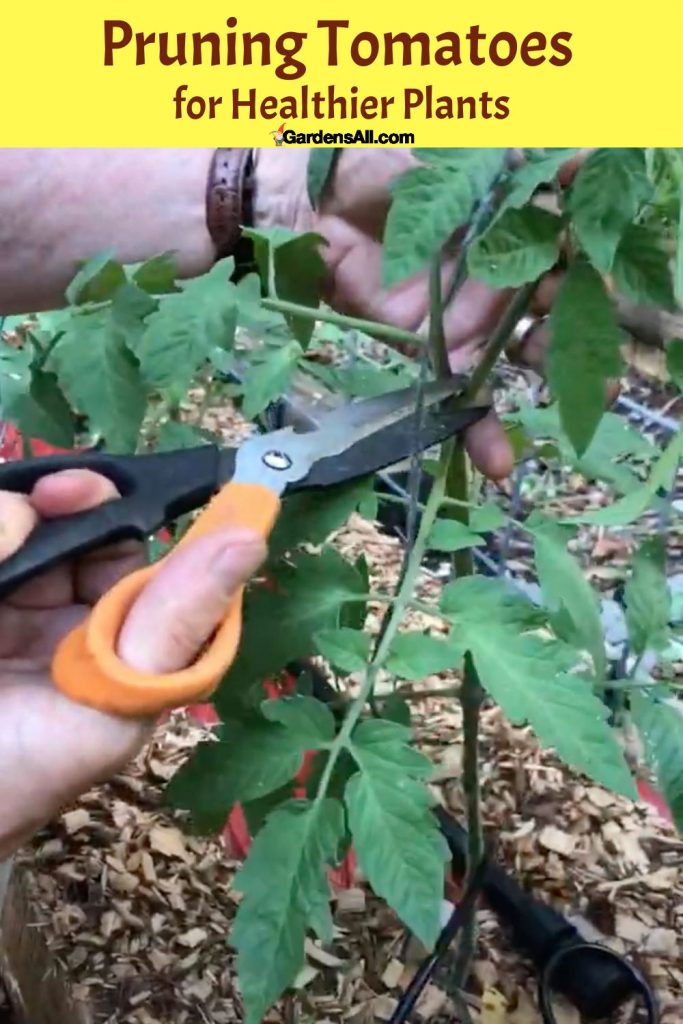
Determinant Varieties are Bushier
Before pruning, you must determine which kind of tomatoes you’re growing. Determinant – bushier variety or the indeterminate vine type? Some people have both types. We’re just growing indeterminate this year.
If you’re a beginning gardener new to growing tomatoes and not familiar with these terms, it can be confusing. To help you with that we’ve linked a helpful video by Burpee in the reference section at the end of this article.
For a quick rundown on the pruning of these kinds of tomato plants, here’s a snapshot.
Our favorite pruner is by Felco available on Amazon or your local home and hardware store. You can read more about our top gardening tools here. We appreciate that Felco even has pruners for smaller hands, as well… an often overlooked need, especially for women and children gardeners.
One of the most often overlooked growing practices is pruning tomatoes.
Excerpted from the LSU Ag Center

Pruning Tomato Plants
Excerpted from the LSU Ag Center
Tomato Pruning by Type
Determinate Type
To properly prune a determinate tomato, pinch all suckers from the ground level to the first flower cluster. See the diagram 1 below, and pinch the areas shown with red circles around them.
You will want to pinch the sucker at the base. Remove the sucker while it is small. If you wait until the suckers are the diameter of a pencil or larger, you run the risk of stripping the outer layer of tissue (the cambium layer) from the main stem. Leaving a large open wound may enable fungus and other unwanted pests to attack your tomato shrub.
A sucker is a small stem that is growing at a 45 degree angle between the main trunk and stem of a plant.
DIAGRAM 1 – Pruning Determinate Tomatoes
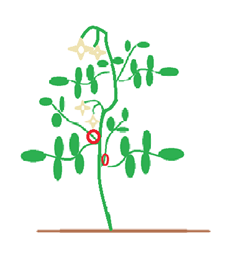
Pinch all suckers from the ground level to the first flower cluster.
Indeterminate Type
To properly prune an indeterminate tomato, prune all suckers from the ground level up to the second flower cluster. See diagram 2. Follow the same instructions as for determinate tomatoes.[1]https://www.lsuagcenter.com/topics/lawn_garden/home_gardening/vegetables/home_garden_crops/pruningtomatoes
DIAGRAM 2 – Pruning Indeterminate Tomatoes

graphic by LSUagCenter.com
Grounded or Airborne?
If Your Growing Your Tomatoes on the Ground
Now that we have the pruning of tomato plant types sorted, let’s move on to how you plan to handle them. If you are letting the plants remain on the ground, then it’s best not to prune so as to leave most of the leaves alone to protect the fruits from the sun scalding.
We know gardeners who get great results letting the plants grow naturally along the ground. However. many growers advocate staking, trellising, and/or caging their tomatoes. Each approach will require a certain amount of pruning.

Our nearby Virginia Cooperative Extension Service advises keeping the ‘maters off the ground.
Plants should be staked or caged. Trellising is an intermediate method. Though growing upward requires more initial work, this makes caring for tomatoes easier than letting them sprawl out horizontally. Since they are off the ground, fruit rots are reduced, spraying is easier and harvesting is much less work. [2]https://pubs.ext.vt.edu/426/426-418/426-418_pdf.pdf
For more on how to construct you own tomato “containers” see our article on building tomato cages. Tomato Cages you can build.
Growing vertically, saves space, protects the fruit and plants, and simplifies growing, tending and harvesting.


Staking Tomato Plants
- As the plants grow, pull the stems toward the stakes and tie loosely.
- Prune staked tomatoes to either one or two main stems.
- At the junction of each leaf and the first main stem a new shoot will develop.
- If plants are trained to two stems, choose one of these shoots, normally at the first or second leaf-stem junction, for the second main stem.
- Remove all other shoots, called suckers, weekly to keep the plant to these two main stems.
- Pinch or snap shoots off with your fingers or use a blade, scissors, or pruners for thicker stems.
Pruning with a blade, scissors or pruners helps to minimize plant damage and speed healing.
Staking and Pruning Tomato Plants
The following videos by Mark Hutton with the University of Maine’s Cooperative Extension Service, shows one way of trellising.
Staking Tomatoes – Part 1
Trellising Tomatoes – Part 2
Both the single stem and two stem pruning methods are quite similar to staking. It’s very important to leave enough leaf cover to prevent sun scald.
There are many ways to trellis tomatoes however, the basics of pruning tomato plants are the same.
Caging Tomatoes
Caging requires only minimal pruning and many say the caging method is most productive. Because there is more leaf cover, the fruits are less exposed to the sun and creatures that might consume them. Here’s a quick review of the strategies for corralling your growing crops by Burpee.
Now that you’ve seen these ideas on how to grow, control, and optimize your tomatoes, get on out there and garden! May this season bring you a cornucopia of tasty veggies!
For more on growing tomatoes, you may enjoy this article on how to grow tomatoes, which also includes a pollination tip that can significantly increase your yield.
In this article we share the jute twine method of staking tomatoes that we’re using.
We love the awesome feature image by Lukasbieri on Pixabay.
So on we grow!


G. Coleman Alderson is an entrepreneur, land manager, investor, gardener, and author of the novel, Mountain Whispers: Days Without Sun. Coleman holds an MS from Penn State where his thesis centered on horticulture, park planning, design, and maintenance. He’s a member of the Phi Kappa Phi Honor Society and a licensed building contractor for 27 years. “But nothing surpasses my 40 years of lessons from the field and garden. And in the garden, as in life, it’s always interesting because those lessons never end!” Coleman Alderson
References