

We never cease to be in awe of the amazing resources provided by this wonderful and abundant planet. As with most herbs, the uses for lemon balm plant are many and varied, and very much worth getting to know.
Botanically known as Melissa officinalis L, this perennial herb with the wonderful lemony scent is named after the bees that love it. Melissa, is from the Greek words for bee, which is also derived from the Greek word for honey.
What to Do With Lemon Balm?
So your lemon balm is thriving, (er… taking over)… and you’re wondering what are some of the additional uses for lemon balm that you can try…? That’s what got us started on this wonderful lemony journey of discover with Melissa officinali L.
We’re growing Melissa Officinalis L., in four large pots, because — like other plants in the mint family — it spreads abundantly! Our uses for lemon balm currently include for cooking, salads, garnish, dried for tea, or crushed fresh into water.
But we also wanted to expand our use of this unpretentious mint in more ways. It’s not fussy, loves to grow and puts out loads of bushy leaves full of beneficial oils and nutrients. As an edible herb, lemon balm has a subtle minty herbal lemon herbal flavor good for many culinary uses.
How is Lemon Balm Used?
Lemon balm is often used fresh, dried and as tincture, oil, salves and creams. If you don’t have time to make something with fresh lemon balm at any point in your garden harvesting processes, you can always dry it for greater longevity and later determination of usage.
Lemon Balm Forms
- lemon balm extract
- fresh lemon balm
- dried lemon balm
- powdered lemon balm
Uses for Lemon Balm
- COSMETICS –
- candles
- cream
- lotion
- oil –
- body oil
- essential oil
- soap
- CULINARY –
- edible oil
- fresh leaves
- HEALTH –
- capsules
- salve
- tea
- tincture
Abundance in Nature is Often a Clue
Abundant and prolific plants, especially those growing in the wild like dandelion, are often called weeds. Yet these tenacious plants, determined to grow no matter what, are often Mother Nature’s way of showing us which plants are beneficial for many things.
She puts the most potent plants right in front of us, often underfoot and to the point of annoyance for many, such as beneficial weeds like the mighty dandelion with many benefits.
In this age of massive and rapid content creation and proliferation, it’s easy to find lots of great information, as well as lots of misinformation. And sometimes it can be hard to know the difference.
While we value the centuries old indigenous and tribal traditional uses of plant medicine, we also like to peruse the scientific research that works to explain and verify some of the amazing properties and uses.
So let’s dig into that here with you to discover more of some of the proven lemon balm benefits for health and wellness, as well as some of the traditional uses of lore.
Culinary Uses for Lemon Balm Plant
Culinary uses for lemon balm includes infused vinegars, fresh leaves in salads and cooking, as well as baked goods and beverages, including cordials and champagne.
Beverages to Make With Lemon Balm
- Cocktails
- Tea –
- fresh lemon balm tea
- dried lemon balm leaves
- hot or cold herbal tea and tea blends
- add to black tea with stevia for sweet, minty lemon flavored tea
- Water, such as cucumber water with lemon balm
Cocktails to Make With Lemon Balm
- Benedictine
- Champagne
- Chartreuse
- Cordial
- Liqueur – Infuse into vodka for no more than 3 days. Strain. Blend with cordial/syrup/shrub to taste
- Oxymel – mixing lemon balm vinegar with honey to make an oxymel
- Shrub – Mix your lemon balm vinegar with your lemon balm cordial or syrup, to make a shrub. These are great for giving gentle acidity and structure to cocktails.
REFERENCES: Mark Williams of GallowayWildfoods.com[1]https://gallowaywildfoods.com/lemon-balm-identification-edibility-distribution-ecology/
Condiments to Make With Lemon Balm
- Jelly – you can create the lemon balm jelly using homemade lemon balm syrup or cordial
- Oil – infuse chopped fresh lemon balm in a jar covered in olive oil and steep for a week before straining
- Salad dressings – using lemon balm oil and/or vinegar
- Syrup – infuse into a 1:1 sugar:water syrup by gently heating. Cool in sterilized jars. Pour on puddings. A great cocktail ingredient.
- Vinegar – All mints infuse beautifully with cold apple cider vinegar. Infuse leaves for a week, strain and use in salad dressings
Cooking With Lemon Balm
You can use lemon balm leaves in cooked and fresh foods for a touch of fresh herbal lemon flavor and in any recipe calling for lemon zest (lemon peel).
Fresh Lemon Balm Culinary Uses
- Infused oil
- Pesto – substitute lemon balm in this parsley pesto recipe
- Salads – toss a handful of lemon balm leaves into various salads
- Sandwiches – layer lemon balm leaves on favorite summer sandwiches, such as this grilled summer squash sandwich
- Vinaigrette – infuse vinegar with fresh lemon balm leaves
Garden Uses for Lemon Balm
Deer Repellent Plant
Lemon balm is one of many deer resistant plants. So if you have a deer problem, consider placing pots of lemon balm around your garden, and especially close to plants deer like to munch on.
So if you’re growing okra, hostas, sunchokes, and other deer favorites, place lemon balm pots in and around them. For more, here’s an article on best deer deterrents, and another on perennial deer resistant flowers.
Insect Repellent
The citronella in lemon balm plants tend to repel mosquitoes and gnats when the crushed fresh leaves are rubbed directly on the skin.
Homemade Insect Repellent Spray
Alternately, you can also make homemade bug sprays from an infusion of lemon balm leaves. Add in a few other herbs for good measure, such as catnip and rosemary, or other favorites. Steep in a jar covered in witch hazel for a couple weeks. Than strain and fill a spray bottle halfway with the strained lemon balm brew. Add a few drops of lemon balm (or other) essential oil for added strength, then top with water.
Refrigerate when not in use, and it should keep for a week or two.
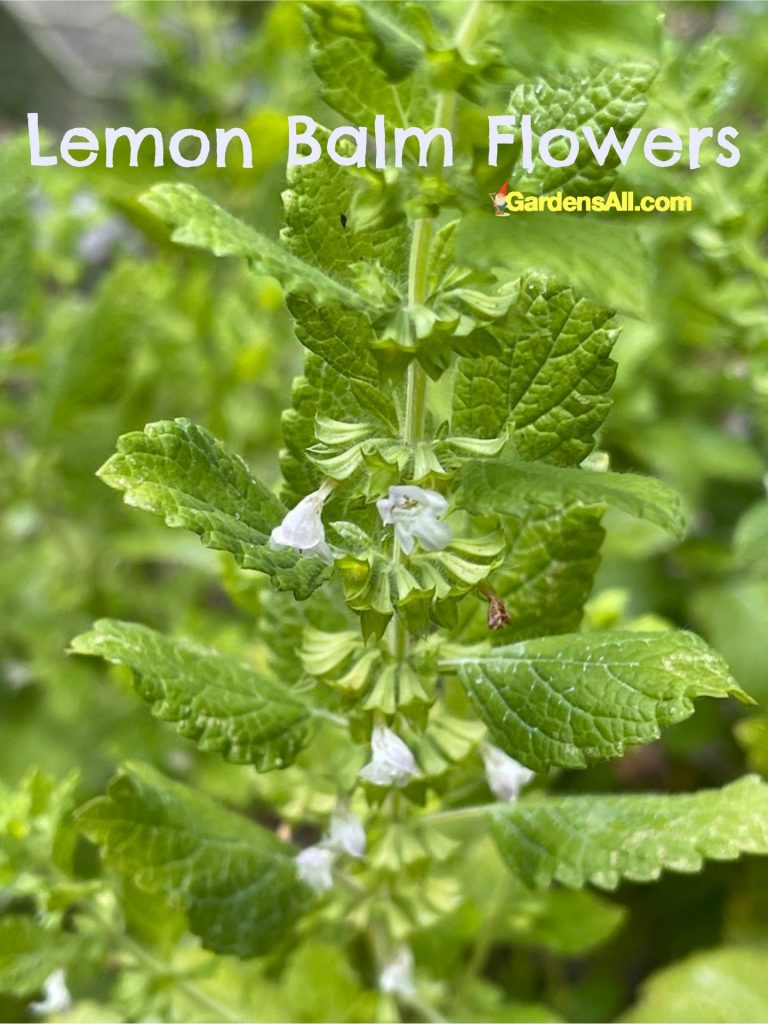
Pollinators Love Lemon Balm Flowers
Bees love lemon balm flowers. In fact, while it’s best to harvest lemon balm leaves before flowering, we let some of our plants go to flower for the bees.
SEE: Flowers for pollinators.
Weed Control
In agriculture, lemon balm is an allelopathic plant where lemon balm essential oil was studied for use in treatments of weeds that impact crops. More studies are needed, but results show promise.
Allelopathy, is the direct or indirect positive or negative effect of one species by another, and in plants, and is often used for weed control. [2] … Continue reading
Proven Medicinal Uses for Lemon Balm
Lemon balm is an herbal medicine with many proven health benefits in both traditional medicine and modern remedies.
Lemon balm’s sunny disposition is not its only attribute. People have been growing lemon balm for centuries to take advantage of the many uses of this popular herb.
FIRST: Beware of These Possible Lemon Balm Side Effects
IMPORTANT: Long term habitual use is not recommended, and anyone on thyroid medication, or suffering from thyroid or goiter issues, should avoid unless cleared and advised by your medical service provider. Always consult appropriate health professionals and discontinue use should you experience any adverse effects.[3]https://www.verywellhealth.com/the-health-benefits-of-lemon-balm-89388
Proven Health Benefits of Lemon Balm
- Alzheimer’s – Parts used: leaves & seeds[4]https://www.ncbi.nlm.nih.gov/pmc/articles/PMC6885391/#B26
- Antibacterial – kills bacterial and is an action of the eugenol[5]https://www.mountsinai.org/health-library/herb/lemon-balm
- Anti-inflammatory – an action of the rosmarinic acid[6]https://www.drugs.com/npp/lemon-balm.html
- Antimicrobial – inhibits or kills bacteria[7]https://www.mountsinai.org/health-library/herb/lemon-balm
- Antioxidant – with many health benefits[8]https://www.ncbi.nlm.nih.gov/pmc/articles/PMC8073307/#B8-molecules-26-02369
- Antiparasitic[9]https://www.ncbi.nlm.nih.gov/pmc/articles/PMC5871149/
- Antispasmodic