
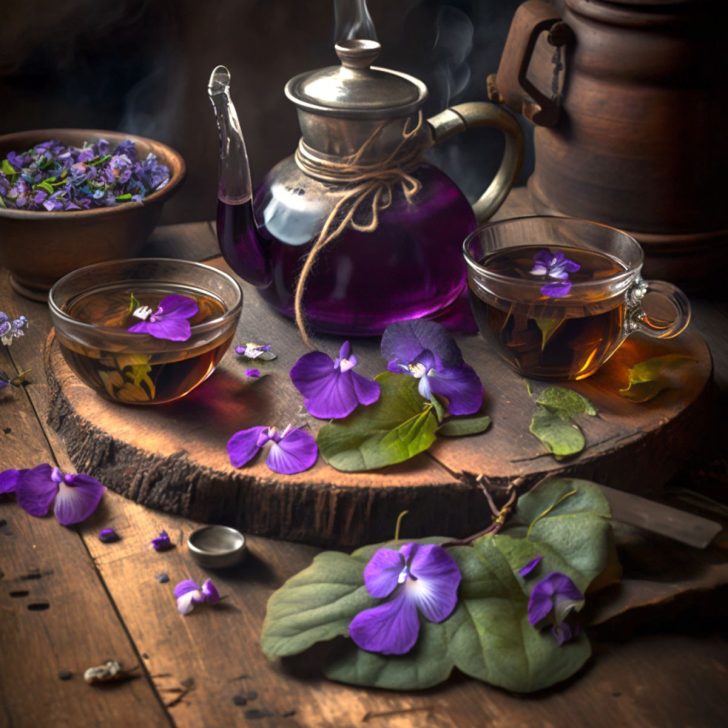
Wild violets tea is made from the leaves and flowers of the wild violet plant. You can make tea and more using wild violets leaves and flowers, either fresh or dried.
Those with manicured lawns, may curse the sight, while those who recognize wild violets benefits, will find delight in the splashes of bluish purple flowers amidst the brown leaves and slumbering lawns.
Which Are the Best Wild Violet Plants to Use for Wild Violet Tea?
The leaves and flowers of the wild violet plant contain several health-promoting compounds, including antioxidants, flavonoids, and vitamins. These nutritious and medicinal properties are believed to help reduce inflammation, support the immune system, and promote overall health and well-being.
The most common wild violets used for food and tea in North America are the Viola sororia and Viola odorata.
Most other species of wild violets also have medicinal properties and can be used for team but it is important to properly identify the species and ensure they are safe for consumption or use.
“Wild violets come in over 100 different varieties. Although they all are edible, some are more palatable than others.”
REFERENCE: University of Minnesota Extension Service[1]https://extension.umn.edu/news/wild-edibles-common-blue-violets#:~:text=Wild%20violets%20come%20in%20over,with%20varying%20hues%20of%20blue.
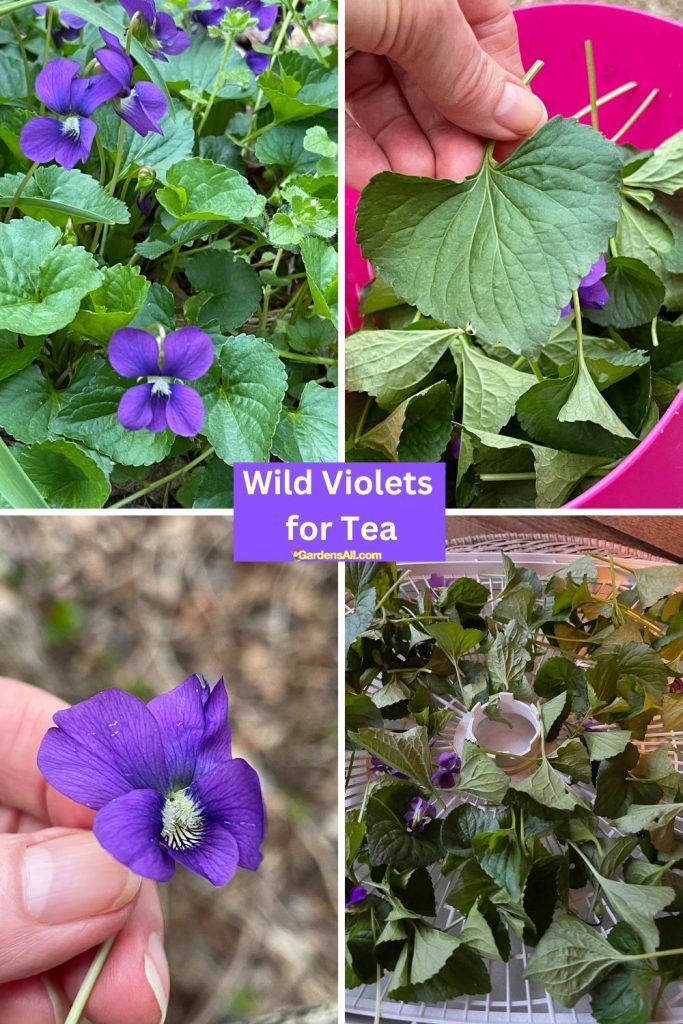
NOTE: We enjoyed using these colander harvest baskets for years now, pictured in the upper right hand corner of the image above.
How to Make Wild Violet Tea
To make wild violet tea, you can either use fresh or dried leaves and flowers of the wild violet plant. We prefer making wild violet tea from the dried leaves and flowers because it produces more flavor.
In this section we’ll cover how to make wild violet tea using both ways, using the fresh and dried herb.
How to Make Wild Violet Tea From Fresh Leaves and Blossoms
Making wild violet tea from fresh leaves and blossoms is a simple process, and the measurements are approximate guidelines with a lot of room to tweak and adapt.
Many advise boiling the leaves and blossoms, however, cooking destroys most vitamins, such as the vitamins A & C found in wild violets. So we prefer to boil the water and then pour over the herbs to steep
Use more leaves and blossoms if you enjoy stronger teas, or less for milder versions that are more like wild violet water.
Here are the steps for making ~4 servings of fresh wild violet tea:
Ingredients:
- 1 cup of fresh wild violet leaves and blossoms, roughly chopped in order to more readily release oils
- 4 cups of water
- Optional: honey and/or lemon to taste, (violet blossoms are a natural sweetener).
Instructions:
- Rinse the fresh wild violet leaves and blossoms in a strainer, and set aside to drain.
- Bring the water to a boil in a kettle or saucepan.
- Roughly chop leaves and blossoms and place in a heatproof 8-cup measuring cup or other heatproof vessel that can hold over 5 cups.
- When water is boiling, turn off heat and pour the boiling water over the fresh chopped leaves and blossoms.
- Steep the herbs in the hot water for 10-15 minutes minimum; you can also steep for hours or overnight), best to steep covered, so as to retain the heat and essence.
- Strain the tea through a fine mesh strainer into your serving container or individual cups.
- If desired, add honey and/or lemon to taste, (although if violet flowers are used, they should make the tea delightfully sweet).
- Enjoy the tea warm or let it cool and serve over ice.
Wild violet tea has a slightly floral taste (if blossoms are included), and is known for its potential health benefits, including anti-inflammatory properties and soothing effects on the respiratory system.
How to Make Wild Violet Tea From Dried Leaves and Blossoms
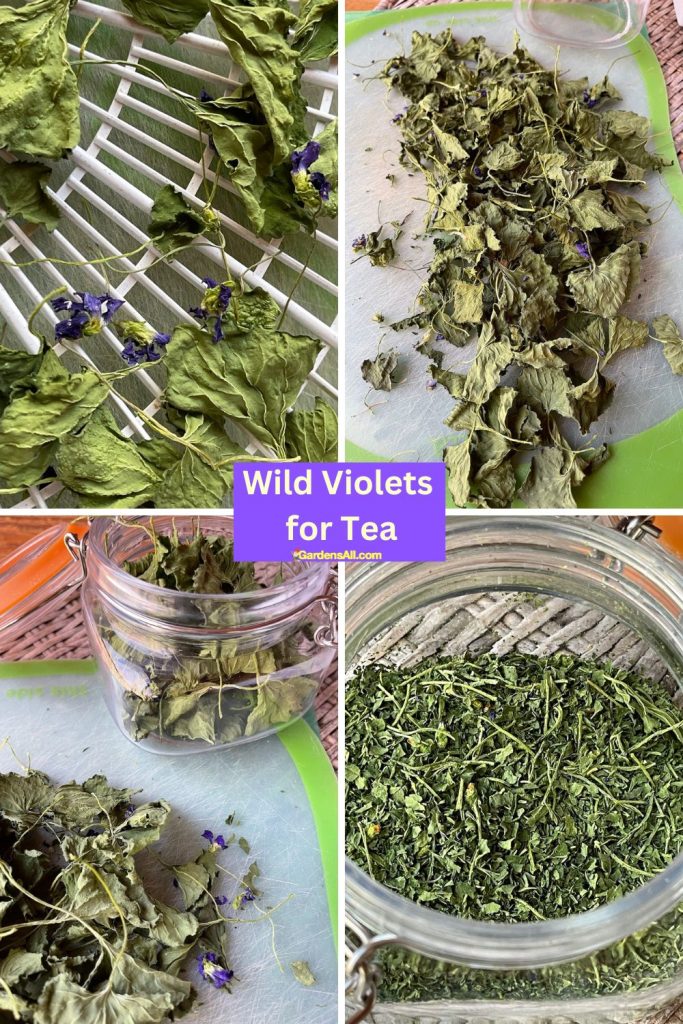
Making wild violet tea from dried leaves and blossoms is also a simple process. You can find information on dehydrating herbs here.
Ingredients:
- 1/2 cup of dried wild violet leaves and blossoms
- 4 cups of water
- Optional: honey or lemon to taste
Instructions:
- Bring 4 cups of water to boil.
- Place the dried herb in a heatproof 8-cup measuring cup or infuser teapot that can hold over 5 cups.
- When water is boiling, turn off heat and either pour the boiling water over the dried leaves and blossoms, or allow to steep in an infuser teapot with built-in strainer.
- Steep for 5-15 minutes minimum; you can also steep for hours or overnight), preferably covered in order to retain the heat and essence.
- Pour the tea through a fine mesh strainer into a heat proof pitcher (or from the infuser pot into individual cups).
- Add honey, if desired (if violet blossoms are used, the tea will be sweet without added sweeteners).
- Enjoy the tea warm or let it cool and serve over ice.
Dried wild violet leaves and blossoms can be found in health food stores or online, if you don’t have enough growing near you to harvest. Wild violet tea made from dried leaves and blossoms has a slightly more concentrated flavor compared to tea made from fresh leaves and blossoms.

Medicinal Benefits of Wild Violets Tea — Sipping Supplements
As with most herbal teas, you can use wild violet tea as a daily of periodic tonic. I consume daily herbal teas as a way of sipping supplements. Beyond that, you can use it as a mouthwash and gargle for mouth sores and for a sore or dry throat.
You can find lots more wild violets benefits here.
Wild Violet Tea Variations
Wild violet tea has a mild, slightly sweet and floral flavor, and can be enjoyed plain or with a touch of honey or lemon. I like to blend it with any combination of fig leaves tea, avocado leaves, mango leaves, strawberry leaves and dried banana peels in any combination of one or more of those.
It’s important to note that wild violet tea may not be suitable for everyone, especially those with allergies or sensitivities to plants in the violet family, (violaceae). As with any herbal tea, it’s best to consult with a healthcare professional before adding it to your diet.

Viola Sororia Plant Characteristics
Bloom Information
- Bloom Color: dark blue, purple, lilac, pale rose, or white
- Bloom Time: Late winter; early spring
Viola Odorata Plant Characteristics
Bloom Information
- Bloom Color: dark blue or purple but lilac, pale rose or white
- Bloom Time: late winter and early spring
We hope you’ll also visit our article on wild violet benefits, to discover lots more about this beneficial plant, and also these other wonderful weeds with purple flowers.

I’m LeAura Alderson, a garden, herb and plant enthusiast with a passion for discovering the many edible and medicinal benefits of the plants all around us, including the weeds, while transforming the land through regenerative permaculture practice. I am also a writer, editor and media publisher (now mostly retired due to replacement by AI), but which now allows more time to build our regenerative permaculture homestead farm.
References