
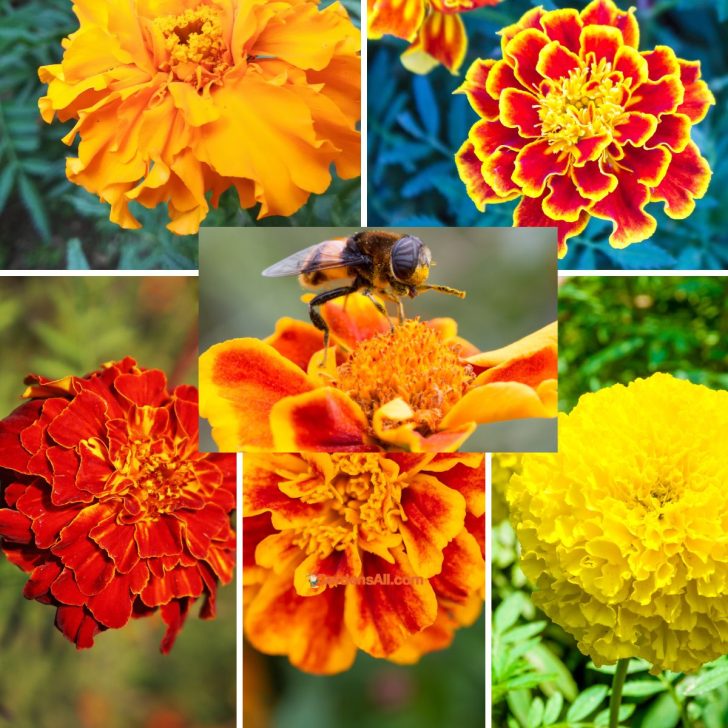
Also known as the True Marigold, the Tagetes Marigold benefits and uses is a HUGE topic because this plants offers an abundance of that!
There are many wonderful uses of Marigold Tagetes species, from ornamental to garden pest control, culinary and medicinal, the Tagetes species of Marigolds contain as many hidden treasures as they do visible ones!
Any search online for uses of marigold will bring up mostly results related to Calendula officinalis, (see Calendula benefits). However, Calendula, often called by the common name of “pot marigold”, is actually a different plant genus and is not considered a “true Marigold”.
So this article is specifically about the true marigold plant, of the Tagetes genus, (pronounced Tă-jŭh-teez), native to America and now widely cultivated and popular globally.
Tagetes spp. Marigold Scientific Name
- GENUS: Tagetes
- FAMILY: asteraceae
Tagetes is the genus name for this plant in the Asteraceae family, which is one of the largest plant families in the world.
Asteraceae numbers over 23,000 members and include mums and daisies, as well as wild flowers like daisy fleabane and Calico asters, sunflowers and sunchokes, and a number of plants, shrubs and trees.[1]https://www.britannica.com/plant/Asteraceae
Marigold Tagetes Taxonomy
- Kingdom: Plantae
- Domain: Eukarya
- Phylum: Tracheophyta
- Class: Magnoliopsida
- Order: Asterales
- Family: Asteraceae
- Genus: Tagetes
- Family: Asteraceae
- Order: Asterales
- Class: Magnoliopsida
- Phylum: Tracheophyta
- Domain: Eukarya
You can find more on the Marigold history here.
Uses of Marigold Tagetes spp.
Studies prove that several species of Tagetes contain pesticidal activity. However, some are proven, others are valid lore, some maybe myths. So we’ve created comprehensive lists on all that we’ve found and included scientific validation where available.
All marigolds have similar properties, however some of the most studied Tagetes are on the African marigold (Tagetes erecta), Mexican Marigold, (T. minuta), and French marigold, (T. patula).
If you know of other proven or traditional uses, or your own direct experience of marigold Tagetes, we’d love to hear from you.
Meanwhile, here’s are our lists compiled to date on most of the uses of marigold Tagetes, broken down by type of usage.
Garden, and Landscape Uses of Marigold Tagetes
- Attract beneficial insects
- Aromatic and attractive brightly flowered bedding plant in landscapes
- Companion plants in the garden help deter pests and disease
- Cover crop
- Can reduce growth in troublesome weeds, including:
- Pest repellent, deterrent
- deer
- rabbits
- insects
- Insects / insecticidal
- Nematode suppression, especially the root knot nematodes (Meloidogyne spp.), [2]https://edis.ifas.ufl.edu/publication/NG045
See also, our article on Marigold as Insecticidal
- Nematode suppression, especially the root knot nematodes (Meloidogyne spp.), [2]https://edis.ifas.ufl.edu/publication/NG045
- Plant Diseases:
- Bactericidal – Fungus / Fungicidal – T. minuta essential oil showed inhibition against Aspergillus niger[3]https://pubmed.ncbi.nlm.nih.gov/31724710/
- Viruses – some plant viruses have been found to be remediated by some Tagetes compounds.
Consider planting marigolds and other deer resistant flowers around plants that deer love, such as hostas or okra plants, to help repel deer from eating them.
Insecticidal Uses of Marigold Tagetes
An extensive study on the the French marigold (Tagetes patula), identified the ability to repel numerous of the hemiptera “true bugs”:
- aphids [4]https://pdfs.semanticscholar.org/a21e/eba9c5719d37f9aff99b8f8aa2b206d826d9.pdf
- bed bug [5]https://www.ncbi.nlm.nih.gov/pmc/articles/PMC7237031/#pone.0233511.ref029
- caterpillars[6]https://www.ncbi.nlm.nih.gov/pmc/articles/PMC7237031/#pone.0233511.ref031
- grain/seed beetles[7]https://pubmed.ncbi.nlm.nih.gov/23778081/
- leaf hopper[8]https://www.ncbi.nlm.nih.gov/pmc/articles/PMC7237031/#pone.0233511.ref022
- lice[9]https://www.ncbi.nlm.nih.gov/pmc/articles/PMC7237031/#pone.0233511.ref028
- mites, (nematicides)[10]https://www.ncbi.nlm.nih.gov/pmc/articles/PMC7237031/#pone.0233511.ref034
- mosquitoes / mosquito larvae – T. erecta (African), T. minuta (Mexican), T. patula (French)[11]https://agris.fao.org/agris-search/search.do?recordID=US201302426621[12]http://www.ijps.ir/&url=http:/www.ijps.ir/article_1860.html
- sand flies[13]https://www.ncbi.nlm.nih.gov/pmc/articles/PMC7237031/#pone.0233511.ref021
- termites[14]https://www.ncbi.nlm.nih.gov/pmc/articles/PMC7237031/#pone.0233511.ref027
- ticks (acaricides)