
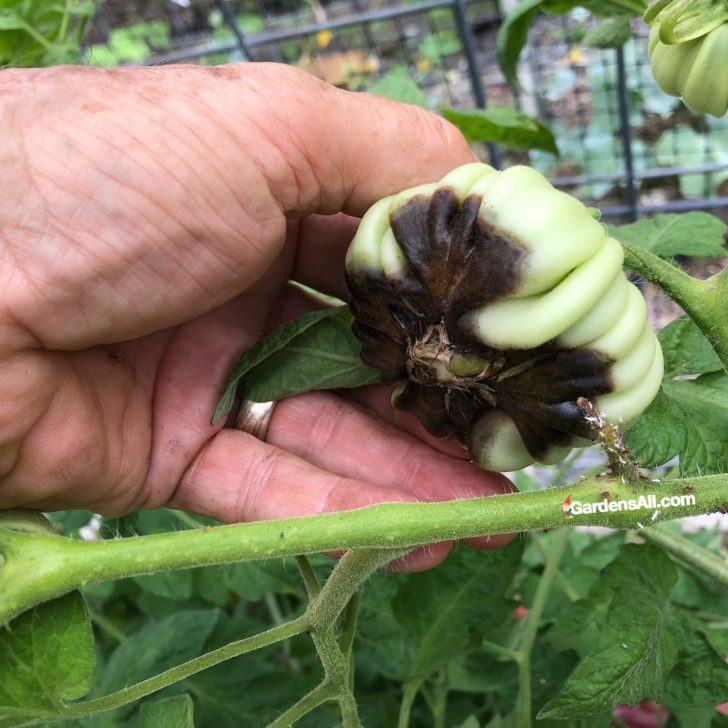
It’s always alarming to discover your prized tomato plants afflicted by disease. This past week we found and are treating Tomato Blossom End Rot on our tomatoes plants.
Blossom End Rot, (BER) is a common physiological disorder that can cause significant yield loss for both commercial farmers and home gardeners.
Fortunately, there are solutions that will make a difference in your tomato harvest, beginning with understanding its causes and how to prevent it. This article will delve into the causes, symptoms, and natural remedies for tomato blossom end rot.
Are your tomatoes suffering from something else? Check out tomato diseases.
Don’t Panic – There’s Good News
If you discover this ugly malady on your tomatoes, don’t worry, don’t panic and don’t rip out those plants! The Blossom End Rot is remedial and typically short lived.
Blossom-end rot is often a passing problem, occurring only on the first and second clusters of fruit.
University of Tennessee Extension Service[1]https://extension.tennessee.edu/publications/Documents/SP277-Y.pdf
Succeeding clusters then may show no problems, with no action taken by the grower.
What is Tomato Blossom End Rot?
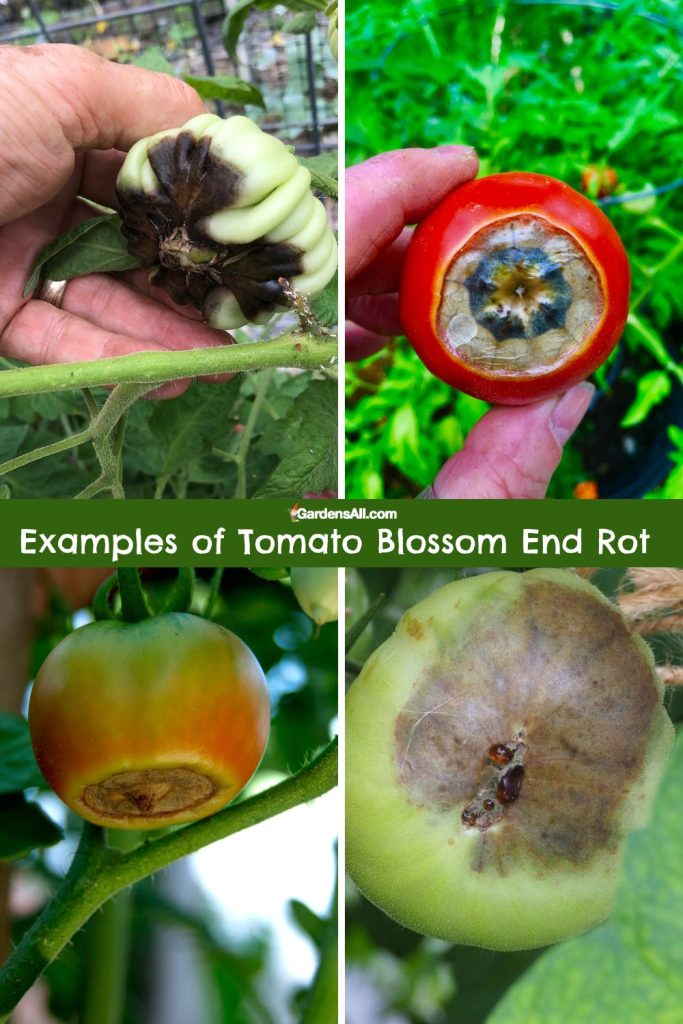
Tomato blossom end rot manifests as water-soaked spots on the blossom end of a tomato fruit, the end opposite the stem. These spots grow larger and darken over time, resulting in a rotten, leathery appearance on a portion of the fruit’s surface.
BER does not appear to affect the tomato plant leaves, just the fruit.
Is Tomato Blossom End Rot a Disease?
Blossom End Rot is a disorder rather than a disease, meaning it is not caused by pathogens (fungi, bacteria, or viruses), and so it is not contagious. However, the damaged fruit portion often attracts secondary fungal or bacterial infections and insects, which hasten fruit rot and loss.
Causes of Tomato Blossom End Rot
At its core, BER is a calcium transportation issue in the plant that shows up in the developing fruit. While a deficiency in soil calcium can be a cause, often the problem is not the lack of calcium in the soil, but the plant’s inability to transport available calcium to the fruit.
Calcium Deficiency in Tomato Plants
When it comes to BER, it may not be that your soil is deficient in calcium.
- Inconsistent watering: Irregular or extreme fluctuations in soil moisture levels can affect the plant’s ability to absorb and transport calcium. Both overwatering and underwatering can lead to BER.
- Rapid plant growth: A fast-growing plant may not be able to transport calcium quickly enough to its fruits, leading to a localized deficiency.
See also: Fast growing plants - Damaged roots: Any damage to the roots from over-fertilization or from garden pests can impair the plant’s ability to uptake nutrients, including calcium.
See also: How to get rid of voles (who may be eating your plant roots). - High soil salinity: High salt levels in the soil can interfere with the plant’s calcium uptake.
- Nutrient imbalances: High levels of nitrogen from over-fertilizing, or high levels of other cations* such as magnesium and potassium, can also interfere with calcium absorption.
- Susceptible varieties: Some tomato varieties are more susceptible to BER than others.

*A Note About Cations and Bioavailability of Nutrients
Cations are positively charged ions. They are created when an atom or a molecule loses electrons. In the context of soil science and plant nutrition, common cations include calcium (Ca++), magnesium (Mg++), and potassium (K+), among others.
The relevance of cations to plant growth and the development of conditions like Tomato Blossom End Rot lies in the way plants absorb nutrients from the soil. Plant roots take up most nutrients in ionic form, and the balance of different ions can affect how well plants can absorb and utilize these nutrients.
For example, when soil contains high levels of certain cations such as magnesium and potassium, these can compete with calcium for uptake by plant roots, potentially causing or exacerbating a calcium deficiency in the plant, even if there is plenty of calcium in the soil. This is one reason why maintaining a balanced nutrient ratio in the soil is important for preventing conditions like Tomato Blossom End Rot.
Even if your soil has adequate calcium content, high magnesium and potassium content can interfere with a plants calcium absorption.
Natural Prevention and Remedies for Blossom End Rot (BER)
Fortunately, several natural strategies can prevent and mitigate Tomato Blossom End Rot.
- Consistent watering: Maintain even soil moisture by watering consistently, especially during dry spells. Drip irrigation systems and mulching can both — individually and collectively — help to regulate soil moisture levels.
See also: Red plastic mulch for tomatoes, and also wood chip mulch. - Balanced fertilization: Avoid excessive nitrogen fertilizer that leads to rapid vegetative growth at the expense of fruit development. Also, use a balanced fertilizer that does not contribute to excess of potassium or magnesium which compete with calcium absorption.
- Plant health: Keep plants robust and healthy, reducing susceptibility to BER. This includes practices such as crop rotation, proper spacing for air circulation, and organic soil amendments to improve soil structure and health.
- Calcium amendments: If your soil is genuinely deficient in calcium, you can use amendments like:
- bone meal
- calcium supplements (we used calcium supplements blended in water):
- added to the plant base
- applied as foliar sprays for a temporary quick fix
- eggshells, rinsed, crushed and powdered [see more instructions below]
- gypsum
- lime
- Monitor soil pH: Calcium availability to plants is highest when the soil pH is between 6.5 and 7.5. If your soil pH is too low or too high, lime or sulfur can be used to adjust it.
- BER Resistant Varieties: Choose Blossom End Rot resistant tomato varieties and avoid susceptible ones. (We cover both types below).
Myth or Truth… Do Calcium Foliar Sprays Work?
Calcium solutions can be used as a quick, albeit temporary, solution for treating Tomato Blossom End Rot (BER). This is typically done through a foliar application, where a calcium solution is sprayed directly onto the plant’s leaves.
Mixed Messages
We found conflicting information between two university extension services, but one study showing positive results in foliar calcium spray. You can read those below.
Another study about calcium spray applied to the tomato fruit showed no effect whatsoever, which of course makes sense, given that the tomato skin makes the fruit impervious.
Clemson University Extension Service Says it’s a Myth:
Calcium that is present in leaves is not able to move through the phloem into the fruit. In addition, the skin of the fruit is not able to directly absorb foliar-applied calcium. As a result, foliar calcium sprays are not effective.
Clemson University Extension Service[2]https://hgic.clemson.edu/gardening-myths-fix-blossom-end-rot-with-calcium-sprays/
The University of Tennessee Extension Service Says Calcium Foliar Sprays may Help:
Calcium chloride sprays applied to the foliage may help prevent blossom-end rot on developing fruit.
University of Tennessee Extension Service[3]https://extension.tennessee.edu/publications/Documents/SP277-Y.pdf
Scientific Study on Foliar Application of Calcium
A 2019 study shows that calcium spray applied to tomato plant leaves improves growth, yield and quality of tomato cultivars.
NOTE: Another study that applied calcium spray to the tomato FRUIT, showed no improvement whatsoever.
“It was concluded that the tomato cultivar Rio grande should be sprayed with calcium @ 1.5% for better growth, yield, quality and minimal blossom end rot infestation.”
[4]https://www.researchgate.net/publication/336071445_Foliar_application_of_calcium_improves_growth_yield_and_quality_of_tomato_cultivars
Our Take
More studies are needed, as the one cited is limited in the number of varieties and results. However, since the foliar spray was shown to be beneficial for at least one variety, we figure that we might as well use it.
We’re making calcium water for the plant roots anyway, so it’s not much more effort to also apply it as a spray, and a battery powered garden sprayer makes quick work of it.
How to Treat Tomato Blossom End Rot
Calcium Water Recipes
Simple Calcium Supplement Water
We use approximately 12 calcium pills per 1 gallon of water.
INGREDIENTS:
- ~12 Calcium pills
- 4 Qts. water
INSTRUCTIONS:
- Blend a handful of calcium pills (approximately 1 dozen) in a blender with 1 quart of water
- Pour calcium water into a water pitcher and add ~3 more quarts of water and stir.
- Water base of tomato plants with calcium water


Simple Eggshell Calcium Water Recipe
INGREDIENTS:
- Clean eggshells (about a dozen)
- 1 quart of water
STEPS:
- Rinse the eggshells to remove any egg residue.
- Dry eggshells completely, (you can place in the sun, a dehydrator or oven warmer setting for quicker drying).
- Crush the eggshells into a fine powder. A coffee grinder works well for this.
- Blend (using a blender or shaker bottle) the crushed eggshells into the water and steep overnight.
- Pour the calcium water into a spray bottle.
To apply, thoroughly spray the plant’s leaves with the calcium solution, ensuring you cover both the tops and bottoms of the leaves. The best time to spray is early in the morning or late in the evening to prevent the sun from scorching the leaves.
Remember, while this foliar calcium application can temporarily help address BER symptoms, it’s essential to also address the root causes like inconsistent watering, rapid plant growth, damaged roots, high soil salinity, or nutrient imbalances to prevent recurrence.
Moreover, while eggshells are a good source of calcium, the calcium may not be immediately available to plants as it takes time to break down in the soil. That one reason we favor the calcium citrate supplements, which should be more readily bioavailable as compared to eggshells. although it’s not been studied or proven, it seems like a reasonable guess for now.
Then there are other methods such as adding lime or gypsum to the soil or using commercially available calcium sprays may offer a more immediate remedy.
But what does your soil need? The best way to know for sure is to do a simple soil test to determine your soil’s calcium and pH levels before making any significant amendments.
Tomato Blossom End Rot Resistant and Susceptible Varieties
If your favorite tomatoes on in the most susceptible list, don’t worry. You can still grow them armed with the prevention tips listed previously. Knowing which varieties are more susceptible, simply helps us to take more preventive measures.

12 BER Susceptible Tomato Varieties
Factors contributing to a higher susceptibility in some varieties include the fruit’s size, the plant’s growth rate, and its preference for specific climate conditions. Calcium uptake can be a challenging process and these tomato types tend to struggle more with the right balance, leading to a greater risk of developing BER.
- ‘Beefsteak’
- ‘Big Boy’
- ‘Brandywine’
- ‘Celebrity’
- ‘Cherokee Purple’
- ‘Early Girl’
- ‘Mortgage Lifter’
- ‘Mushroom Basket’
- ‘Orange Accordion’
- ‘San Marzano’
- ‘Supersteak’
- ‘Yellow Pear’
12 BER Resistant Tomato Varieties
Some varieties exhibit a higher resistance to the condition due to certain genetic characteristics and their ability to more effectively manage calcium uptake and distribution within the plant. These resilient tomato types often have a more balanced growth rate and are typically better adapted to a broader range of soil and climate conditions, making them less likely to experience drastic changes in water uptake, which can trigger calcium deficiencies leading to Blossom End Rot.
- ‘Ace 55’
- ‘Amelia’
- ‘Better Bush’
- ‘Celebrity’
- ‘Champion II’
- ‘Heatmaster’
- ‘Kewalo’
- ‘Mountain Fresh Plus’
- ‘Mountain Merit’
- ‘Roma’
- ‘Solar Fire’
- ‘Sun Leaper’
In Summary
Tomato blossom end rot can be a frustrating problem for tomato growers, but with understanding and proper management, it can be significantly reduced. Implementing these natural remedies and prevention strategies will help ensure a healthy and bountiful tomato harvest, free of the disappointment of BER.

I’m LeAura Alderson, a garden, herb and plant enthusiast with a passion for discovering the many edible and medicinal benefits of the plants all around us, including the weeds, while transforming the land through regenerative permaculture practice. I am also a writer, editor and media publisher (now mostly retired due to replacement by AI), but which now allows more time to build our regenerative permaculture homestead farm.
References