
We love the concept of edible hedges and landscapes toward expanding food options. There are many plants that are both ornamental, edible, and also medicinal. The best of both worlds of beauty and function.
For years we’d only planted for beauty and aesthetics, mainly because we live in the woods where it’s been too shady for a full on vegetable garden. But in the last couple years we finally cut down a few scrub pines to let in more light to make room for a vegetable garden.
But beyond the garden, we’re really getting into planting edible plants as a part of foodscaping with edible landscaping whenever possible. When the plant is beautiful and has food benefit, it’s a win. If that plant is lovely, can be eaten, AND has medicinal benefit, it’s a win-win-win! One of our favorite examples is nasturtiums.
While edible flowers like the perennial nasturtiums may not be the best for edible hedges, they are a great accompaniment to the design and planning of an edible landscape along with edible ground cover plants. Edible perennials can make for lovely borders and accents to an edible hedgerow.
When it comes to plants for hedges, there are many shrubs and trees that can be trained and pruned to be effective fences and hedgerows.
Multipurposing Plants for Fences, Food and Health
We’re all about leveraging time by planting perennials, when available, and multi-purposing whatever we can. So when we first saw examples of creative fencing using edible plants, trees and shrubs, we were intrigued to learn more and to try some.
But first, let’s cover the pros and cons of edible hed
RELATED: Perennial vegetables to grow
GROW A FENCE! Instead of building a fence… plant it, grow it, eat it and use it!
Growing Edible Hedges
When planting a hedge why not make it dual purpose and create an edible hedge? It will mark your boundaries, or block unsightly views plus provide healthy food, herbs and even medicine while adding landscape beauty. A win-win situation!
If you’re tight on space and want to use as much of that space for growing food, all the more reason to plant edible hedges. While you’re at it why not consider planting edible ground cover plants too?!
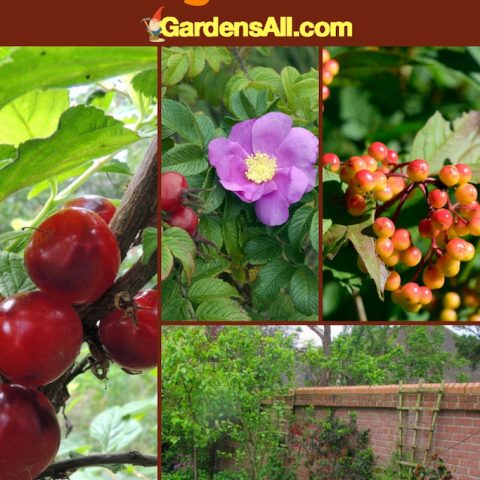
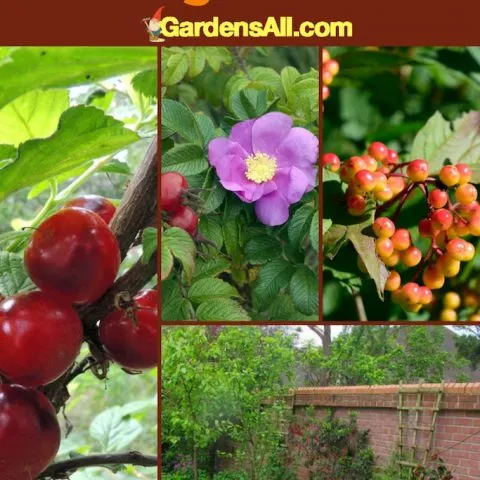
The lovely English garden below offers example of the edible hedge concept. It’s not entirely an edible hedge or edible fence, but it’s so beautifully arranged where the edibles hug the perimeter walls surrounding the small lawn area blending flowers and staging plants by height from smallest in front to tallest in back. Smart, efficient and lovely!

In the following photo, that perimeter brick wall could also serve as perfect for growing espalier fruit trees. Walls add support, radiant warmth, and protection from the elements.


Uses for Edible Hedges
Consider what purpose you need your edible hedges to serve.
- To keep out wildlife and dogs, select hedge plants with sharp thorns such as blackberry, gooseberry, and rugosa rose. Plant these thickly so they fill in quickly, forming an impenetrable wall.
- For an evergreen hedge that won’t lose its leaves. Depending on your area, these might include citrus, natal plum, sweet bay, and rosemary
- For edible berries, consider elderberry, blueberries, mahonia, blackberry or raspberry
- Edible vegetables might include asparagus, corn and sorghum
- Seasonal hedges can include beans, peas, squash and other vining vegetables, growing on attractive trellis fences that should be fine even for picky home owners associations.
- Nut bushes such as hazelnuts (filberts) make an attractive edible hedgerow
Fruit Trees for Fencing and Edible Hedges
Fruit trees trained espalier style can make artsy and elegant edible hedges. Naturally, these will require work to build the desired structures and time to train and prune them to shape. Or, you can simply plant them close together than for an orchard and keep them trimmed more hedgellike, as cropped or freestyle as you like.
Most fruit trees can become edible hedges, however, may be better espaliered because you won’t want fruit bearing trees to be crowded together. If growing too closely together, the interior fruits would be hard to harvest and inclined to rotting on the branch from age, bugs and disease.
Fruit Trees for Edible Hedges Best for Espalier Fences
- Apple
- Blueberry
- Cherry
- Citrus
- Fig
- Kiwi
- Peach
- Pear
Here’s more on espalier apple trees and other fruit trees.
EDIBLE HEDGES
There are many types of plants, shrubs and trees that can serve as an edible hedge. We’re featuring some of the favorites below here, listed alphabetically by name of the fruit or vegetable. But first, here’s a longer list of many of the best options for edible hedges.
Plants that are more trees than shrubs, are good for taller edible hedges, however, you can also keep them pruned to be shorter and smaller. Herbs like lavender and rosemary can make low hedgerows that are good for defining landscape areas and perimeters.
The list of possibilities is vast and includes many varieties that most people are not familiar with considering that few of the hundreds of edible plants are actually sold in stores. We’ve included bamboo, which young shoots are edible, however, it’s also very much a functional plant. From fishing poles to a bean teepee trellis, tomato supports and pea trellises, growing bamboo is like growing garden tools.
So this list is a start and includes some familiar and some that may be new to you, as they were for us. But this is a start to get us all thinking on and exploring some of the many options.
List of Edible Hedges, Including Herbs, Plants, Shrubs, and Trees Good for Edible Landscapes
Some of these are expanded on further below this list.
- Asparagus
- Bamboo – (Arundinaria & Phylostachys species); choose clumping varieties to prevent bamboo invasion
- Bay leaf tree or shrub – Willow Bay (Laurus nobilis)
- Blackberries
- Blueberries
- Camellia
- Chokeberries – Aronia melanocarpa
- Cornelian cherry dogwood
- Cranbush, American var. – (Viburnum trilobum)
- Currants
- Espalier fruit trees
- Gooseberry
- Huckleberry – (Vaccinium ovatum Pursh)
- Lavender
- Lingonberry
- Mahonia, (Mahonia aquifolium), AKA Oregon grape
- Mulberry – (Morus nigra)
- Natal plum – (Carissa macrocarpa), fragrant flowers, edible fruit, zones 9-11
- Oregon Grape – (Mahonia aquifolium)
- Raspberries
- Roses – especially, R. acicularis, R. rubiginosa, R. rugosa (make very good flowering hedges), & R. villosa for the largest rosehip fruit
- Rosemary – tall growing varieties for hedges; low growing, creeping variety for edible ground cover
- Serviceberry – (Amelanchier alnifolia), AKA Juneberry, the Saskatoon var. is the most flavorful