
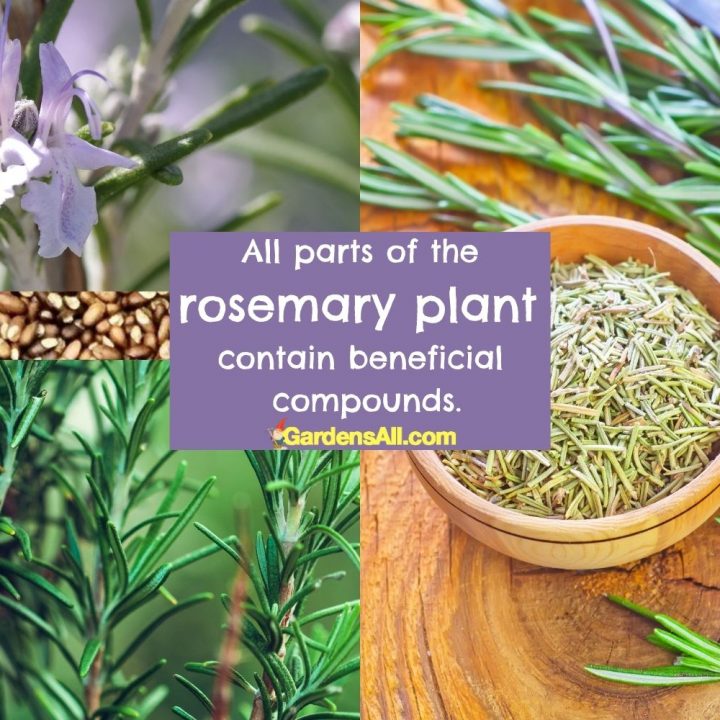

Rosemary Benefits and Uses Backed by Scientific Research
When thinking of rosemary, it’s easy to get lost in casserole, salad and holiday recipes because of its popularity in the mainstream as a culinary herb. However, health benefits of rosemary take it well beyond palate pleasing flavoring.
Scientific research has shown that rosemary, Salvia rosmarinus, (formerly known as Rosemary officinalis or Rosmarinus officinalis prior to 2017) is also a very useful aromatic and medicinal plant. In fact, the health benefits of rosemary essential oil place it alongside some of the best known healing herbs, including that of hemp and CBD oil.
A shrub with fragrant, evergreen, needle-like leaves and white, pink, blue, or purple flowers, Rosemary is native to the Mediterranean region. Later in this article, we discuss how rosemary is thought to contribute to health and longevity, especially in one Italian village.
Rosemary is of the Lamiaceae family of plants, along with basil, lemon balm, mint, oregano and sage, all beneficial culinary and medicinal herbs.
When it comes to the health benefits of rosemary, science is proving what folk medicine knew long ago.
~GardensAll.com

Uses for Rosemary Essential Oil
Rosemary essential oil has a wide range of uses either externally or internally. External applications include diffusers or infused in products like balms and shampoo. Internal applications include food, teas and tinctures.
So exactly what does rosemary essential oil do, and how does it work in everyday usage? In this article, we go over some of the most well-documented healthy benefits of rosemary in the human body, as well as its most popular uses around the house.
Modern medicine is the descendant of traditional plant medicine.
Modern Versus Traditional Medicine
Plant medicine and natural healing from herbs has been around for thousands of years as compared to the past 150 years or so of modern medicine in the form of pharmaceuticals as we know it today. The first pill for an ill was aspirin, which evolved from over 3,500 years of use first in its natural form as white willow bark.
But today, more are returning to plant medicine such as the potent benefits of rosemary essential oil. Add to that homegrown, garden fresh foods, and you’ll have nature’s best food and medicine at your fingertips.
RELATED: What is holistic medicine?
The prana — vital life force — in fresh herbs and vegetables, conveys that vibrancy to us.
~GardensAll.com

Herbs Are Cheap and Easy to Grow
Growing herbs is like growing your own medicine and cost so little in comparison to pharmaceuticals. Powerhouses of preventive and medicinal properties, herbs are easy to grow and don’t take up much space. Herbs are also easy to harvest, process and preserve as well, like lemon balm and lavender.
Many pharmaceuticals have negative side effects. Sure, some herbs can as well, which is why it’s important to learn, study and experiment carefully and with proper professional guidance and books. However most plant “side effects” are actually benefits in the way of more nutrients, flavor and health.
If we could give every individual the right amount of nourishment and exercise, not too little and not too much, we would have found the safest way to health.
~Hippocrates, physician, Father of Modern Medicine, c. 460 BC-375 BC
4 Well Known Benefits of Rosemary Essential Oil
- PAIN RELIEF: If you’re suffering from chronic pain or swelling due to gout, tennis elbow or a sprain, consider making use of rosemary essential oil’s analgesic and anti-inflammatory properties. It also aids in blood circulation and coagulation, making it a solid bet for dressing wounds, gashes and scratches.
- ANTIBACTERIAL / ANTIMICROBIAL: Because of rosemary’s established antibacterial and antimicrobial benefits, rosemary essential oil is a very good candidate for use in massaging the lymph nodes. Use recommended amount of essential oil and combine it with a carrier oil such as almond, avocado or virgin coconut oil (cold pressed is always best). Work rosemary infused oil into the insides of the elbows and base of the neck, you get a lasting aromatherapeutic boost to the immune system to fight off diseases caused by free radicals.
- DETOXIFIER: Rosemary essential oil’s role as a natural detoxifier aids tremendously in promoting and maintaining optimal liver function, particularly in the regulation of bile flow. This makes rosemary a viable form of treatment for various symptoms of indigestion, including gas, constipation, bloating and stomach cramps.
- HAIR LOSS PREVENTION: Rosemary essential oil is a very common ingredient in shampoo, conditioner and hair treatment products. This is because rosemary is replete with carnosic acid, a powerful antioxidant effective at combating the nerve damage and tissue degeneration that leads to hair loss. This nourishes hair from root to tip by promoting ample blood supply which stimulates follicles and even helps eliminates dandruff.

23 Health Benefits of Rosemary
- Analgesic – pain relief [1]https://pubmed.ncbi.nlm.nih.gov/25635991/
- Anti-anxiety (see more best herbs for stress relief)
- Antibacterial[2]https://www.ncbi.nlm.nih.gov/pmc/articles/PMC6165352/
- Antidiabetic [3]https://pubmed.ncbi.nlm.nih.gov/18063331/
- Antimicrobial[4]https://www.ncbi.nlm.nih.gov/pmc/articles/PMC6165352/
- Anti-inflammatory [5]https://www.ncbi.nlm.nih.gov/pmc/articles/PMC7491497/#B25
- Antinociceptive (pain reduction) [6]https://pubmed.ncbi.nlm.nih.gov/17223299/
- Antioxidant [7]https://www.ncbi.nlm.nih.gov/pmc/articles/PMC4227022/