
Eat the Weeds… Don’t Spray Them!
Eat those weeds instead! Well, some of them. So many of the plants that we treat as pests in our lawns are both tasty and nutritious backyard edible weeds you can eat instead of pulling or poisoning them.
If we were on a hike and saw a head of broccoli or kale, we’d know what that was and that we could eat it. If it was growing in our yard, we’d harvest it for food.
Well, similarly, there are many wild edible plants even in our yards! Weeds you can eat are there waiting and ready to be plucked as food, tea, holistic remedies and more. For instance, some of the weeds add more nutrients to your soil than they use. Others, provide pollinator flowers for bees and butterflies.
Learning about wild edible weeds and plants expands our awareness on what’s possible. Beyond that, knowledge of the benefits and uses of edible weeds can lighten our grocery bill, nourish our bodies and help in preparedness and survival skills should we ever need to survive on edible plants in the wild.
DISCLAIMER: The information in this article and site cannot be construed as medical advice or health advice. We are not medical professionals and are only sharing information gleaned from our own experience, study, and research.
7 Benefits of Edible Weeds You Can Eat
- Free… gifts from Mother Earth!
- Adds variety to your diet
- Often readily available
- Many are rich in nutrients
- Most have medicinal benefits
- Valuable to know about as survival foods
- They’re locally grown!!!

Imported Staple Foods
Did you know that some of the common weeds people pay money to kill today were brought over by our European ancestors to plant as food crops? Yep! We’ll get into a few of them here and link to a few others by the end of this.
Today, Americans regularly kill the plants our ancestors brought with them for survival food and medicine.
Many Wild Plants and Weeds Are Edibles
If you’re a regular reader here at GardensAll.com, you’ll have noticed that we’re big on wild edibles and even weeds you can eat as a valuable food source. Many of them are often pulled as weeds—or worse—poisoned to kill out.
Sorry to say that we did that for years. Can’t even explain why we weren’t more aware sooner. Clearly we weren’t thinking! Anyway, now we’re making up for it by harvesting our backyard edible weeds as much as practical.
Now, everytime we encounter a new plant our first thoughts are, “Is it edible and/or medicinal?”
GardensAll.com
Growing Edible Weeds on Purpose
We’re also planting and growing some edible weeds on purpose. Our favorite wild weed you can eat, that we love and value, but most people curse (!), is Dandelion!
We’ll link those other articles at the end of this one in the footnotes and references. Meanwhile, grab your clippers! Here are three weeds you can eat that are probably growing in your backyard right now.
First up is a plant named for the animal that likes it.
WEEDS YOU CAN EAT
- Burdock, Arctium lappa – edible stems and taproot, available on Amazon to plant, as dried root and as tinctures
- Chickweed, Stellaria media
- Dandelion, Taraxacum officinale
- Garlic Mustard, Alliaria petiolata – all parts edible, but considered highly invasive, so easier to find seeds than the plants.
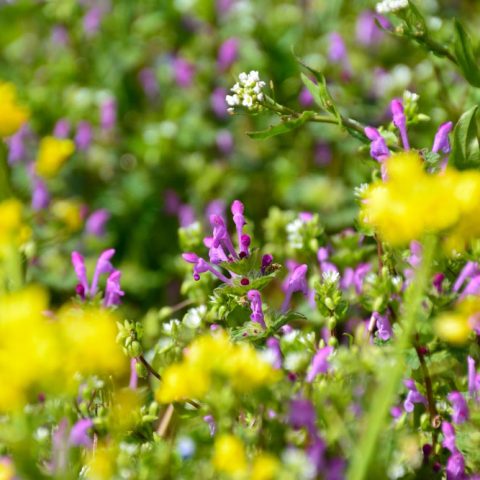
- Henbit, Lamium-amplexicaule
- Lamb’s Quarter, Chenopodium album
- Marsh Mallow Plant – Althea officinalis
- Plantain, Plantago major
- Sheep Sorrel, Rumex acetosella – (seeds available on Amazon)
- Violets, Viola odorata
- Wood Sorrel (Oxalis spp.) – a beautiful ornamental as well, in many colors, seeds on Amazon
Check out Chickweed
Chickweed (Stellaria media) is a cute, low growing plant with oval-shaped leaves that grow in an opposite pattern. Chickweed’s tiny, white flowers have five petals that are so deeply divided that they look like ten petals until you examine them closely. You’ll begin to see this spreading plant in winter in the temperate states, and everywhere by spring.
Look around the base of trees for chickweed, in dappled sun areas, and against raised beds and house foundations. Chickweed is extremely delicious with a taste similar to a mild spinach. Leaves and flowers are edible, cooked or raw.

Nutritionally this small plant gives big returns. One serving of chickweed (about 3.5oz) can provide the following RDA’s (based on a 2,000 calorie diet):
- 53% of your potassium needs
- 121% of your calcium needs
- 300% of your Vitamin A needs
- 625% of your Vitamin C needs
- 1407% of your iron needs (What?!)

Chickweed is also rich in magnesium, B vitamins, zinc, manganese, and dietary fiber. This plant is no joke, and is one of the more nutritious weeds you can eat and is routinely found in backyards.
Nutritionally, chickweed is a small plant that gives big returns.
Trim the tops of your chickweed patch, and let it re-flush before harvesting more. It should grow continually and spread.
Add the leaves raw to green juices and salads. You can top sandwiches with chickweed, or saute them. Fresh chickweed pesto is a flavorful, green tasting treat.
Chickweed May Aid Weight Loss
- Anti-obesity due to reduction of absorption of fat storage[1]https://bmccomplementmedtherapies.biomedcentral.com/articles/10.1186/1472-6882-12-145
“Stellaria media may prevent high-fat-diet induced fat storage in adipose tissue by inhibiting the intestinal absorption of dietary fat and carbohydrates through inhibition of digestive enzymes.”
~2012 Study on anti-obesity activity of Henbit – Stellaria media

Chickweed Recipes
Chickweed Pesto
INGREDIENTS:
- 3 cups of fresh chickweed leaves
- 1/2 cup extra virgin olive oil
- 2 cloves of garlic, minced
- 1/4 cup of pine nuts (optional)
- salt and pepper to taste
DIRECTIONS:
Add all ingredients to a food processor, and blend until a smooth paste forms. Add salt and pepper to taste. Will keep in the fridge (covered) for about 10 days.
Potato Leek Soup or Vichyssoise Recipe with Chickweed
Here’s one more of our favorite recipes where we substitute chickweed for watercress when our chickweed is in season.
Vichyssoise is a creamed soup of potatoes and leeks. We add fresh watercress or chickweed greens to ours. Yo