

The many varieties and cultivars of the Camellia sasanqua plants are treasured by fall gardeners. The sasanqua variety of camellias are hardy plants with lustrous evergreen foliage and a vast array of fall blooms.
But camellias are so much more than beautiful flowering bushes. Besides beauty, there are many benefits and uses for the Camellia plant. We’ll get into that soon but first we want to briefly share our home garden visit and more about the Camellia sasanqua specifically.
Last Sunday we enjoyed a visit to Will and Kate Ferrell’s amazing landscape garden near High Point, NC. The focus was on their majestic array of fall-blooming camellias (Sasanqua type) but we also saw many other wonderful plants there as well.
The Ferrell’s are avid landscape gardeners, and it’s always a pleasure to pass the time talking plants with fellow gardening enthusiasts. Will really knows his plants.
Check out the video here.
Camellia Sasanqua for Prolific Autumn Blossoms
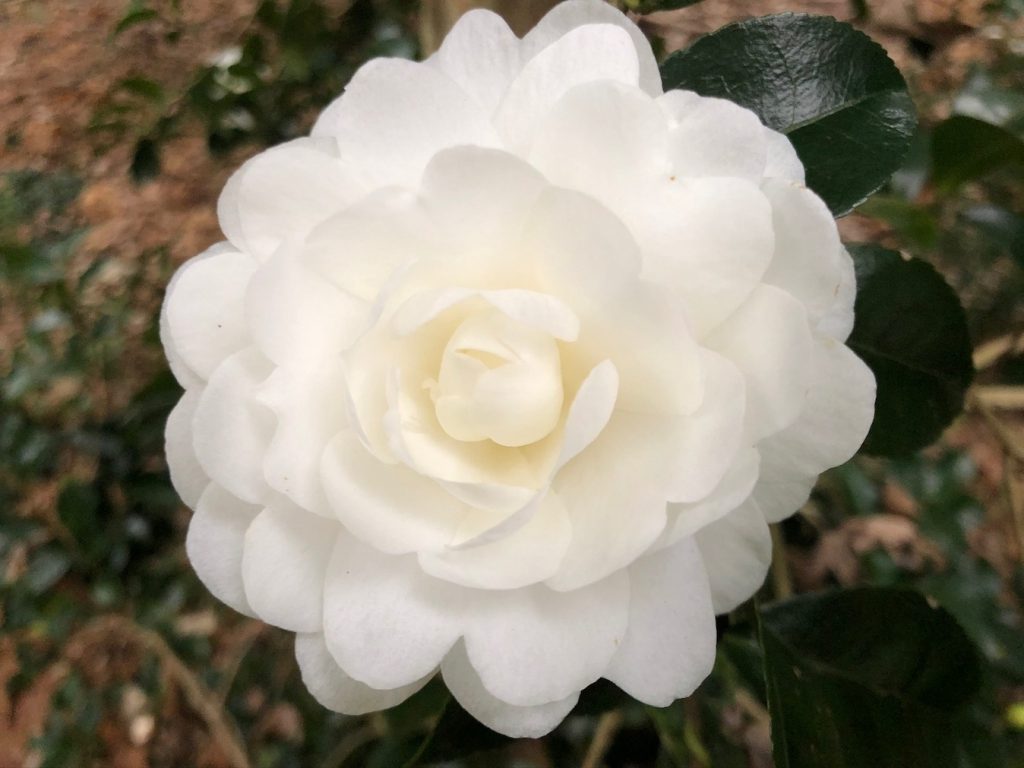
Autumn Moon Camellia Sasanqua
This gorgeous white Camellia is an incredible deep blossom of many layers of petals. The closer you get the more beautiful she is.
Camellias
Camellias come in a huge variety of species. Their taxonomy yields over 250 and counting.
They are all members of the tea family, and while the Camellia sinensis is most common camellia used for tea, cosmetics and health supplements, specific to being cultivated for tea.
If you’ve ever enjoyed real tea, it came from the Camellia plant in the Theaceae family, and most probably the Camellia sinensis variety, specifically.
Another species, Camellia sasanqua, is treasured by fall gardeners for its lustrous evergreen foliage and the vast array of fall blooms offered by so many splendid varieties and cultivars.
Growing Camellia Sasanqua
Many gardeners have discovered how easy it is to grow camellias. Here’s a quick guide.
- FLOWERS: Fall, Winter blooming Camellia, October-April
- NAMES: Camellia sasanqua, Thea sasanqua
- FAMILY: Theaceae
- ZONE: Zones 7-9
- SIZE: Slow growing up to 9′ tall and 5′ wide
- SOIL: Well-drained organically rich soil, slightly acidic soil
- SUN: Dappled sunlight, perfect woodland or partial shade plant
- TYPE: Evergreen shrub
- AVOID: Avoid planting beneath shallow rooted trees that compete for water and nutrients
Soil Treatment
- Perform soil test
- Add pH acidifier if needed
- Add organic material- leaf compost, decayed bark mulch, peat moss or similar
Planting
- Early spring or late fall
- Supply adequate moisture for roots to grow
- Space individuals five feet or more apart
- Hedgerow plantings three feet apart
How to Plant a Camellia
The American Camellia Society recommends these 9 steps for planting a camellia.[1]https://www.americancamellias.com/care-culture-resources/general-culture-requirements/planting-camellias
- Dig a hole at least two feet wider than the root ball.
- Leave some soil in the center of the hole undisturbed to prevent settling.
- Place the root ball on a mound of soil in the center of the hole.
- The top of ball should be slightly above soil level.
- When planting a container-grown plant, wash soil from root ball and pull open tightly bound roots
- Fill the hole around the root ball with a topsoil and organic matter mixture.
- Build a 3′ berm of soil around the plant to prevent water from running off.
- Mulch with straw or other organic matter around the plant.
- Water well after planting and soak once a week during dry weather.
Amazing Benefits of Camellias – Especially Camellia Sinensis
As if their beauty weren’t enough, these amazing plants are also full of beauty and medicinal benefits! While most of the best medicinal properties are not concentrated in the C. sasanqua variety, we thought you’d want to know a little about this amazing Camellia sinensis too.
You can see here, an overview of Camellia sinensis tea plant.
Camellia Sinensis Oil Benefits [2]https://www.organicfacts.net/health-benefits/oils/camellia-oil.html
- balances cholesterol levels
- lowers blood pressure
- improves hair health
- speeds up wound healing
- reduces inflammation
- good for skin care
- improves bone health
- reduces cancer risk, especially prostate cancer[3]https://www.sciencedirect.com/science/article/pii/S1021949815000897
- boosts the immune system
- protects against oxidative stress
- stabilizes high blood pressure
- osteoporosis
- Treats cold & flu
- respiratory infection,
- eczema
- psoriasis
- acne
- weak immunity
- brittle hair
- hair loss
- dandruff
- wounds
The essential oil is from the seeds of the tea plant, Camellia sinensis, or the Camellia oleifera plant. The Japanese tea oil is made from Camellia japonica which has significantly different attributes.
Camellia sinensis extract also comes in tincture and supplement forms.
Camellia Oil is High in:
- oleic acid – omega 9 fatty acid
- linoleic acid – omega-3 polyunsaturated fatty acid
- alpha-linolenic acid – omega-3 polyunsaturated fatty acid[4]https://www.ncbi.nlm.nih.gov/pmc/articles/PMC4350958/
- stearic acid – a saturated long-chain fatty acid and main ingredient in shea and coconut butters.
- vitamin E
- calcium
- potassium
- triterpenes – accelerate the healing of wounds and tissue
- saponins – decreases blood lipids, lowers cancer risk and lower blood glucose response
- squalane – more hydrating to the skin that all other oils[5]https://biossance.com/pages/what-is-squalane
For more on flowers, you may enjoy this article on purple flowers and knockout roses, which are lovely from spring through fall.
Camellia – the Green and Black Tea Plant
You can make tea from any Camellia plant. The most popular for plant for caffeinated black tea besides the well known Camellia Sinensis leaves are the Camellia sasanqua and Camellia Japonica.
If you’re interested in health and wellness, then you’re familiar with the many health benefits of green tea. While we’ve enjoyed tea for years, we’ve only recently thought to look into growing our own. How wonderful to be able to grow a Camellia bush for landscape beauty and then to also harvest leaves as well as blossoms for making your own tea!
If you’re in zone 7 or warmer, you may be able to grow your own tea plants.
Camellia Sinensis
Camellia sinensis is the Camellia plant leaves most often used for making tea.[6]https://senchateabar.com/blogs/blog/camellia-sinensis All Camellia leaves and even the blossoms can be used to make tea, however the Camellia sinensis is universally favored for flavor, caffeine and medicinal content.[7]https://theteagardener.com/[8]https://www.americancamellias.com/care-culture-resources/the-camellia-family/camellia-sinensis-backyard-tea[9]https://camellia5.azureedge.net/assets/Journal-0608-Backyard%20Tea.pdf
We’re thoroughly enjoying home brewed tea from our Camellia sasanqua bush. It’s reminiscent of fresh black tea with hints of green tea and sweet clove.
You can buy Camellia tea plants at select sellers online as well as through Amazon sellers.
Camellia Sasanqua Tea
Yes, you can indeed use Camellia sasanqua for tea![10]https://plantaddicts.com/are-camellias-poisonous/#:~:text=There%20are%20several%20species%20of,caffeinated%20green%20or%20black%20tea. The caffeine and nutrient content aren’t likely the same as C. Sinensis, however, it still contains many of the beneficial camellia oils, and we thoroughly enjoy the flavor. Your can dry the leaves and blossoms of your Camellia plants to add to water and step for tea.
Whenever trying a new plant tea or herb, always test a small cup to make sure it’s agreeable to you before harvesting and preparing more.
The new spring growth are favored for making the best Camellia tea, however, we harvest from our bush whenever we want or need more black tea! 🌸🫖🍵
Grow a Camellia bush for landscape beauty and homemade black and green tea.
Most popular for tea is sinensis, but you can make tea from all Camellias.
Alabama Beauty Sasanqua – Fall Blooming Camellia
The Alabama Beauty Sasanqua Camellia has elegant rose-red to deep pink blossoms.


Autumn Sunrise Sasanqua – September Blooming
Autumn Sunrise, my 1st sasanqua to bloom this fall, today. Same day as last year but 4 days later than 2019.
An interesting tendency for sasanquas of a particular cultivar to bloom earlier the further north it is, the opposite of most everything else.
Enjoy many more beautiful flowers that bloom in fall here.


If it’s fall and you’re already future visioning into spring, you may want to check out this article on flowers to plant in spring by hardiness zone.
Wishing you great gardens and happy harvests!


G. Coleman Alderson is an entrepreneur, land manager, investor, gardener, and author of the novel, Mountain Whispers: Days Without Sun. Coleman holds an MS from Penn State where his thesis centered on horticulture, park planning, design, and maintenance. He’s a member of the Phi Kappa Phi Honor Society and a licensed building contractor for 27 years. “But nothing surpasses my 40 years of lessons from the field and garden. And in the garden, as in life, it’s always interesting because those lessons never end!” Coleman Alderson
References