
A Special Visit by a Rare Bird
Having our bird feeders just outside the home office windows invites pleasant distractions. It’s refreshing to eyes and psyche to occasionally look up from our cyber windows and gaze at the wildlife outside our real windows.
Bird watching (and even the squirrel acrobatics at the bird feeders) is a pleasant distraction and reminder of the wonderful natural world especially in winter, when we’re more housebound.
Time in nature—even if from the window—is wonderful for putting life into perspective, and for appreciating the simple things. We never ever grow tire of enjoying and appreciating the wonders of nature, and her surprises.
Nature is full of life, wonder and sometimes……….. surprises!
White Cardinal in the Neighborhood
The other day, we spied a bright flash of white moving from the feeder into a beech tree. Could it be…? Could it be that cardinal “ghost’… that special natural anomaly rumored to be gracing our woods?

Well, actually, it’s more than a rumor. My mother-in-law, Carol, had been seeing this special bird for weeks. Her bird feeder is positioned closer to the window at her breakfast table where she enjoys breakfast watching the birds and squirrels.
One morning she phoned us excitedly, saying there was a white cardinal at her feeder. But of course, by the time we ran over, (she lives next door), it was gone.
Then over the next few weeks, Carol enjoyed almost daily visits by this special bird. She tried getting photos, but it was a challenge to get good ones.


We determined that, the next time it came to the feeders, we’d be ready with a camera. We could then share our amazement and explore this phenomenal coloration.
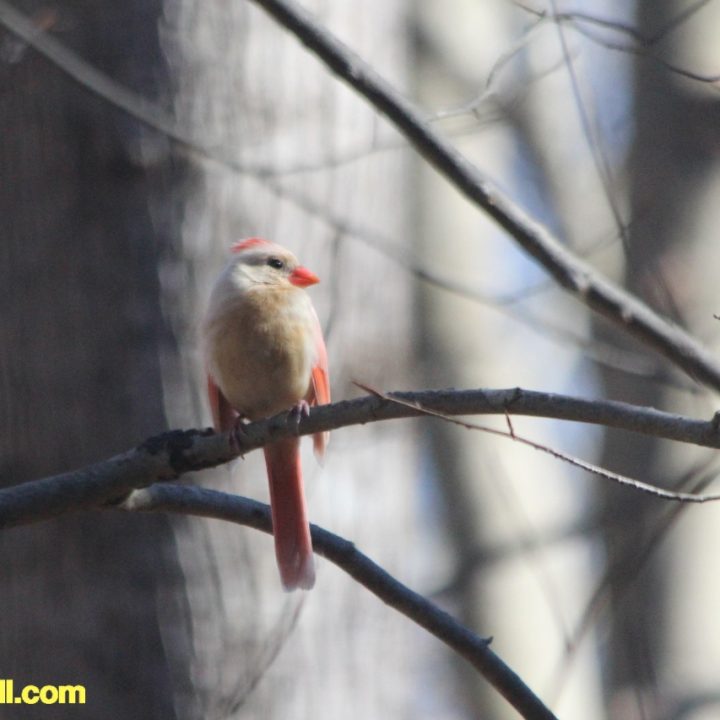
Not only did this lady (we’re pretty sure it’s a she-bird) grace us with her presence, she came in close and posed! We took numerous still shots and a short video.
White Cardinal Bird
This lovely white cardinal bird has been hanging out around our bird feeders lately. We’re pretty sure it’s a she, and she seems to be more shy than the male and female red cardinals. She’s easily scared away, often not to return until perhaps the next day.
This white cardinal is very attentive and observant. We’ve watched her look and listen and examine the entire scene at the feeder and everything beyond that, before she finally flew in to feed. This time we were ready and she stayed long enough for some good shots and even a video clip.
White Cardinal Photos

About White Cardinals
The white cardinal has a condition known as “leucism”, brought on by a lack of melanin-producing enzymes that can cause a whitish appearance (albinism).
Given that our particular visitor still has the reddish coloration of a typical female, and dark colored eyes, she’s a “partial-albino” as opposed to a completely white, pink-eyed creature. Her pallet of brownish and greenish coloration is missing. [1]https://www.sibleyguides.com/2011/08/abnormal-coloration-in-birds-melanin-reduction/

Leucism
There are many reasons for the condition of leucism that causes a red cardinal to look more white, so it’s quite difficult to deduce specific causes. Partial albinism, as seen in our white cardinal, happens occasionally in many species, including birds, but true albinos are quite rare. [2]https://www.sibleyguides.com/2011/08/abnormal-coloration-in-birds-melanin-reduction/
Albinism in Cardinals — White Cardinal Facts
- Most white cardinals are only partially albino
- Approximately 1 out of every 1800 cardinals are white cardinals
- Often short lived being so easily spotted by predators
- Odd coloration may deter mating due to birds’ keen sense of color
- In birds, albinism more frequently affects the brown pigments than the yellows
Bird Rescues
How fortunate we are to host such a unique creature. As you likely know, we love birds and have done numerous bird rescues. Among the rescues have been several cardinals-both male and female.
We have shared some of our bird rescues in previous articles, as well as the “home-boy” window deflectors, in case you noticed and wondered about those strings hanging over our windows). You can find these below. The deflectors are in the red cardinal article, that includes great photos and a video.
Here’s one with a red cardinal, and another story about a hawk and a kinglet, and another about a white-throated sparrow rescue.
This delightfully rare appearance reminds us that detaching from our big and little screens now and then in order to connect with the natural world is a good thing. Who knows what surprises may await?

Cardinals Are Beneficial for the Garden
Cardinals: aphids, beetles, codling moths, cotton bollworms, cotton cutworm, grasshoppers, leafhoppers, scale insects, slugs, snails, and stink bugs. YAY! We definitely need to attract cardinals around to help with stink bugs!
RELATED: Birds that eat mosquitoes and other garden pests.
White Cardinal Bird on Video
Sorry about the noise and voices on this video. We’ll create a silent version when we have time. For now, please just turn your volume off. You won’t need it at all for this short clip.
Cardinal’s Lifespan
Cardinals tend to live to around 3 years in the wild, however, average 14 years in captivity. The oldest recorded cardinal in captivity lived to be 28.5 years old!!
As we might imagine, their shorter lifespan in the wild is due to many factors, especially predators. From eggs to grave, cardinals do live a challenging life.
Excerpt From Penn State on Cardinal’s Lifespan
“Northern cardinals are preyed upon by owls, small hawks, and house cats. Their nests may be raided by chipmunks, blue jays, crows, and a variety of snakes. Also, cowbirds are common nest parasites, and northern cardinals compete with catbirds and mockingbirds for nesting sites.
SOURCE: The Pennsylvania State University, PSU
Before you go, here’s one more exotic bird treat encountered in our neighborhood.
The Neighborhood Peacock on the Road in NC
Periodically, we hear the uniquely loud and haunting sound of a lonely peacock. He lives down the street from us at a small farm that has small goats. Sometimes, especially in spring, we hear him searching for a peahen. He’s a precocious fellow, roaming neighbors yards and even flying to up to rooftops and treetops.
For more on this beautiful creature, check out our neighborhood peacock photos and video.
Grateful for nature’s many wonders!


G. Coleman Alderson is an entrepreneur, land manager, investor, gardener, and author of the novel, Mountain Whispers: Days Without Sun. Coleman holds an MS from Penn State where his thesis centered on horticulture, park planning, design, and maintenance. He’s a member of the Phi Kappa Phi Honor Society and a licensed building contractor for 27 years. “But nothing surpasses my 40 years of lessons from the field and garden. And in the garden, as in life, it’s always interesting because those lessons never end!” Coleman Alderson
References