
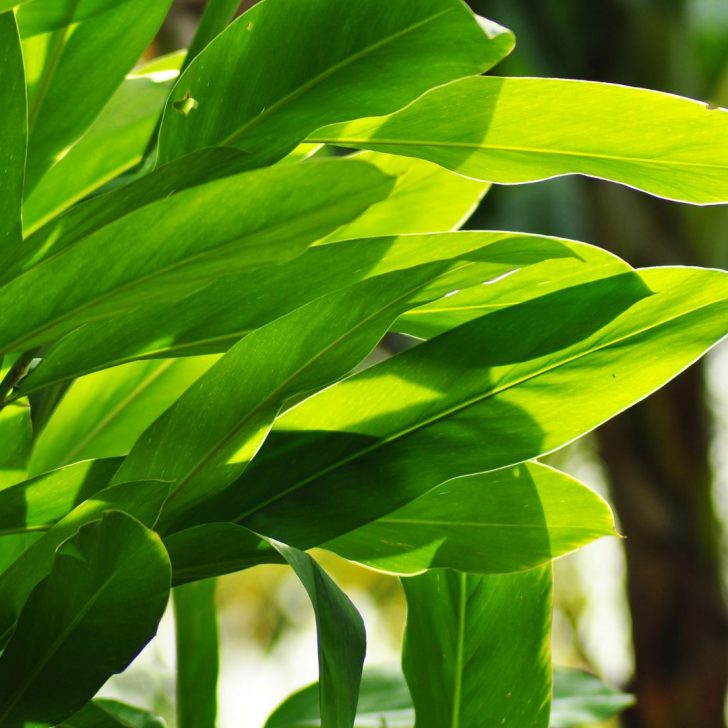
Most people are familiar with the vast and beneficial uses of ginger root, (rhizome, actually). But did you know that you can also make good use of ginger leaves?
That’s what I wondered about as my son, Nikolai, was pruning his ginger plant. His white butterfly ginger had gotten so tall that the long stalks were falling over and getting broken. So naturally I wondered about uses of ginger leaves and if they’re edible and/or medicinal.
The answer is “yes”, ginger leaves are edible and medicinal! The young ginger shoots are eaten raw, steamed or sauteed, especially in Asian countries and tropical zones where ginger grows abundantly, both cultivated and wild. But the most common use for ginger leaves in North America is ginger leaf tea.
The ginger leaf has been proved to have great potential to be developed into functional foods and other health products, because it has higher antioxidant activity than rhizomes and flowers!
Ginger leaves are higher in antioxidants that the ginger rhizomes or flowers.
REFERENCE: 2019 Study on clinical and health benefits of ginger.[1]https://www.tandfonline.com/doi/full/10.1080/09064710.2019.1606930
Proven and Traditional Use of Ginger Leaves
Ginger leaves, also known as ginger plant leaves or ginger shoots, have been used for centuries in traditional medicine and culinary practices.
While we’ve created quite a list here, there are so many proven and traditional ginger leaf uses and benefits that we finally had to stop for now, but please know that for all of these there’s still more, as well as more studies underway.
- Cosmetic
- Culinary
- Cooking
- Seasoning
- Tea
- Insect repellent
- Medicinal & health benefits
- calming
- digestion
- essential oils
- extracts/tinctures
- inflammation
- pain
- skin health
Cosmetic
Ginger compounds are used in skin and hair care products in the form of ginger oils, lotions, creams, shampoos and conditioners. In addition, ginger’s antifungal and antibacterial qualities are put to use in helping to preserve cosmetics as well as enhance them.[2]https://www.ncbi.nlm.nih.gov/pmc/articles/PMC9110206/
Culinary Use of Ginger Leaves
Ginger leaves are used in some Southeast Asian and Caribbean cuisines as a flavoring agent. They can be used in marinades, curries, soups, stir-fries, and fresh or dried for ginger leaf tea, which is how we like to use it.
Health and Medicinal Use of Ginger Leaves
The studies we link under in this article are by no means, representative of all the various studies and research available. Rather, it is to provide examples of scientific proof as to ginger leaf benefits, which validate (or otherwise) traditional use of ginger leaves.
In both Traditional Chinese Medicine, and modern China, the ginger plant is used in about half of all herbal prescriptions.
REFERENCE: Clinical aspects and health benefits of ginger.[3]https://pubag.nal.usda.gov/catalog/6464256
Antibacterial – Against Dental Caries and Plaque
The ginger (Zingiber officinale Roscoe) leaves contain a volatile oil rich in valuable phytoconstituents and found to be effective on dental bacteria and plaque.[4]https://japsonline.com/admin/php/uploads/2717_pdf.pdf
Further, a study on the essential oil from ginger leaf versus rhizomes, indicated that both the leaf and rhizome oils were moderately active against certain bacteria.(https://www.sciencedirect.com/science/article/abs/pii/S0308814610007727))
Anti-inflammatory Properties
Ginger leaves contain compounds that have anti-inflammatory effects. Research has shown that these compounds can help reduce inflammation in the body, which can help alleviate conditions such as osteoarthritis, rheumatoid arthritis, and asthma.
Antimicrobial Benefits
Studies show the efficacy of ginger extract as a natural antimicrobial, alone as well as in symbiotic combination with black pepper and thyme extracts.[5]https://applbiolchem.springeropen.com/counter/pdf/10.1007/s13765-018-0352-x.pdf[6]https://www.ncbi.nlm.nih.gov/pmc/articles/PMC6616534/[7]https://pubmed.ncbi.nlm.nih.gov/25572733/
Antioxidant Properties
Ginger leaves are rich in antioxidants, which help protect the body from damage caused by harmful molecules known as free radicals. Antioxidants can help reduce the risk of chronic diseases such as cancer, heart disease, and Alzheimer’s disease.[8]https://www.tandfonline.com/doi/full/10.1080/09064710.2019.1606930
Eleven out of 14 species of ginger leaves (78%) had significantly higher antioxidant values
REFERENCE: Study published in 2011 on free radicals and antioxidant property of ginger leaves.[9] … Continue reading
in the leaves than in the ginger rhizomes.
Aromatherapy Benefits
The essential oil extracted from ginger leaves has a pleasing, calming aroma that also has proven medicinal benefits. Ginger essential oil and extract, as well as ginger leaf tea, can be used in aromatherapy to promote relaxation and alleviate stress, with studies that indicate its anti-anxiety and calming benefits (anxiolytic).
Some studies show health related benefits from inhaling ginger essential oil, which can come from the leaves, stems and/or rhizomes. In particular, the anti-nausea benefits of ginger combined with lemon has shown to reduce nausea symptoms, and stimulate salivary gland production that is typically negatively impacted from chemotherapy for throat cancer.[10]https://pubmed.ncbi.nlm.nih.gov/26051575/[11]https://pubmed.ncbi.nlm.nih.gov/28042578/
Calming and Stress Reduction
As indicated above under ‘Aromatherapy’, ginger is used to help calm the body and alleviate stress.
NOTE: While that is the perception of people using ginger essential oil, we have not yet found studies that have not concluded the biomarker stressors to also be alleviated.
We say if it helps you, then it helps, however beyond that, additional stress reduction practices, such as garden therapy, meditation, yoga, breathing exercises, etc., are also known to be beneficial.
Cancer Treatment
As mentioned above under ‘aromatherapy’, studies have shown ginger essential oil to help improve the negative side effects of chemotherapy.
Another study proved that compounds in ginger leaf extract can induce apoptosis in cancer cells (cell death), which may help slow or stop the growth of tumors. [12]https://www.ncbi.nlm.nih.gov/pmc/articles/PMC4210498/
Digestive Aid
Ginger leaves have been traditionally used to aid digestion and relieve digestive discomfort. They contain compounds that help stimulate the production of digestive enzymes, which can help improve digestion and reduce bloating, constipation, and nausea.[13]https://www.ncbi.nlm.nih.gov/pmc/articles/PMC6470712/
Glycemia Lowering Effects
Studies of the white butterfly ginger plant, Hedychium coronarium, show glycemia lowering effect of an aqueous extract of the ginger leaves.[14]https://www.ncbi.nlm.nih.gov/pmc/articles/PMC6470712/
Pain Relief
Ginger leaves have long been used in traditional medicine for their anti-inflammatory and pain-relieving properties. Traditional use for pain include making tea to help relieve menstrual cramps, sore throat, and cold symptoms.[15]https://www.tandfonline.com/doi/full/10.1080/09064710.2019.1606930[16]https://www.ncbi.nlm.nih.gov/pmc/articles/PMC6196928/
Respiratory Health
Ginger leaves have been used to help relieve respiratory conditions such as asthma, bronchitis, and coughs. They contain compounds that help relax the muscles in the airways, which can help improve breathing.[17]https://www.ncbi.nlm.nih.gov/pmc/articles/PMC3604064/[18]https://www.ncbi.nlm.nih.gov/pmc/articles/PMC6616534/
Skin Health
The antioxidant and longevity generating compounds of ginger can reduce some of the age-related skin damage. In addition these properties have been shown to promote skin elasticity and improve the appearance of wrinkles and other signs of skin aging.[19]https://www.ncbi.nlm.nih.gov/pmc/articles/PMC9110206/
Beyond that, Zingiber officinale properties are proven to be antibacterial and anti-inflammatory, in addition to potent anticancer activities. Beyond that, the antioxidant and longevity generating compounds in ginger can reduce some of the age-related skin damage.[20]https://www.ncbi.nlm.nih.gov/books/NBK92775/[21]https://pubmed.ncbi.nlm.nih.gov/15630166/
Insect Repellent
Zingiber officinale essential oil was found to have mosquito repellent properties, although not as strong as Eucalyptus globulus. However, it’s reasonable to assume that ginger essential oil extracted from fresh parts of the plant are a beneficial ingredient to include in natural mosquito control.[22]https://pubmed.ncbi.nlm.nih.gov/30738419/[23] … Continue reading
In another study on brown ticks, ginger, (Z. officinalis) was found to have potent lethal/repellent agents for control of ticks.[24]https://www.ncbi.nlm.nih.gov/pmc/articles/PMC6885137/
A Note on Ginger Allergies
While allergies to spices like ginger aren’t that common, it is possible, and more so related to skin irritation. So if you’re not sure, and you’re using ginger as a topical application, it’s a good idea to test a small amount on the skin before using it further.[25]https://www.healthlabs.com/ginger-allergy-testing
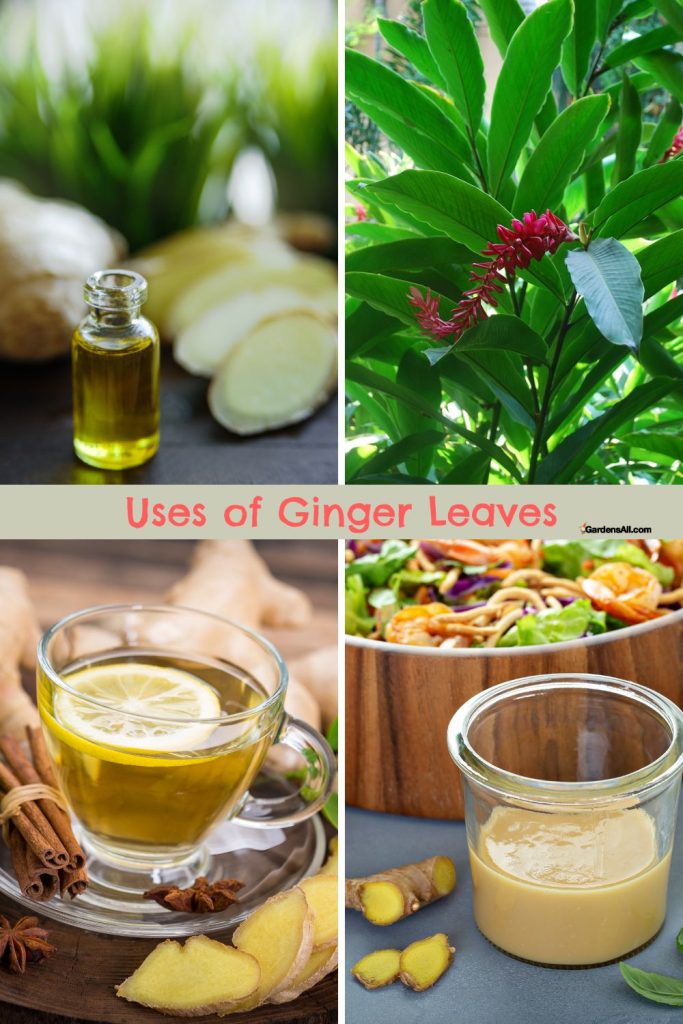
Grateful for an Abundance of Health and Wellness Resources
Our takeaway from all of this vast world of benefits from this one beautiful plant? WOW!!! Just WOW❣️
We live in a world abundant with healing plants all around us ready and able to help us with so many human ills.
We LOVE that we can grow our own medicine… “Physician heal thyself”, and “Let thy food be thy medicine.”
You can find a list of 6 of the edible ginger plants in our ginger leaf tea article.

I’m LeAura Alderson, a garden, herb and plant enthusiast with a passion for discovering the many edible and medicinal benefits of the plants all around us, including the weeds, while transforming the land through regenerative permaculture practice. I am also a writer, editor and media publisher (now mostly retired due to replacement by AI), but which now allows more time to build our regenerative permaculture homestead farm.
References