
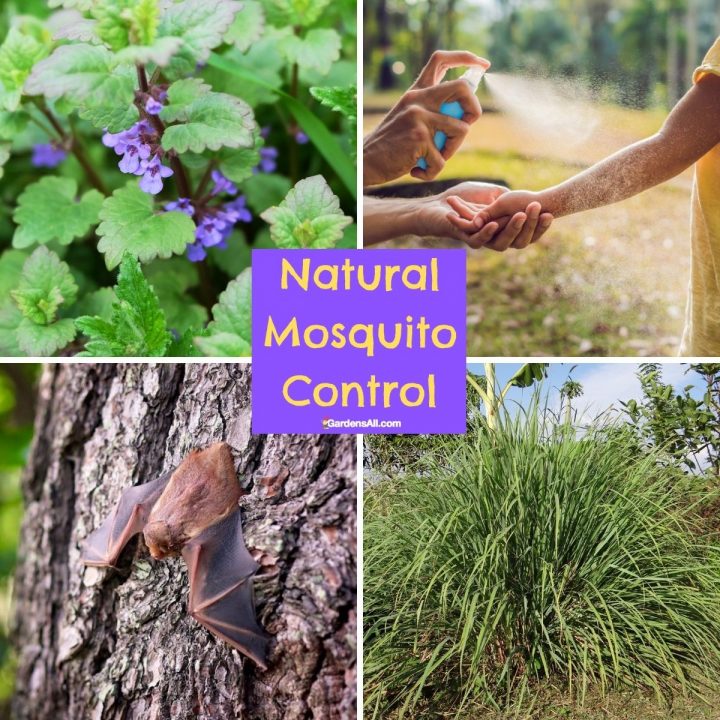
Is natural mosquito control effective? What about mosquito repellent plants and other remedies…? Are they myth or real?
We LOVE spending time outdoors and in the garden. In fact we work outside as much as possible when it’s not too cold or too hot.
Yet mosquitoes and other pesky flying insects can drive us away from our favorite places quickly. So what works and what doesn’t? What are some of the best solutions and does natural mosquito control really work?
Mosquito Health Risks
More than just an annoyance, mosquitoes can pose health risks. While malaria isn’t an issue in North America, the mosquito-borne “Zika” virus , is closer to home and a topic that does merit attention.[1]https://en.wikipedia.org/wiki/Zika_virus
Apart from the fact that they’re so annoying, these mini airborne hypodermics also transmit dengue fever, West Nile Virus, malaria, heartworms, etc. So it’s important to find solutions to the mosquito problem because it’s about more than reclaiming your outdoor space.
Fortunately, there are measures we can take that will minimize their presence. Recommendations abound as to how to deal with mosquitoes. We’re in favor of trying multiple approaches to this problem to determine what works best for you.
First, let’s do away with the popular recommendations which, according to scientific testing, are not as effective as advertised.

Natural Mosquito Control – Myths and Facts
Are Bats Good for Controlling Mosquitoes?
Here are some mosquito myth busters, and our apologies if we’re stepping on any long-held beliefs in this regard. We’re all about discovering the truth over being right, and finding solutions, what works and what’s right for you. We invite you to share your discoveries as well and we’ll be glad to add it to this article.
MYTH #1
Bats consume a multitude of insects including mosquitoes, therefore you can combat mosquitoes by installing specially designed bat house(s).
FACT
True, bats are huge consumers of insects. All kinds of insects. However, studies have shown that when given the choice of insect to devour, mosquitoes are at the bottom of their menu at less than 1%.
A bat’s diet consists of less than 1% mosquitoes.

Do Birds Help with Natural Mosquito Control?
MYTH #2
Purple martins consume vast amounts of mosquitoes.
FACT
Like bats, purple martins prefer other fare. Only about 3% of their intake is mosquitoes, plus they eat dragonflies that DO enjoy mosquitoes in quantity.
So, bats, birds and purple martins are good in general for natural insect control (thus good for the garden) but not specifically for mosquitoes.
Find more on birds that eat mosquitoes here.

Do Specific Plants Act as a Mosquito Repellent?
MYTH #3
Certain plants, like the popular citronella-scented citrosa, are believed to repel mosquitoes automatically. Similar claims have been made about lemon grass, mints, and other herbaceous varieties having strong anti-mosquito properties.
FACT
While these plants contain certain essences that mosquitoes actually avoid, they have to be activated by crushing and to further the effect, rubbed on the skin. Planting these around gathering areas where people can brush by and “activate” the repellent or grab a few leaves to rub on the skin can be effective.[2]https://www.mosquitoworld.net/mosquito-myths/
More Mosquito Myths
Other mythical deterrents and exterminators:
- Dryer sheets (fabric softener)
- Bug zappers
- Lemon Joy dish soap
- Listerine mouthwash
- Sonic electronic devices
None of these are proven to produce the desired results consistently over time by independent researchers.
However, our take on it is that if you find that it works for you, then that’s all the proof you need!
SOURCE: MosquitoWorld.net.[3]https://www.mosquitoworld.net/
The Surprising Mosquito Repellent Plant (it may not be what you think)
Most people are familiar with the benefits of the mosquito repellent plant, citronella for natural mosquito control. We’ll get into more on that and other mosquito repellent plants in a minute.
But first, did you know about catnip? It turns out that catnip is a highly effect mosquito repellent plant when used in the right way.
“Researchers report that nepetalactone, the essential oil in catnip that gives the plant its characteristic odor, is about ten times more effective at repelling mosquitoes than DEET — the compound used in most commercial insect repellents.”[4]https://www.sciencedaily.com/releases/2001/08/010828075659.htm
But... planting catnip near your outdoor area, aka “the fifth room”, won’t likely deter mosquitoes.
You can see our full article on growing catnip here.
It’s the mosquito repellent plant oil that repels mosquitoes, not just the plant.
However, growing the plants near your outdoor hangout is a great idea. The fragrance from the plant might help, but more than that, you’ll have the leaves handy to use whenever you’re out there.
Just crush a few of the leaves in your hands and rub it over your exposed skin. If you’re allergy prone, or have sensitive skin often affected by contact dermatitis, test a small patch of skin and wait a day before applying more. If you see a reaction, then don’t use it.
Catnip is 10 time more effective than DEET, when used properly.
How to Use Mosquito Repellent Plants for Natural Mosquito Control
The most effective application of mosquito repellent plants is to pluck the fresh leaves, roll them between your palms and then rub those on your exposed areas. My wife prefers wearing the natural plant oil over spraying with sticky sprays, even over the natural ones. She adds crushed leaves to water and dispenses it from a mister or spray bottle