
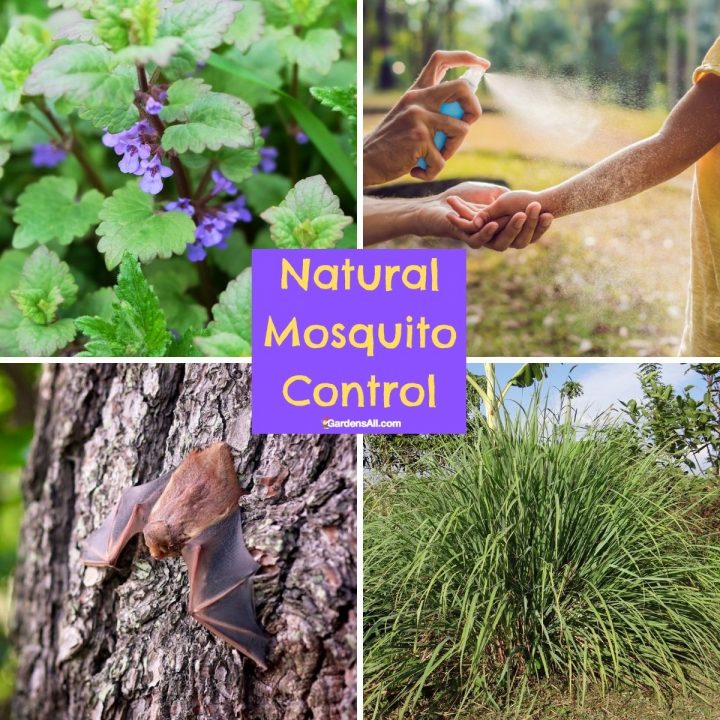
Is natural mosquito control effective? What about mosquito repellent plants and other remedies…? Are they myth or real?
We LOVE spending time outdoors and in the garden. In fact we work outside as much as possible when it’s not too cold or too hot.
Yet mosquitoes and other pesky flying insects can drive us away from our favorite places quickly. So what works and what doesn’t? What are some of the best solutions and does natural mosquito control really work?
Mosquito Health Risks
More than just an annoyance, mosquitoes can pose health risks. While malaria isn’t an issue in North America, the mosquito-borne “Zika” virus , is closer to home and a topic that does merit attention.[1]https://en.wikipedia.org/wiki/Zika_virus
Apart from the fact that they’re so annoying, these mini airborne hypodermics also transmit dengue fever, West Nile Virus, malaria, heartworms, etc. So it’s important to find solutions to the mosquito problem because it’s about more than reclaiming your outdoor space.
Fortunately, there are measures we can take that will minimize their presence. Recommendations abound as to how to deal with mosquitoes. We’re in favor of trying multiple approaches to this problem to determine what works best for you.
First, let’s do away with the popular recommendations which, according to scientific testing, are not as effective as advertised.

Natural Mosquito Control – Myths and Facts
Are Bats Good for Controlling Mosquitoes?
Here are some mosquito myth busters, and our apologies if we’re stepping on any long-held beliefs in this regard. We’re all about discovering the truth over being right, and finding solutions, what works and what’s right for you. We invite you to share your discoveries as well and we’ll be glad to add it to this article.
MYTH #1
Bats consume a multitude of insects including mosquitoes, therefore you can combat mosquitoes by installing specially designed bat house(s).
FACT
True, bats are huge consumers of insects. All kinds of insects. However, studies have shown that when given the choice of insect to devour, mosquitoes are at the bottom of their menu at less than 1%.
A bat’s diet consists of less than 1% mosquitoes.

Do Birds Help with Natural Mosquito Control?
MYTH #2
Purple martins consume vast amounts of mosquitoes.
FACT
Like bats, purple martins prefer other fare. Only about 3% of their intake is mosquitoes, plus they eat dragonflies that DO enjoy mosquitoes in quantity.
So, bats, birds and purple martins are good in general for natural insect control (thus good for the garden) but not specifically for mosquitoes.
Find more on birds that eat mosquitoes here.

Do Specific Plants Act as a Mosquito Repellent?
MYTH #3
Certain plants, like the popular citronella-scented citrosa, are believed to repel mosquitoes automatically. Similar claims have been made about lemon grass, mints, and other herbaceous varieties having strong anti-mosquito properties.
FACT
While these plants contain certain essences that mosquitoes actually avoid, they have to be activated by crushing and to further the effect, rubbed on the skin. Planting these around gathering areas where people can brush by and “activate” the repellent or grab a few leaves to rub on the skin can be effective.[2]https://www.mosquitoworld.net/mosquito-myths/
More Mosquito Myths
Other mythical deterrents and exterminators:
- Dryer sheets (fabric softener)
- Bug zappers
- Lemon Joy dish soap
- Listerine mouthwash
- Sonic electronic devices
None of these are proven to produce the desired results consistently over time by independent researchers.
However, our take on it is that if you find that it works for you, then that’s all the proof you need!
SOURCE: MosquitoWorld.net.[3]https://www.mosquitoworld.net/
The Surprising Mosquito Repellent Plant (it may not be what you think)
Most people are familiar with the benefits of the mosquito repellent plant, citronella for natural mosquito control. We’ll get into more on that and other mosquito repellent plants in a minute.
But first, did you know about catnip? It turns out that catnip is a highly effect mosquito repellent plant when used in the right way.
“Researchers report that nepetalactone, the essential oil in catnip that gives the plant its characteristic odor, is about ten times more effective at repelling mosquitoes than DEET — the compound used in most commercial insect repellents.”[4]https://www.sciencedaily.com/releases/2001/08/010828075659.htm
But... planting catnip near your outdoor area, aka “the fifth room”, won’t likely deter mosquitoes.
You can see our full article on growing catnip here.
It’s the mosquito repellent plant oil that repels mosquitoes, not just the plant.
However, growing the plants near your outdoor hangout is a great idea. The fragrance from the plant might help, but more than that, you’ll have the leaves handy to use whenever you’re out there.
Just crush a few of the leaves in your hands and rub it over your exposed skin. If you’re allergy prone, or have sensitive skin often affected by contact dermatitis, test a small patch of skin and wait a day before applying more. If you see a reaction, then don’t use it.
Catnip is 10 time more effective than DEET, when used properly.
How to Use Mosquito Repellent Plants for Natural Mosquito Control
The most effective application of mosquito repellent plants is to pluck the fresh leaves, roll them between your palms and then rub those on your exposed areas. My wife prefers wearing the natural plant oil over spraying with sticky sprays, even over the natural ones. She adds crushed leaves to water and dispenses it from a mister or spray bottle
15 Mosquito Repellent Plants and Herbs for Natural Mosquito Control
- Alliums – garlic and onions
- Basil
- Catnip
- Citronella geranium
- Flossflower
- Garlic
- Geranium –
- aka “mosquito plant”;
- aka “citronella plant”
- Citrosa geranium, or
- Pelargonium citrosum
- Lavender
- Lemongrass
- Lemon balm
- Marigolds
- Pennyroyal
- Peppermint
- Rosemary
- Sage
Sources Include: Washington Post, Garden Design, Natural Living Ideas
Hmmm… even sage! Perhaps the Native American Indians were doing more than purifying the air and invoking the spirits when burning smudge sticks. It may just be that they were also getting rid of mosquitoes!
What is a Citronella Plant?
While citronella is not actually a plant, there are a number of plants that contain the citronella essential oil.
Do Mosquito Repellent Candles and Incense Work?
Citronella candles and incense work best in close proximity to the “fumes”, which may not work for your lungs!
We’ve found that mosquito punks and citronella candles definitely help. However, the fumes of these tend to drive us away as much or more than the mosquitoes. Others find these to work only marginally.[5]https://www.gardenmyths.com/citronella-plant-keeps-mosquitoes-away/
As wonderful as the catnip and citronella plants smell, it’s just not as pleasant inhaling the smoke and fumes of the coils, candles and punks. Not only can the burning fumes be unpleasant, there may be concerns about the toxicity of the fumes. So if they irritate you, stay away.
Otherwise, the more natural mosquito repellent sticks should be safe. Look for the ones that say natural, DEET Free with Plant Based Essential Oils.
Mosquito repellents that contain mosquito repelling herbs are generally better.
Tips for Burning Mosquito Repellents
To make the mosquito repellent smoke less bothersome, these strategies help.
- Place repellent sticks low to the ground, in a 2-4 places on the perimeter of your area.
- Light the sticks ahead of time to chase away the pesky blood suckers before you settle in for that relaxing cup of brew.
- Supplement with crushed leaves of mosquito repellent plants rubbed on exposed areas.
- Snuff the burning sticks when the smoke begins to bother you. The fumes should have driven the droves away, and the essential plant oil should be able to do the rest.
You can always snuff them out if the smoke gets to you, and you’ll have your crushed herb or homemade herb spray as backup. Bottom line? If they bug you more than the mosquitoes, don’t use them.
For Natural Mosquito Repellent: It’s not pleasant inhaling the fumes of the coil, candles and punks. Better to use natural sprays and plant oils
Rosemary – Another Mosquito Repellent Plant for Natural Mosquito Control
We’ve had success rubbing rosemary on the skin, though it’s a little tricky since the leaves are those “needle-like” leaves reminiscent of evergreens. Here again, I take a large sprig of rosemary, roll it between my palms to release the oils, then rub or roll the plant on exposed areas. I finish off by rubbing my now rosemary-fragrant palms on my face.
When the mosquitos are out in full force we use an incense stick style mosquito punk. These are easy to place in the soil of a potted plant, taking care to keep the heat away from foliage, of course.
When the mosquitos are out in full force we use an incense style mosquito punk. These are easy to place in the soil of a potted plant, taking care to keep the heat away from foliage, of course.
Our latest experiment in natural herbal mosquito repellents is a simple homemade concoction and it has worked for me but not for my daughter. This has actually worked very well—better than over-the-counter remedies for eliminating itching from rash, food allergies and candida as well.
Homemade Rosemary Mosquito Repellent Recipe
- 1-2 cups Rosemary Leaves (dried)
- 1/2 – 1 cup Lavender Leaves (dried)
- 1/4 cup Rose Petals (dried) (optional)
- 2 cups water, brought to a boil
Pour the 2 cups of hot water over the dried leaves and steep for a few hours. Strain liquid and pour into a spray bottle.
We’ve been outside for several days with mosquitos flying all around us, yet not biting us. The only thing is that this needs reapplying more often since it’s water based, but we prefer it because it’s actually refreshing and without any sticky, oily residue. If you want it to last longer, then you could add a few drops of essential oils such as you’ll read about further down.
So Which Natural Mosquito Controls Actually Work?
Fish
FISH? Yep! “The mosquito fish is a live-bearing American fish that is utilized by some mosquito control districts across the country as a very effective predator of mosquito larvae. As far as natural predators go . . .it can be said without hesitation that the mosquito fish is by far the most efficient natural predator of mosquitoes.” SOURCE: WBRcouncil.org
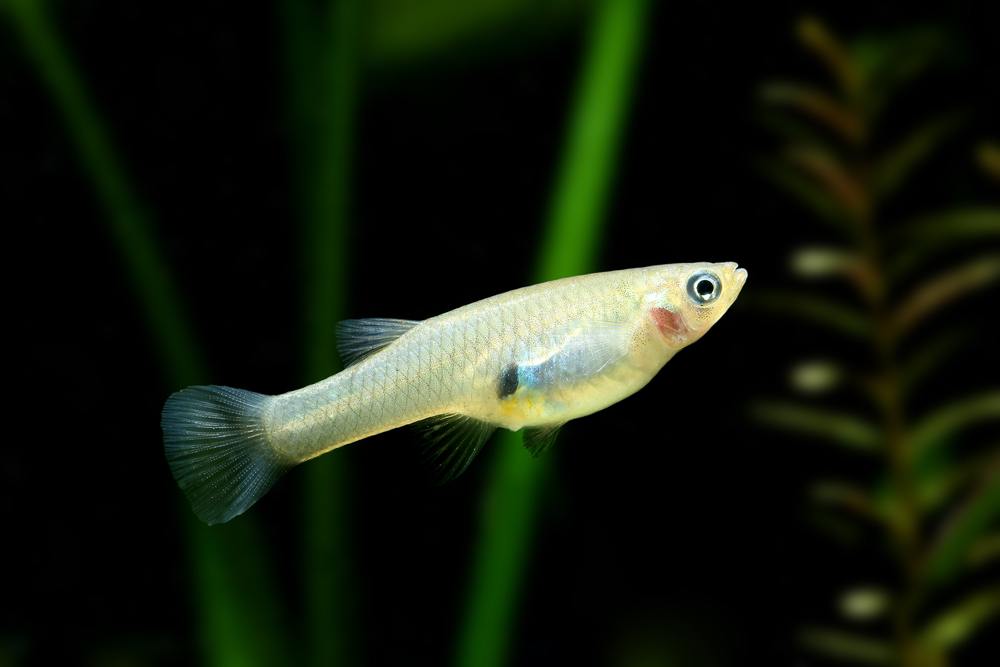
Raising this particular species is easy according to the literature. “They are one of the few varieties that can survive Northern winters as well as warmer southern waters. They can thrive in indoor aquariums or outdoor ponds.
Mosquito fish are often used specifically for mosquito control and they are prolific breeders. They are also live-bearers and great feeder fish. They can eat up to 300-mosquito larva a day and have up to 60 babies.”
Learn more about how to raise these fish in this book titled, Livebearers by David Alderton.
Some patio dwellers take their gambusia affinis mosquito fish fish tanks outdoors and set them where they can dine upon the local mosquito fare.[6]https://en.wikipedia.org/wiki/Mosquitofish
Dragonflies
These insects do prey on mosquitoes and actually, they do the most damage at the nymph stage where they occupy many of the same water breeding environments as the mosquito.
This is good news. So next time you see dragonflies you may want to appreciate them for more than their beauty![7]https://www.wbrcouncil.org/Departments/Mosquito-Abatement/Natural-Mosquito-Killers[8]https://www.nwf.org/How-to-Help/Garden-for-Wildlife/Gardening-Tips/Attracting-Dragonflies.aspx

Bacillus Thuringiensis Israelensis
This product is used to treat garden ponds, and other bodies of water, including rain barrels. Often called “Mosquito Dunks” they release a form of bacteria that kills the larvae. A very effective and safe treatment, this will not harm animals, humans and most other insects. It has no effect on the adult insects.
Do Away with Breeding Habitats
The best proactive way to keep the mosquito population down is to take away their breeding grounds – drain the standing water found in low spots, plant saucers, bird baths, old tires, discarded containers, gutters, drain pipes and other locations.[9]https://www.halton.ca/cms/One.aspx?portalId=8310&pageId=9933
One more simple trick to keep the mosquitoes from bothering you while you’re sitting outside is to use a house fan to blow them away.

Homemade Mosquito Repellants – Better than DEET
The use of DEET may do the trick in keeping would be attackers at bay. Yet, many folks prefer a less chemically intensive repellent. Here are several plant derived solutions that may be applied.
- Cinnamon leaf oil (one study found it was more effective at killing mosquitoes than DEET)[10]https://www.sciencedaily.com/releases/2004/07/040716081706.htm [11]https://www.ncbi.nlm.nih.gov/pmc/articles/PMC5585972/
- Clear vanilla oil mixed with olive oil.[12]https://www.ncbi.nlm.nih.gov/pmc/articles/PMC6189689/
- Wash with citronella soap, and then put some 100 percent pure citronella essential oil on your skin.
- Catnip oil (according to one study, this oil is 10 times more effective than DEET) [13]https://www.sciencedaily.com/releases/2001/08/010828075659.htm
- Lemon eucalyptus oil was found very effective in a 2014 Australian study; a mixture of 32 percent lemon eucalyptus oil provided more than 95 percent protection for three hours, compared to a 40 percent DEET repellent that gave 100 percent protection for seven hours.[14]https://www.ncbi.nlm.nih.gov/pubmed/24772681
- Use a natural formula that contains a combination of one or more of these essential oils to repel mosquitoes, fleas, chiggers, ticks, and other biting insects.[15]https://www.ncbi.nlm.nih.gov/pmc/articles/PMC6189689/
- cinnamon
- citronella
- lemongrass oil
- peppermint oil
Eucalyptus Oil is more than twice as effective as DEET!
SOURCE: RealFarmacy.com.[16]https://www.realfarmacy.com/attracts-mosquitoes-repel/
15 Mosquito Repellent Plants
Here’s a list of 15 natural insect repellents you can grow yourself. It’s important to note that many of these plants are also perennial deer resistant flowers.
Basil – Ocimum americanum
Basil has essential oils that can be extracted and used as a spray to repel mosquitoes. It has also been an effective repellent when grown nearby.
Bee Balm – Monarda
Bee Balm is a beautiful flowering plant that attracts hummingbirds and, of course, bees. It is also very effective used as a mosquito repellent, when allowing the fragrant oils to be released when the leaves are crushed.
We love the many other bee balm uses and benefits as well.
Catmint – Nepeta faassenii and Catnip – Nepeta cataria
Catmint and Catnip are very effective at keeping mosquitoes away. It is even better than commercial bug sprays at keeping the pests away. Simply, cut off the flowers and boil them to make a spray.[17]https://azarius.net/encyclopedia/12/Catmint/
One of the main active ingredients in catnip, nepetalactone, was found to be 10X stronger than even DEET in a recent study. It is a good non-toxic alternative to traditional chemical sprays.[18]https://voices.yahoo.com/organic-uses-catnip-mosquito-control-7546744.html
Catnip is potentially 10x stronger than DEET!
Citronella Grass – Cymbopogon nardus
Citronella Grass is a plant which, when crushed, releases an oil. This oil can be placed directly on the skin to act as a mosquito repellent, or mixed with other oils and liquids to make repellents.[19]https://www.ask.com/question/how-does-citronella-repel-mosquitoes
Garlic – Allium sativum
Garlic is a natural way to repel mosquitoes. One way to use it is to cut up garlic and sprinkle it around your outdoor living areas. A yard spray can also be made. Garlic can even be mixed with natural aromatic oils in order to create a mosquito repelling body spray.[20]https://www.naturalnews.com/041421_west_nile_virus_mosquito_repellent_garlic.html
Lavender – Lavandula angustifolia
Even though lavender is a smell often enjoyed by humans, lavender repels mosquitoes because mosquitoes dislike the scent lavender gives off. It can be planted in gardens or made into oil and applied to the skin or mixed with other oils to keep mosquitoes away.[21]https://www.doityourself.com/stry/using-lavender-to-repel-mosquitoes
Mint – Mentha
Growing mint in gardens is often for culinary purposes such as for tea and food. However, mint also helps to repel mosquitoes, and is a perennial deer resistant plant as well, plus you can make your own mosquito repellent with mint! [22]https://www.searchamelia.com/making-mosquito-repellent-with-mint-leaves
All species of mint, contain aromatic properties that are repulsive to insects.
Wormwood – Artemisia
Wormwood strong but natural way to ward away mosquitoes. Crush up wormwood leaves and distribute around your outdoor living areas in order to effectively keep these nasty insects away.[23]https://propelsteps.wordpress.com/2014/01/06/know-26-mosquito-repellent-plants/
Rosemary – Rosmarinus officinalis
Rosemary can be planted in your garden in order to control mosquito infestation. It can also be mixed into various formulas and lotions to act as a mosquito repellent for the body.[24]https://bestplants.com/plants-that-repel-mosquitoes/
See also, Rosemary Benefits
Tansy – Tanacetum vulgare
Used for a variety of health problems, Tansy helps increase blood and saliva flow. Tansy can also be used as a bug repellent around your home.[25]https://www.experience-essential-oils.com/tansy-essential-oil.html
Lemon-Scented Plants
Lemon Balm – Melissa officinalis
Lemon balm is a herb in the mint family that has a variety of uses like in flavoring in herbal teas. Make a quick mosquito repellent, by crushing a handful of leaves and rubbing on your exposed skin. Grow them in the garden for easy access when you need them.[26]https://www.motherearthnews.com/natural-health/lemon-balm-mosquito-repellent-zmaz07aszsto.aspx
Lemon Grass – Cymbopogon citrates
Citronella oil, which is a natural oil that repels mosquitoes is the principle active ingredient of lemon grass. It is used in Southeast Asia to flavor things such as chicken. In India, it is used as an anti-inflammatory medicine. Lemongrass has a wonderful aroma so that it is often used in perfumes and other toiletries.[27]https://www.hortmag.com/weekly-tips/lemongrassmosquitoes
Lemon Scented Geranium – Pelargonium crispum
Lemon scented geranium is a great plant to add to your landscape to allow you access to a natural mosquito repellent. When the leaves are crushed, they emit a strong lemony smell. The crushed leaves can be spread around your living area to keep mosquitoes at bay.[28]https://www.garden.org/searchqa/index.php?q=show&id=7332&ps=18&keyword=Choice,%20Control,&adv=0
Lemon Thyme – Thymus vulgaris
Lemon thyme repels mosquitoes naturally. Mosquitoes tend to hate their citrus smell. Crush a few parts of this plant and rub on the body to keep these harmful bugs away. Make sure that your skin can tolerate the oil before applying to larger areas of the body.[29]https://homeguides.sfgate.com/lemon-thyme-mosquito-repellent-96327.html
Lemon Verbena – Aloysia triphylla
Lemon verbena can be planted in your garden, doorways, and windows in order to repel mosquitoes. It has an aromatic, fresh lemon scent. The plant’s oils can also be applied to the body to ward off bugs.[30]https://bestplants.com/plants-that-repel-mosquitoes/
Next: natural insect repellent recipes you can easily make at home.
Summer Repellent Oil Recipe for Natural Mosquito Control
Recipe from Rose Mountain Herbs[31]https://mountainroseblog.com/herbal-mosquito-repellents/
Ingredients:
- 8 oz organic jojoba oil or almond oil or sunflower oil
10 Drops each of organic essential oils (we prefer organic; of course it’s up to you what you choose):
For more on healthy benefits of Rosemary here, and how to grow and make lavender oil here.
Directions:
Slowly drip the allotted drops of each essential oil into the jojoba oil, carefully counting out the correct number of drops for the optimum ratio. Mix all ingredients in the bottle by rolling the bottle between the palms of your hands. Shake as well as possible before each use and re-apply as often as needed.
Don’t let the mosquitos take over your yard and drive you inside. Use some of these many effective homemade mosquito remedies from Mother Nature and enjoy the great outdoors!
We’d love to hear your favorite remedies, so feel free to drop us a note or join in on the conversation on the Gardens All Facebook page.
Contributions from the GardensAll Community
Here are tips for natural mosquito control from members of the Gardens All Facebook page sharing what works well for them.
Ammonia With Lemon – Repels All Bugs / Reduces Itching
I keep a spray bottle of sudsy lemon ammonia mixed with a little water on my deck. I spray it on everything including the deck. It repels all bugs. And if you do get an itchy bite it takes the itching away! We also use fans.
~Pamela Clayton
BT Pellets for Prevention
And a member of the Planting for Retirement Facebook group shared this:
I look for any area that holds water. No standing water, no saucers. Standing water such as bird baths are changed out every 3 days. We have BT in pellets that we spread out in the puddling area through the rainy season which will get the mosquito larva before they take flight.
What Are BT Pellets?
“Bacillus thuringiensis serotype israelensis (Bti) is a group of bacteria used as biological control agents for larvae stages of certain dipterans. Bti produces toxins which are effective in killing various species of mosquitoes, fungus gnats, and blackflies, while having almost no effect on other organisms.”[32]https://en.wikipedia.org/wiki/Bacillus_thuringiensis[33]https://www.ncbi.nlm.nih.gov/pmc/articles/PMC3035146
Bug Zappers
Living here in the Caribbean, I can say I’ve tried many of these. The mosquitoes here are vicious, especially during the rainy season. I keep bug zappers in the rooms in my home, and the best deterrent outside is a fan blowing in my direction. And I use “Mosquito Bits” in my bromeliads to kill any larvae.
~Lauren River
Fans Deter Mosquitoes
Don’t forget the fan. Mosquitoes hate a breeze and wind. Keep a fan on near you when you’re enjoying the outdoor patio. It will keep mosquitos away and you can enjoy a nice breeze at the same time. 
~Lauren River
Peppermint Essential Oil
Diluted peppermint essential oil sprayed on the skin works. Every year, we vacation on Roanoke Island in NC and enjoy evening runs on the paved island trail. After years of spraying DEET and then having a horribly toxic taste on my tongue, I heard of and decided to try peppermint essential oil. Not only did it work, but it worked even at the end of my run when I had previously sweated off my DEET spray and became a moving dinner for bugs. It works and it lasts. I would not stand by it if we didn’t know from years of experience in a high-humidity mosquito area.
~Melissa Dietrich


G. Coleman Alderson is an entrepreneur, land manager, investor, gardener, and author of the novel, Mountain Whispers: Days Without Sun. Coleman holds an MS from Penn State where his thesis centered on horticulture, park planning, design, and maintenance. He’s a member of the Phi Kappa Phi Honor Society and a licensed building contractor for 27 years. “But nothing surpasses my 40 years of lessons from the field and garden. And in the garden, as in life, it’s always interesting because those lessons never end!” Coleman Alderson
References