


Another cancer-fighting, fat burning cabbage cousin.
Before we started growing kohlrabi greens and root, we researched the kohlrabi health benefits. It turns out that kohlrabi greens and the bulbous stem of this funky looking tuberous vegetable has some powerful nutritional benefits!
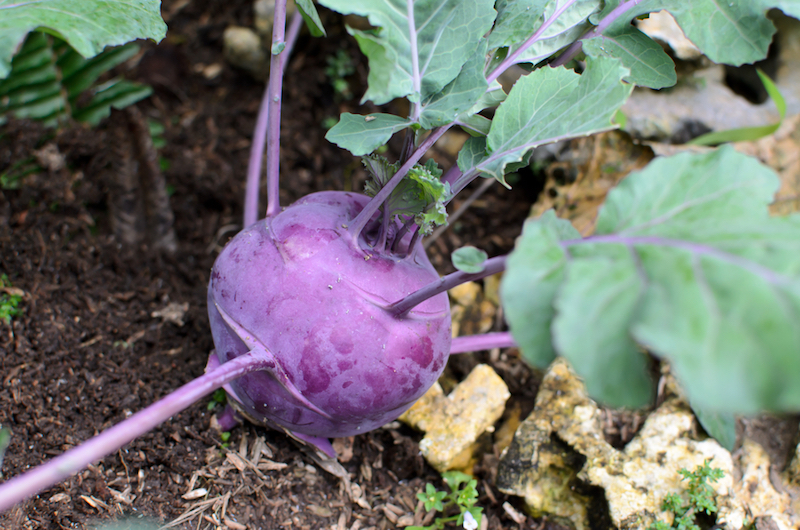
Growing Kohlrabi – a Two Month, Two Season Vegetable
Except for being highly attractive to flea beetles, kohlrabi is relatively easy to grow, and is ready to harvest fully in just two months.
When to Plant Kohlrabi
The timing for planting below is based on a median of hardiness zone 7a. So if you’re in a hotter or colder growing zone, adjust forward or back on the calendar to suit your climate.
Plant Kohlrabi in Early Spring
Plant kohlrabi in late winter to early spring for a late spring to early summer harvest.
It is usually grown as transplants that can be set out as a later winter, or early spring vegetable, similar to other fall and winter vegetables. Growing kohlrabi takes 55 to 60 days to maturity.
We used row covers in early summer to protect our cruciferous crops from flea beetles and cabbage moths, and that really helped!
Plant Kohlrabi in Early Fall
Depending on your grow zone, you can plant your second crop of kohlrabi in late summer to early fall for a winter harvest.
In our late winter / early spring plantings, we covered our cruciferous veggies with frost covers as needed. Kohlrabi can handle some frost, but as with heat and drought in summer, too much freezing will make them tough. It worked really well to protect the plants from excessive frost until harvest time in our hardiness zone 7a.
Harvesting Kohlrabi
Summer Harvest
Harvest your spring planted kohlrabi at 55-60 days, before the weather is hot and dry. If left to grow in too much heat or drought, the bulbous stem will get tough and woody.
Winter Harvest
Harvest your fall planted kohlrabi at around two months, when the stem is large but still tender. So if you plant your fall crop around mid September, you can be eating it by mid November.
If you’re in a colder hardiness zone, plant in early September, so long as it’s not too hot.
RELATED: See article on organic pest control.
This earthy tuber also comes in a beautiful purple color (see these on Amazon), which has been found to have more of the cancer-fighting glucosinolate than the white or pale variety.[1]https://pubmed.ncbi.nlm.nih.gov/25853486/[2]https://pubmed.ncbi.nlm.nih.gov/28965308/
Another interesting discovery is that the later fall kohlrabi crops tend to have more nutrition than the early spring crops. In fact, another huge article could be written on how studies are revealing that the different growing climates definitely affect the nutrients in food.

If you’re growing Kohlrabi and have any tips or recipes to share, please send us a note to tell us how it’s doing and how you like it.
Oh! And don’t forget to eat the kohlrabi greens too, along with other edible leaves of fruit and vegetables!
List of Cruciferous Vegetables
For weight loss and to aid with cancer prevention and treatment, here’s a list of cruciferous vegetables so you can include some in your diet each day.
- arugula
- bok choy
- broccoli, (love this one: Romanesco Broccoli, aka Fibonacci broccoli!)
- broccoli rabe
- broccolini
- brussels sprouts
- cabbage
- cauliflower
- collards / tree collards
- horseradish
- kale
- kohlrabi
- mustard greens
- radish
- red cabbage
- rutabaga
- turnips
- turnip greens
- watercress
RELATED: ferment food recipes
Let’s keep on growing!

Health benefits of Kohlrabi (aka Knol-khol)
First and foremost for many people is the anti-cancer and anti-fat benefits of cruciferous vegetables. Cruciferous vegetables are known for reducing belly fat in particular, and are proven to reduce the size and number of tumors and cancer cells.
- LOW IN CALORIES – Mildly sweet, crispy textured kohlrabi is notably rich in vitamins and dietary fiber, yet low in calories at only 35 calories per 1 cup or 135 gram servin
- FAT REDUCING – especially helpful in reducing belly fat
- CANCER FIGHTING – Kohlrabi, like other members of the Brassica family, contains health-promoting phytochemicals such asisothiocyanates, sulforaphane, and indole-3-carbinol that are supposed to protect against prostate and colon cancers.
Kohlrabi Nutrition Information
- B-COMPLEX VITAMINS –
- niacin
- B-6 (pyridoxine) at 10% of DV – Daily Value
- thiamin
- pantothenic acid
- MINERALS – notably has good levels of minerals especially available in the stem:
- copper
- calcium
- potassium – an important component of cell and body fluids that help control heart rate and blood pressure by countering effects of sodium
- manganese – used by the body as a cofactor for the antioxidant enzyme, superoxide dismutase
- iron
- phosphorus
- VITAMINS
- A – small amounts of vitamin A, and carotenes
- C – fresh kohlrabi stem is a rich source of vitamin-C; providing 140% of RDA
The PURPLE KOHLRABI PEEL was found to contain four times more of the cancer-fighting glucosinolate compound than the white kohlrabi. However, it must be consumed without peeling the purple skin for the greatest anti-cancer benefits.[3]https://pubmed.ncbi.nlm.nih.gov/28965308/
Both the purple and white kohlrabi have numerous beneficial nutrients. So regular doses of all of these in your diet should go a long way toward keeping your body healthy and protected.
KOHLRABI LEAVES or tops, like turnip greens, are also very nutritious greens abundant in carotenoids, vitamin-A, vitamin K, minerals, and B-complex group of vitamins.
Purple Kohlrabi skin is high in cancer-fighting glucosinolate.
REFERENCE: 2017 Sep 30, PMID: 28965308, Identification and Characterization of Anthocyanin Biosynthesis

How to Eat Kohlrabi
When I first saw this strange looking plant, the bulbous stem reminded me of broccoli stems, which when peeled, are great raw veggie snack. Indeed, it does taste similar to broccoli stems, or the thicker parts of cabbage. That makes sense given that Kohlrabi is in the cruciferous brassica family of fierce fat and cancer fighting vegetables, along with broccoli.
To unleash the antioxidant called sulforaphane, which is a powerful natural anti-cancer compound, the cruciferous vegetables must be chewed well.
Any part of any edible vegetable that isn’t your favorite to consume cooked or raw, can be dried into a greens powder that can be used in broth, smoothies, green juice, salad dressings and seasoned salt blends.
Eating Kohlrabi Stem (the large bulbous part)
Raw Kohlrabi Stem
If you haven’t yet peeled broccoli stem or kohlrabi for raw veggie snacks, aka crudités, give it a try. Both make for satisfyingly crunchy snacks with a hint of sweet and super health benefits. Shredded, it can be added to or made into its own coleslaw, similar to broccoli slaw, and tossed with leafy salads to add strands of crunchy texture and flavor.
Your cells will be singing and your taste buds will probably enjoy it as well. If you need to lose weight and improve your health, veggie snacks like these to replace just one junk food snack a day will go a long way toward helping you look and feel better. You’ll feel full faster on the healthy food your body loves.
Cooked Kohlrabi Stem
Chopped, cubed or sliced, kohlrabi stems, (the big tuber-like bottom part that grows above ground) can be eaten in most any recipe that calls for broccoli or cauliflower, or root veggies like parsnips, beets and turnips.
This versatile vegetable can be added to soups, salads and stir fry, or simply steamed and served with butter. The kohlrabi greens can also be chopped or shredded into these dishes. Some people like to cook them like collards, boiling the greens; we prefer to steam, juice or eat them raw for best nutritional benefit.
Eating Kohlrabi Leaves
The large kohlrabi leaves, like other edible leaves, can be harvested sparsely to enjoy as the stem part of the vegetable is growing to maturity. Just pluck a leaf or two per plant as it’s growing, and then you can harvest them all when the swollen stem part of the kohlrabi is ready to eat.
You can enjoy kohlrabi leaves in the same ways you would kale, chard and spinach, where they’re great cooked or raw.
If using the leaves from the purple kohlrabi, DO NOT throw away the midrib part of the leaves. Those are the only section of the purple kohlrabi leaves that are purple and thus contain the beneficial anthocyanin.
Raw Kohlrabi Leaves
Raw kohlrabi leaves can be shredded to add to salads and coleslaw, like this broccoli slaw and beet coleslaw. Just substitute broccoli and beets with the kohlrabi. As indicated above, don’t waste the stems! You can chop them into bite sized pieces to add to the slaw and salads or munching raw while you’re preparing the leaves!
If you find the midrib stem part of the leaves a little too tough or fibrous to enjoy raw, try cooking them instead.
Cooked Kohlrabi Leaves
As indicated above, you can cook kohlrabi leaves in virtually any way that you would other hardy greens. Just remember to also cook the midrib of the purple kohlrabi plant for that is the only part of the leaves with the healtpurple anthocyanins.
Contributions from the Community – Favorite Ways to Eat Kohlrabi
When we first started growing kohlrabi, we naturally wanted to know how to use kohlrabi greens and leaves, so we asked the GardensAll community their favorite ways to use kohlrabi.
Teri Barber I’ve cooked it with a pot roast. Boiled with potatoes, used raw in a veggie platter, cooked up with cheese like broccoli, in a stir fry. Very diverse. I didn’t peel it most of the time.
Also added julienne in salads.
Pork roast today and roasted veggies. All veggies out of garden onions, white and red potatoes, Kohlrabi, beets, rainbow carrots, parsley, and turnips. Tossed with sesame and truffle oil, black pepper, himalayan salt, and basil essential. Smells amazing!
Chad Van Tol It makes fantastic slaw… Grated up with some carrots and radicchio… Add some homemade slaw dressing (mayo, sugar, lime juice)…. YUM
Marty Qualls Thank you. I’ve always fried them up in a skillet with oil and served as a side and was looking for other ideas.
Janelle Renee Joey BrooksI oven roast them in a cast iron skillet seasoned with herbs and spices. I have used both goose fat and olive oil to roast them with. Love them!
Robert W Jones Caraway seed added to chopped cabbage family will limit the skunky sulfur smell. Many people won’t cook cabbage because of this smell. Adding carraway to your homemade sauerkraut is an age old way of limiting the smell. Doesn’t limit the cancer fighting properties.
Mandy Leetch And it tastes like rye bread without the carb calories.
Galia Joe Berry Use it instead of cabbage in your favorite coleslaw recipe.

We are an online gardening publication sharing all things garden related! Including urban farming, family gardening, homesteading, gardening for profits, and more. We’re all about growth!
References