
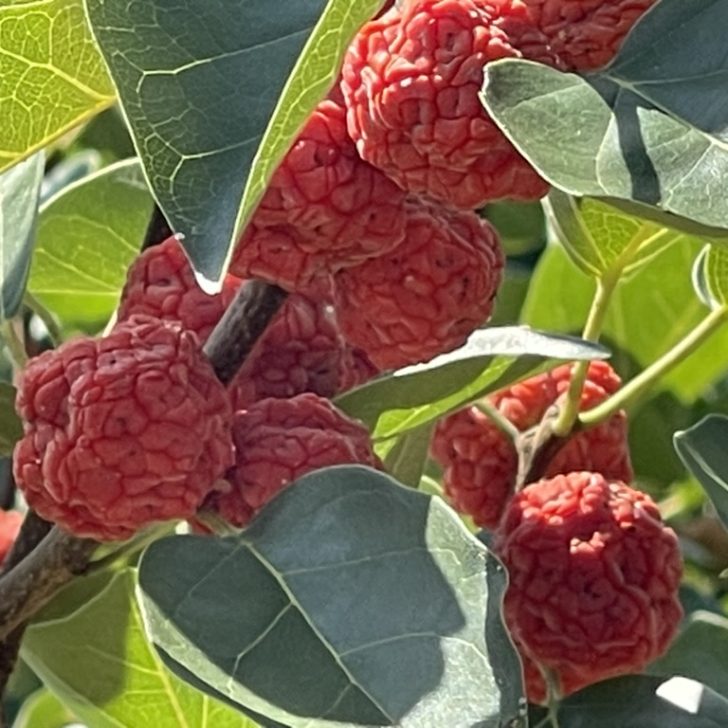
Ché fruit (Maclura tricuspidata) may be one of the best little-known fruits for an edible landscape. Sweet, beautiful, unusual, cold-hardy and remarkably resilient, Ché can produce generous crops while asking surprisingly little from the gardener.
Che (sometimes written Ché) is also known as Mandarin melon berry, Chinese mulberry, cudrang and silkworm thorn. Che is a deciduous shrub or small tree in the mulberry family, Moraceae. Its accepted botanical name is now Maclura tricuspidata; the older name Cudrania tricuspidata is still commonly encountered.
We’ve been growing our seedless Che for around 13 years, and if we had to sum up our experience with this tree in one sentence, it might be:
Che gives so much without asking for anything!
Our Che grows in the lower orchard here in North Carolina, on a steep slope in poor, rocky soil. Before we lived here, it received little attention. Since then, it has endured periods of drought as well as significant deer browsing — enough browsing that some of its lower limbs have died.
Yet year after year, the rest of the tree carries on, thrives and produces another beautiful crop.
If you enjoy incorporating food-producing plants into the landscape, see more of our foodscaping and edible landscaping ideas.
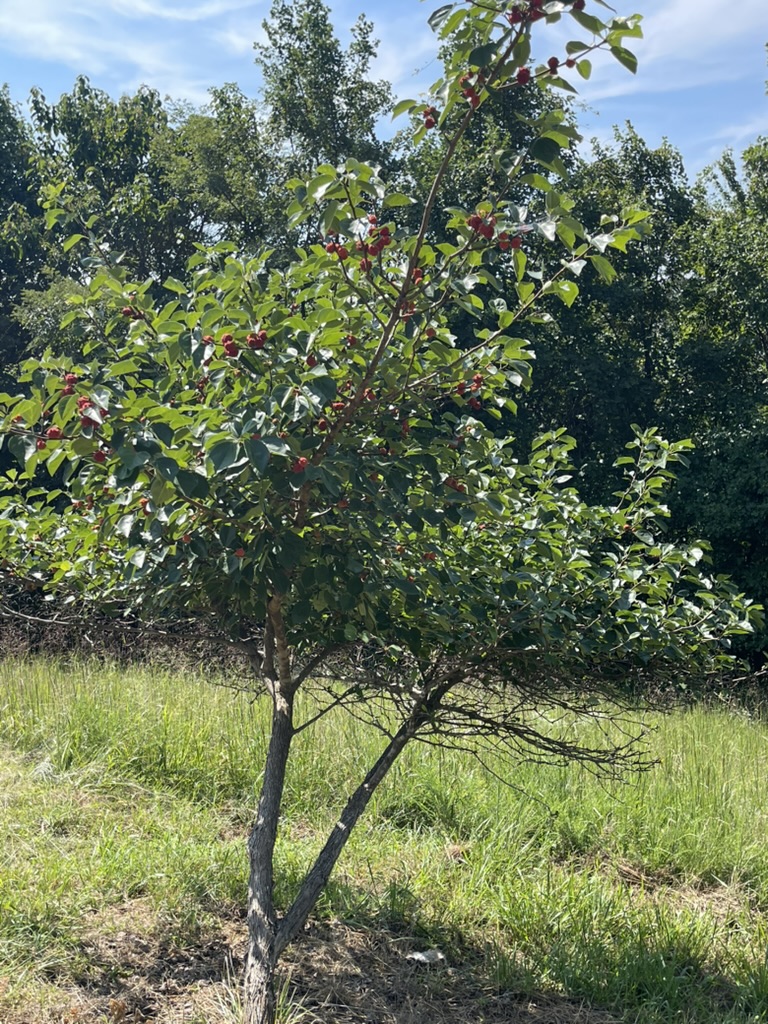
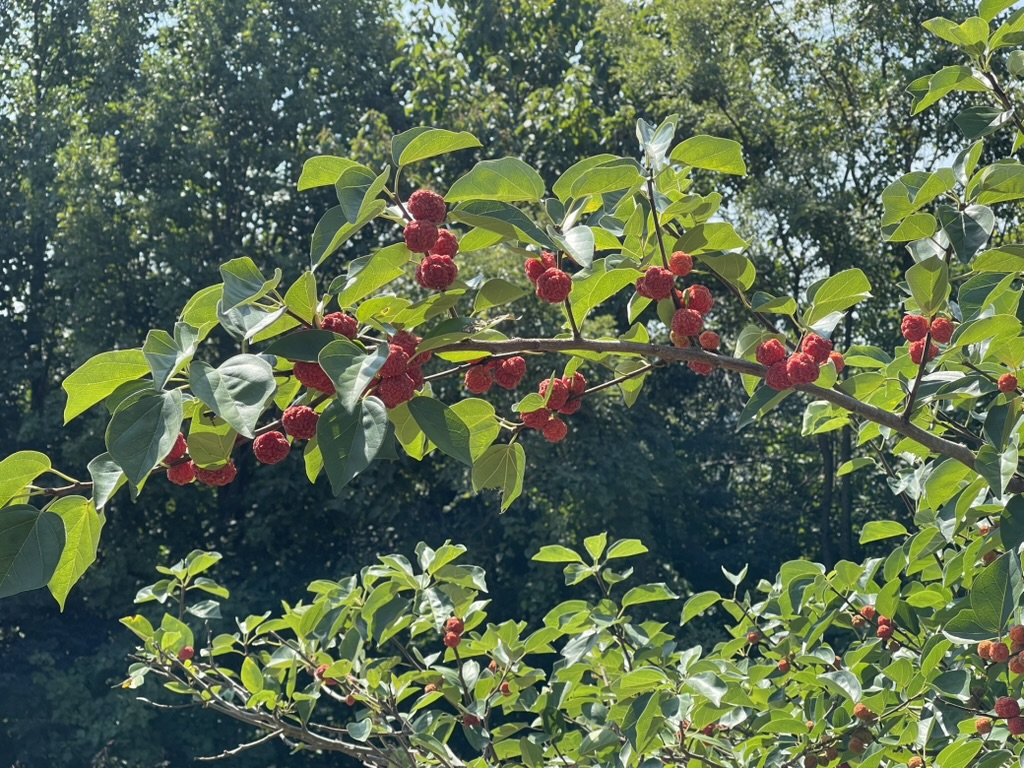
Our approximately 13-year-old Che tree growing on a steep, rocky orchard slope. Despite poor soil, drought, earlier neglect and ongoing deer browsing, it continues to thrive and produce beautiful fruit.
Ché Fruit at a Glance
| Botanical name | Maclura tricuspidata |
| Former botanical name | Cudrania tricuspidata |
| Common names | Che, Mandarin melon berry, Chinese mulberry, cudrang, silkworm tree |
| Family | Moraceae — mulberry family |
| Plant type | Deciduous shrub or small fruit tree |
| Native range | China through Vietnam and South Korea |
| Hardiness | Generally USDA Zones 6–9 |
| Sun | Full sun preferred |
| Soil | Well-drained; notably tolerant once established |
| Fruit | Red to deep red/maroon, typically around 1 inch across |
| Flavor | Sweet; often compared with fig and melon |
| Harvest season | Late summer into fall, depending on climate and cultivar |
| Pollination | Naturally dioecious; some female selections produce seedless fruit without a male |
| Best uses | Fresh eating, edible landscaping, preserves, freezing and other fruit recipes |
Ché is an uncommon but promising edible-landscape plant. Virginia Cooperative Extension rates its fruit production as high and describes it as an attractive large shrub or small tree bearing abundant, sweet red-to-maroon fruit.
Virginia Cooperative Extension — Edible Landscape Species
What Is Che Fruit?
Che is one of those fruits that makes people stop and ask:
“What is THAT?”
The bright red fruits look a little like oversized raspberries growing on a tree. But botanically, Che isn’t a raspberry — or even technically a berry.
It belongs to the Moraceae family, making it a relative of mulberries, figs and Osage orange.
According to the Royal Botanic Gardens, Kew, Maclura tricuspidata is the currently accepted botanical name, and its native range extends from China through Vietnam and South Korea.
Kew Plants of the World Online — Maclura tricuspidata
The tree itself makes an attractive edible landscape plant, with glossy green foliage followed by striking clusters of red-to-maroon fruit.
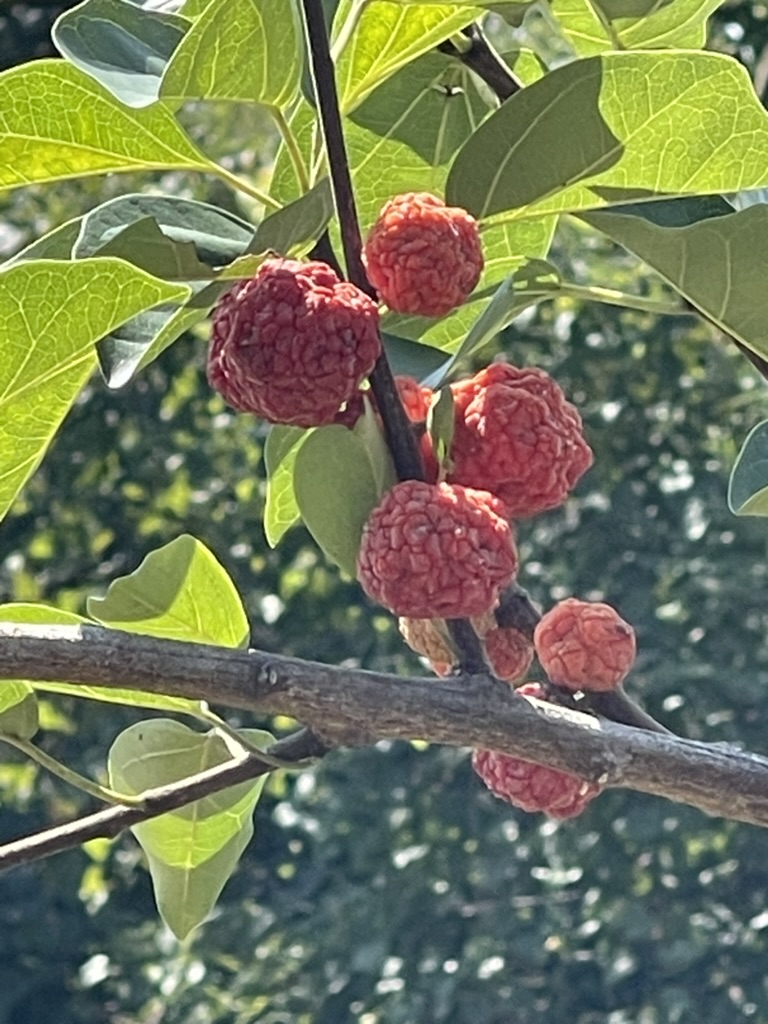
Ripe Che fruits have a distinctive knobby surface and brilliant raspberry-red to deep-red coloring.
Che Isn’t Actually a Berry
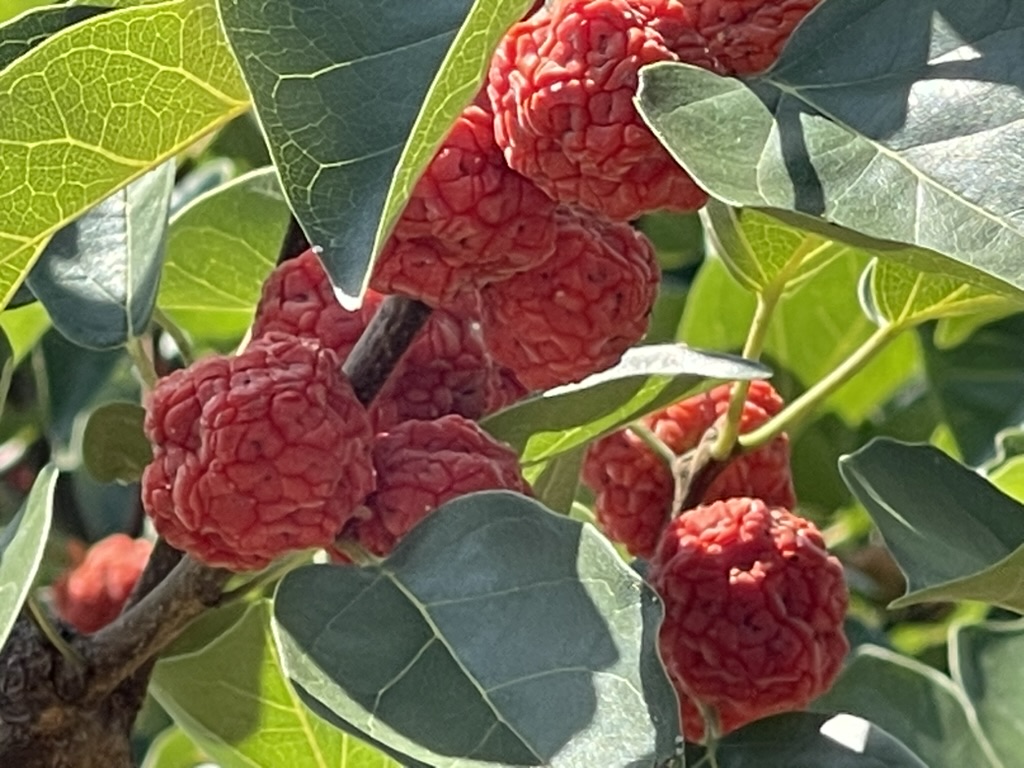
Although one of its common names is Mandarin melon berry, Che —like mulberry— is technically a multiple fruit — also called a collective fruit.
Rather than developing from a single flower, multiple tiny clustered flowers contribute to the knobby round fruit we recognize as Che.
Mulberries and pineapple are other familiar examples of multiple fruits.
Look closely at a Che and those individual little bumps suddenly make much more sense!
[PHOTO: Close-up showing the individual sections of the fruit]
What Does Che Fruit Taste Like?
Che flavor is most often compared with fig and watermelon, although individual perceptions of its flavor vary.
Our seedless Che has a slightly firmer exterior when first picked, giving way to a softer, juicy interior. As the fruit becomes very ripe, it softens quickly and develops more of the squishy texture associated with a fresh fig.
The skin is edible, so the entire seedless fruit can be eaten.
And the important words here are fully ripe.
Che develops its best sweetness and flavor as it reaches full maturity on the tree.
Our Seedless Che Tree
Our tree came from Edible Landscaping in Virginia as a seedless Che selection.
We have fond memories of visiting Edible Landscaping and learning from horticulturist George Stewart. That’s also where some of our experience with another favorite edible and medicinal plant began — passion flower and passion fruit.
The seedless distinction matters because Che naturally occurs as separate male and female plants. However, selected female Che can produce parthenocarpic fruit — fruit that develops without fertilization — allowing a female tree to produce seedless fruit without a male pollinator.
Our single established tree has reliably produced fruit without a male Che nearby.
How to Harvest Che Fruit — There’s a Trick!
Che fruit can initially seem surprisingly difficult to pick.
If you try to pull the ripe fruit straight off or twist it, it doesn’t necessarily want to cooperate — and because ripe Che is soft, pulling or twisting can damage the fruit.
Fortunately, there’s an amazingly simple trick:
Bend it sideways.
Instead of pulling, bend the fruit to the side or fold it over against its attached stem. It pops right off!
Once you know this little trick, harvesting Che becomes much easier.
First Che Harvest of 2026
August 26, 2026 — 3.8 pounds from one tree!
This approximately 13-year-old Che grows in our lower orchard in poor, rocky soil on a steep slope. It has weathered neglect before we lived here, drought and deer browsing — yet year after year it gives us another beautiful, healthy harvest.
Che gives so much without asking for anything!
Che can seem difficult to pick if you pull or twist it. Instead, simply bend the ripe fruit sideways over its stem and it pops right off without damaging the fruit.
A darker red to maroon color is another indication of ripeness. Fully ripe fruit should release readily when handled this way.
Is Che Fruit Edible?
Yes. Ripe Che fruit is edible and delicious eaten right from the tree.
It can also be used in preserves, smoothies and juices, baked goods and other recipes wherever a soft, sweet fruit works well.
Because Che is still relatively uncommon in American gardens and markets, growing your own tree may be the easiest way to have a regular supply.
And an established tree can produce an impressive amount.
Our first picking alone on August 26, 2026 yielded 3.8 pounds from one tree, with more fruit still ripening.