

Do Your HOA Gardening Rules Restrict or Ban Gardening?
Homeowner’s Associations — HOA gardening rules — have foiled many an aspiring gardener. If your HOA restricts food gardens, partially or completely, there are still ways to work edibles into your ornamental landscapes.
During the Covid-19 quarantine, a friend shared that their HOA had sent them a list of all the things that had to be done now that families had more time at home. While we can all appreciate the benefits of someone regulating of neighborhoods for helping to keep up property values and appearances, most of us don’t like to be told what to do and when, and what we cannot do on our own land.
Some people rally their fellow HOA members to try to contest the no-gardening allowed rule, and that’s certainly an option. In fact, a dream neighborhood to us would be one in which all homes were growing food as well as ornamentals instead of lawns, (or predominantly lawns).
More Gardens, Less Lawns
Flying into Atlanta on a nice sunny day, my window seat afforded a grand view of the expansive sprawl of subdivisions along the flight path. At about 2000 feet, it was easy to spot which homeowners had installed food gardens in their yards.
Of the hundreds of cookie-cutter homes stamped upon the terrain in concise patterns, not one garden appeared.
Not one.
The layout of these dwellings in all their efficiency reminded me of office cubicles. Perhaps, many of the inhabitants boxed themselves for convenience… as in work in a box, drive in a box, live in a box, and eat out of a box (basically).

Not to disparage anyone who happens to be in this category, it’s just an observation, an overview that led to wondering why there were no gardens planted in these tracts. Surely, somebody yearned to scratch up some Georgia red clay and plant some collards!?
Vegetable Gardening Not Allowed
Then the realization came. Dollars to donuts, the Homeowner’s Associations (HOA’s) were in charge and for whatever reason, food gardens did not fit the desired pattern. Zoning may also have played a role, but based on a working familiarity with subdivisions and their CCR’s (Conditions, Covenants and Restrictions), it looked like the HOA enforcers were doing their job down there. Then the next realization hit: this is what the homeowners wanted. Simple, safe, easy-care property value insurance. Safe, simple, and uniform.
Cover image from Mother Earth News article by Betsy Model, on Edible Landscaping.[1]https://www.motherearthnews.com/organic-gardening/garden-planning/edible-landscaping-zw0z10zalt.aspx
Everything looked to be so regimented, locked-in, standardized, mass-produced, quality-controlled.
The Ups and Downs of HOA’s and CCR’s
As mentioned, experience in building and developing our own 40 acre “forested” subdivision with lots from 1/2 acre to 5 acres, has informed us of the necessity to install CCR’s as a matter of protection. We are property owners and managers acting in the stead of an official HOA.
Even though our CCR’s are clearly spelled out, registered with the county deeds office, and tied in with every lot, real estate agents miss them. New arrivals often need to be apprised that the CC&Rs exist, which doesn’t set up for a great get-to-know-your-neighbor event.
Often, they have to be convinced that, yes, we do have neighborhood rules. No ATV’s, dirt bikes, commercial shops, setbacks, pigs, mobile homes, and a rather broad category where … “No obnoxious or offensive use of the property will be permitted.”

HOAs Protect Property Values
These measures protect property values, the land itself (ever seen what ATV’s can do to a yard and septic field?), noise, and all manner of disturbances. One newly arrived resident couldn’t understand why it was a problem to fire off practice rounds on weekends from his back porch (50 feet away from the next door neighbor).

HOAs Help Create Pleasant Neighborhoods
Another neighbor decided to open a motorcycle repair shop that operated part time—all hours of the night. We appreciate anyone’s entrepreneurial enterprise and side-hustle.
However this was a noisy one and included frequent customer visits to test drive these bikes all hours of the day and night. We’d awaken to revving and racing up the hill on (some of them) unmuffled motorbikes, and all of which were tweaked for that extra macho loudness.
Each of these things in turn, sets off a cacophony of neighborhood dogs, for an increasing crescendo of noise in an otherwise quiet wooded subdivision. We’d rather listen to the birds, crickets and peepers.

Appearance – How is Food Gardening Offensive?!?
Would the neighbors really complain about something so beautiful? Likely someone would. And I get it, for frost covers and cattle panel greenhouses aren’t necessarily aesthetically appealing, excepting perhaps to the gardener who created them!
Out of some 15 families in this small cul-de-sac neighborhood, only ours keeps a garden. We had to clear a wide swath of pine trees to get enough sun and would have no issue whatsoever with any neighbors doing the same.
Fortunately, our CCR’s do not prohibit vegetable gardening. We never would have considered food gardening as offensive. However, driving down our street and seeing our home and garden, it’s clear that the protective row covers and tunnels in the garden, plus the large pile of wood chip mulch, can make it look like a tent city.
Further, we can see how—to the unfamiliar eye—some vegetable plants look sprawling, unkempt and even weed-like. Never mind that the neighbor might be poisoning some of the best food source on the planet when spraying the dandelion in his grass.
Odors
During parts of the growing season, the straw bales can smell pretty ripe for a few days as the organic fertilizers went to work. Similarly, the organic compost bins and fertilizers can add their own “eau de ripe” aroma.
So we get it and can appreciate how these facets of gardening aren’t for everyone.
The psychology of this is poignantly covered in another article we’ll link to at the end of this. It’s actually very interesting.
So What Can You do?
If you belong to a HOA’s that imposes a ban on food gardens, there may be steps you can take.
The Neighborhood Food Act
There’s good news for Californians. Nearly two years ago, California passed the “Neighborhood Food Act” along with several other bills to promote sustainable and local food growing.
This act essentially bans the banners (HOA’s, CID’s, and other entities like landlords) and promotes the growing of food gardens for personal consumption or donation. [2]https://www.shareable.net/blog/governor-brown-signs-californias-neighborhood-food-act
If you’re not in California, what can you do?

Avoid HOAs if You Can
First, avoid the situation entirely by buying or renting property that is not so subject to neighborhood controls. However, just be aware that your neighbors may actually get to do as they please too.
Advantages of HOAs
We’ve seen, experienced or heard of numerous neighbor situations in unrestricted rural areas that you may not want to experience.
Examples of Neighbors You May Not Want
- Backyard sawmill
- Motor-Cross trail
- Trailer park
- Junk yard – used car parts business; appliance collector, etc.
- Pig farm (or downwind from any livestock farm)
- Shooting range
- or back yard target practice
- often late into the night on weekends while partying
- Honky tonk (or garage band buddies who party late into the night)
- Puppy mill or dog breeder with lots of barking dogs
- or lots of barking dogs in general, (or 1 or 2 incessant barkers)
Scrutinize Your CCRs
If you go with a more subdivision style property, then make sure you know the score up front. If there’s a Homeowners Association, scrutinize for HOA gardening rules. You’ll want to also be aware of other rules, regulations, and ordinances that would be a hindrance to how you wish to use your property. Not only that, but it’s something to keep in mind for resell value.
Find out all you can before signing off on any contract. Talk to residents, get a feel for their HOA administrators. What’s the HOA fee (if any). If using a real estate agency, be sure to have them help you understand and know what CCR’s are tied to the deed.
Though real estate agents are supposed to disclose HOA’s and CCR’s, many agents don’t even know to look into CCR’s if there’s no active HOA. And, if there are CCR’s but no active HOA, these can still be legally enforced by neighbor complaints, but it’s not as straightforward. So always ask.
Once you close the sale, you may have little to no recourse but to abide by the rules.
“Outlaw Gardener” Finds a Way
If you mess with the rules, you might become an “outlaw gardener” like Cristina Santiestevan.[3]https://outlawgarden.com/welcome-page/
Cristina’s lives in a nice neighborhood, but it’s governed by a restrictive homeowner’s association. Her HOA gardening rules prohibits vegetable gardening in the front yard. This is not unusual.
Some HOA gardening rules allow vegetable gardens in the back yard but not the front or sides yards due to visibility from the street. Yet for many homeowners this is a problem. More often than not, the front and side yards have more sun due to the road creating openings between tree lined streets.
Cristina shared the clause in her HOAs rules:
Article VI, Section 10: Vegetable gardens shall be allowed in the rear or side portions of said lots only.
Cristina’s home was a classic example described above: a very lovely, but shady back yard.
Cristina said, “If I wanted homegrown tomatoes, I had to break the rule, so I became an outlaw. I expanded the planting beds along the foundation and stole some land from the lawn, then ripped out several overly sheared shrubs and replaced them with blueberries. I added an herb garden, planted native flowers, and began to sneak vegetables into the mix.
The idea was simple: Grow a vegetable garden that didn’t look like a vegetable garden.
~Cristina Santiestevan
Food Disguised as Ornamentals – Incognito Edibles
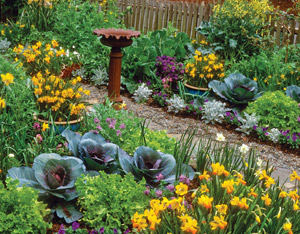
The guiding theme for Cristina’s garden became “Incognito edibles”. Below is a picture of Cristina’s front yard garden. She came up with a fantastic list of ornamental edibles to use whenever possible. And it worked!
The garden thrived, and the neighborhood noticed. Folks began to stop and chat while I weeded. Several drivers rolled their windows down to shout encouragement. No one complained about the vegetables.
Three cheers for good and supportive neighbors!

Bending HOA Gardening Rules with Edible Ornamentals
A perfectly benign front yard garden workaround is to use attractive edible landscape plants, such as dwarf fruit trees and bushes, and vegetables mixed in with florals. You may even be able to grow tomatoes if placed in an attractive planter or pot and blended in well within the landscape design.
For more on the foodscaping topic, you may enjoy this article. Here, we also get into the psychology of why HOA gardening rules and why HOAs are so restrictive and how to work around it.

Gardening Therapy
Because one thing is certain: a neighborhood that allows gardens will be positively transformed in more ways than food for the table! Gardening with children is a wonderful activity for families to do together. It’s also attitude elevating, stress-reducer. Garden therapy is a thing!
When your neighbors see your lovely landscape and how much you’re enjoying it, they may start their own. That would be an incredibly positive ripple effect, wouldn’t it?!
Neighborhoods that allow food gardens will be positively transformed in more ways than food for the table.
“Imagine,” chef, cookbook author and local food activist Deborah Madison mused recently, “if our government asked us to respond to the crisis of global warming, diminishing oil and poor health … by planting vegetable gardens.” From article by Betsy Model on Mother Earth News[4]https://www.motherearthnews.com/organic-gardening/garden-planning/edible-landscaping-zw0z10zalt.aspx
Edible ornamental plants: measures you can take… gardens you can make to be compliant with HOA Gardening Rules.
A Gardening Revolution
Imagine neighborhoods getting on board with this. Could be powerful and even start a movement of gardening communities!
Gardening neighborhoods are a growing thing, such as this garden community built around gardening. Once garden communities like Serenbe become more widely known, hopefully many HOA gardening rules will relax and begin to follow suit. Residents can meet and agree to create a gardening neighborhood out of existing communities, sanctioned by the HOA.
Time to Change HOA Gardening Rules
It’s important to remember that a Homeowner’s Association is a representative body of the neighborhood. If enough residents agree, existing convenance can be amended.
Imagine this “picture book” home yard garden featured above, multiplied times all the homes in the subdivision pictured above (or as many of them as would want to!).
Gardens and gardening is transformative!
You Can Have Your Veggies and Eat it too!
If you’re loving this and want more examples of the concept of yard gardening with ornamental edibles like hostas, edible flowers, living fences, like espalier and edible hedges. And maybe even some lovely wild violets with benefits!
You’ll also want to check out this article on foodscaping ideas that show you how you can landscape your yard with beautiful edible plants that will pass any HOA gardening rules!
Wishing you many years of gardening, and remember, where there’s a will there’s a way.


G. Coleman Alderson is an entrepreneur, land manager, investor, gardener, and author of the novel, Mountain Whispers: Days Without Sun. Coleman holds an MS from Penn State where his thesis centered on horticulture, park planning, design, and maintenance. He’s a member of the Phi Kappa Phi Honor Society and a licensed building contractor for 27 years. “But nothing surpasses my 40 years of lessons from the field and garden. And in the garden, as in life, it’s always interesting because those lessons never end!” Coleman Alderson
References